14

What is the maximum number of intersection points of two different Bernoulli lemniscates in the real plane? (Of course two identical lemniscates share an infinite number of points.)
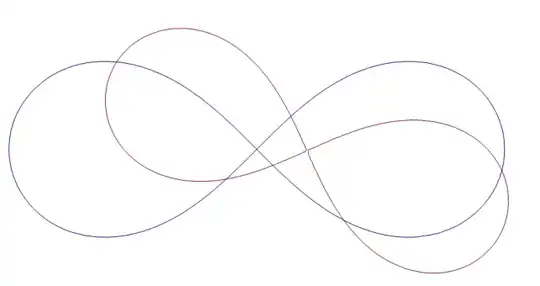
Here are some of my efforts: a Bernoulli lemniscate is a degree four curve with two nodes on the line of infinity in complex projective plane: $I=(i:1:0), J=(-i:1:0)$. By Bezout's theorem every two of these curves intersect in 16 points (counted with multiplicity) in $\mathbb{P^2(C)}$. But two common nodes in $I,J$ contribute at least (and exactly in the generic case) $8 = 2\times 2 + 2\times 2$ in the intersections. So the number of real intersections (i.e. intersections in $\mathbb R^2$) is at most $8$.

However, according to my experience with Mathematica, I think that the maximum number of intersections is at most 6. So what is the correct answer to this problem? If the answer is 6, where are the other two complex points, and can we prove their existence algebraically? (Note I'm interested in the algebraic approach to this problem and not analytic or topological solutions.)

Thanks!

  • 2
    Four questions: Are the sizes of two Lemniscates the same? ( Same value of $a$ in $ (r/a)^2 = \cos( 2 \theta) $ ?) Are only real roots considered for intersection? Is the self-intersection at origin considered a real root? Just to check, how many intersections have two unit circles? I think two. – Narasimham May 01 '15 at 13:19
  • Wikipedia: "lemniscate of Bernoulli is a plane curve defined from two given points $F_1$ and $F_2$, known as foci, at distance $2a$ from each other as the locus of points $P$ so that $PF_1·PF_2 = a^2$." I consider the foci and the value of $a$ to be arbitrary and asked for the number of intersections of two such curves in $\mathbb{R}^2$. – Mostafa - Free Palestine May 01 '15 at 17:04
  • 1
    You seem to have misinterpreted @Narasimham; he was asking if the two lemniscates have to be congruent, or not. – J. M. ain't a mathematician May 01 '15 at 17:10
  • Yes.If the blue curve is enlarged 10 times it will have zero real intersections. Apart from that, no need to mention $ PF_1 \cdot PF_2 = a^2 $ because all cases other than Lemniscate of Bernoulli are either single or double closed ovals. – Narasimham May 01 '15 at 17:22

0 Answers0