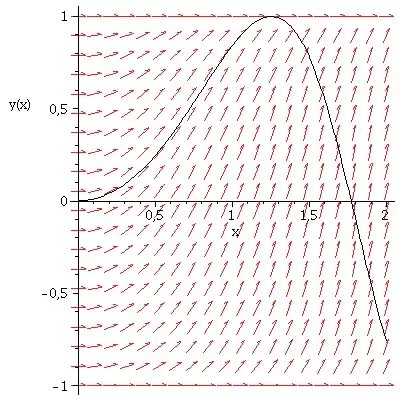
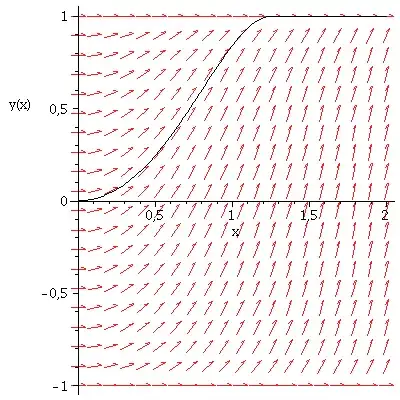
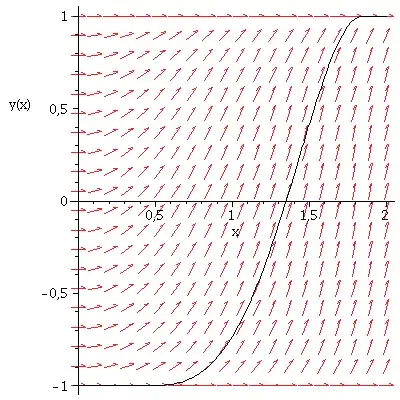
In most introductory ODE textbooks we can find the following definition:
A separable first-order ODE is the one of the form $$y'=g(x)h(y)$$ and if $h(y)\neq0$, then the general solution is found by integration (using chain rule). Next, we must find every $y_0$ such that $h(y_0)=0$ and the constant function $y=y_0$ satisfies the above ODE (called singular solutions).
I'm trying to learn this method in a rigorous way by using the existence and uniqueness of solution theorems and adding restrictions over $g$ and $h$, but can't deal with the following:
Does there exist a solution $f$ defined in some $A\in \mathbb{R}$ such that there exists $x_0\in A$ such that $h(f(x_0))=0 $ but $f$ is not constant? I mean, if $f(x_0)=y_0$, then $h(y_0)=0$, so we can't divide by $h(y)$ and integrate using separable equation method. I know that $f(x)=y_0$ is a solution, but what can we say about a non-constant $f/f(x_0)=y_0$?
Also, can you recommend books explaining this kind of solving-ODE's methods but in an absolutely rigorous way?
EDIT: This edit is made after the bounty (I thought it was implicit in the spirit of the question, but maybe I couldn't state it properly due to my lack of expertise in english), but I'd really want to know what further hypothesis need to be given in order to assure that every singular solution must be constant.
Any help is highly appreciated. Thanks and regards