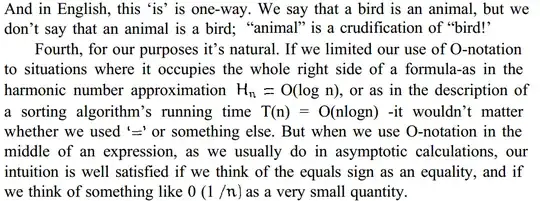
How can I understand the sign "$=$" from the following expression:
$$\mathcal{o}f((x))=\mathcal{o}f((x))+\mathcal{o}f((x));$$ $$\mathcal{o}(kf((x)))=\mathcal{o}(f(x));$$ $$t\mathcal{o}(f((x)))=\mathcal{o}(f(x)).$$ ( $k$ and $t$ are constants,$\mathcal{o}$ is little $o$ Notation )
Someone say the sign "$=$ " only means "$\subseteq$ " ; others confirm" the sign "$=$"has the same meaning as the equivalence of two sets (i.e.Let two sets $A,B$:$A=B\Leftrightarrow A$$\subseteq $$B$ and $A$$\supseteq $$B$ )."But what does the sign "$=$" exact meaning?