3

I want to geometrically prove that $\cos(\pi-\phi)=-\cos\phi$ without resorting to the unit circle or trigonometric formulas, but have difficulties figuring it out.

It's easy enough to do the sine, however: you draw a right triangle to complement the existing scalene triangle and then subtract the area of the smaller right triangle from the bigger one (see picture).
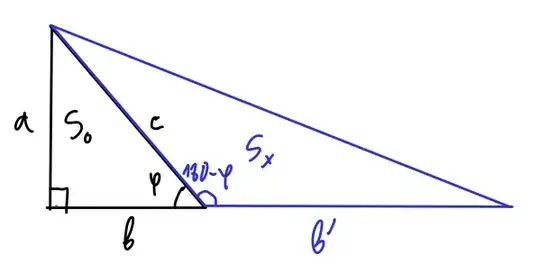
Triangles

$$a=c\sin\phi$$ $$S_x=\frac{c \cdot \sin\phi \cdot (b+b')}{2}-\frac{c \cdot \sin\phi \cdot b}{2} = \frac{c \cdot \sin\phi \cdot b'}{2}$$ On the other hand, $$S_x=\frac{c \cdot \sin(\pi-\phi) \cdot b'}{2}$$ Thus, $$ \sin(\pi-\phi) = \sin \phi$$

I'll be grateful for any ideas/advice.

N. F. Taussig
  • 79,074
dpq
  • 141
  • 7
  • 1
    $\sin(\pi/2-\phi) = \sin \phi$ is false, the true statement is $\sin(\pi-\phi) = \sin \phi$ – Alice Ryhl Apr 03 '15 at 07:51
  • 1
    What formulas do we know? If we make one right triangle with an angle $\phi$, then it's impossible to create another right triangle with an angle $180-\phi$. – Alice Ryhl Apr 03 '15 at 08:01
  • @KristofferRyhl, I slipped, thank you. – dpq Apr 03 '15 at 08:05
  • Of course, your sine argument assumes that the sine-based area formula works for obtuse angles. Since the area formula (for acute angles) derives from $a = c\sin\phi$, you are effectively assuming that $a = c\sin(\pi-\phi)$ (essentially the unit circle definition), so that you get $\sin\phi = \sin(\pi-\phi)$ very directly. For cosine, you must decide which formula that holds for acute angles "should" hold for obtuse ones. One possibility: The Law of Cosines. In your picture, take $b^\prime = c$, and compute the length of the long hypotenuse in two ways. [continued] – Blue Apr 03 '15 at 08:06
  • Simpler than the LoC: In $\triangle XYZ$ with $x$ opposite $X$, etc, $$z = x \cos Y + y \cos X\qquad(\star)$$ In an argument similar to your comparison of areas, one finds that, if (say) $X$ is obtuse, then $x \cos Y$ is larger than $z$, so that $y\cos X$ "must" be negative; in particular, it "must" match $-y\cos(\pi - X)$. But there's no a priori reason to believe that $(\star)$ holds; for all we know, maybe $y\cos X$ (for obtuse $X$) is "supposed to be" the non-negative length of a segment, and we're "supposed to" modify $(\star)$ with subtraction as necessary. [continued] – Blue Apr 03 '15 at 08:18
  • @Blue, I thought of it as if I was rather defining sine for obtuse angles as a function that would behave similarly to acute angles (i.e. introduce a $\psi=\pi-\phi$ and you shouldn't see any differences between this and the known case of acute angles). But now that you pointed it out, I'm no longer confident that it's a valid approach. – dpq Apr 03 '15 at 08:24
  • 2
    What we tend to see, though, is that negative cosines fit better with formulas that work so well with acute angles. The formulas for acute angles pretty-much codify our observations about some fairly non-controversial geometry where lengths are always non-negative and life is good; then, when we hop the fence over $90^\circ$, we rely on those formulas to help guide our understanding of the broader context. "The tail," as they say, "wags the dog." (See also this answer.) – Blue Apr 03 '15 at 08:25
  • 1
    @Blue, thanks a lot for the link to your older reply, it's a very intuitive explanation. – dpq Apr 03 '15 at 08:45

1 Answers1

1

Thanks to @Blue for the idea; also, please check out the post referenced in the question's comments, since there may be a fundamental flaw in this approach to reasoning altogether.

Still, let us build an isosceles scalene triangle ($c=b'$). In that case, the longer hypotenuse can be calculated twofold:

$$(b+b')^2+(b'sin\phi)^2=2b'^2 - 2b'^2cos(\pi-\phi)$$ Knowing that $b=b'cos\phi$,

$$b^2+2bb'+b'^2+b'^2sin^2\phi=2b'^2-2b'^2cos(\pi-\phi)$$ $$b'^2 cos^2\phi + b'^2 sin^2\phi + 2b'^2cos\phi=b'^2-2b'^2cos(\pi-\phi)$$ $$cos\phi=-cos(\pi-\phi)$$

dpq
  • 141
  • 7