Why is the group $G= \langle x,y\mid x^2=y^2\rangle $ not free?
I can't find any reason like an element of finite order or some subgroup of it that is not free etc.
Why is the group $G= \langle x,y\mid x^2=y^2\rangle $ not free?
I can't find any reason like an element of finite order or some subgroup of it that is not free etc.


The abelianization of a free group is a free abelian group: in particular, it is torsion-free. For your presentation, the relation $$2(x-y)=0$$ holds in the abelianization. Therefore, $G$ is free iff it is infinite cyclic. However, there clearly exists a morphism from $G$ onto $\mathbb{Z}_2 \times \mathbb{Z}_2$, so $G$ cannot be cyclic.
Added: In fact, your group $G$ is the fundamental group of the connected sum of two projective planes, that is of the Klein bottle $K$.
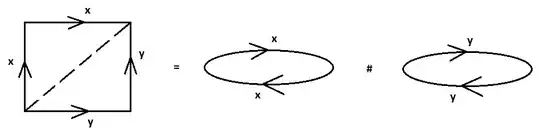
But we know that there exists a two-sheeted covering $\mathbb{T}^2 \to K$ from the torus $\mathbb{T}^2$. Therefore, $G$ has a subgroup of finite index two isomorphic to $\mathbb{Z}^2$. In particular, $G$ cannot be free.
Algebraically, it can be verified that $\langle x^2,xy^{-1} \rangle$ is a subgroup isomorphic to $\mathbb{Z}^2$ of index two in $\langle x,y \mid x^2=y^2 \rangle$.

Here's a direct proof using a little linear algebra. Suppose $G$ is freely generated by a set $S$. Then there is a surjective homomorphism $f$ from $G$ to the module $\Bbb Z^S$ (where finitely many coordinates are nonzero), and $f(x),f(y)$ are vectors in this space. But then $2f(x)=f(x^2)=f(y^2)=2f(y)$, so $f(x)=f(y)$ and since $x,y$ also generate $G$ the image of $f$ is $\Bbb Zf(x)=\Bbb Z^S$, so $f(x)=\pm1$ and $S$ is a singleton (since the module is one-dimensional). Thus $G$ is infinite cyclic, but then if $x=g^m$ and $y=g^n$ we get $2m=2n\to m=n\to x=y$, a contradiction.
Why is $x=y$ a contradiction? The definition of a group presentation like $\langle x,y\mid x^2=y^2\rangle$ is that there are no "extra" equalities that hold other than the ones specified and ones that follow from the specified equalities. In particular, that means that any equality in $G$ must also be an equality in any other group which also is generated by two elements $x,y$ and satisfies $x^2=y^2$. But $C^4=\{1,x,x^2,x^3=y\}$ does not satisfy $x=y$ even though $x,y$ generate it and $x^2=y^2$.

It is clear that $x^2$ is central in your group. As a free group has trivial center if its rank is larger than $1$, we see that it is free then either it is isomorphic to $\mathbb Z$ or trivial.
On the other hand, the abelianization of your group is clearly isomorphic to $\mathbb Z\oplus\mathbb Z/(2,2)$, which is not zero and has torsion. This is impossible.

By the universal property of free groups there are a morphisms $$\phi:\langle x,y\rangle\to\Bbb Z/2\times\Bbb Z/2,\qquad x\mapsto (1,0),\;y\mapsto (0,1)$$ and $$\psi:\langle x,y\rangle\to\Bbb Z, \qquad x,y\mapsto 1$$ both factor through $G$. Note that
By the first point, if $G$ were free, it would have to be free on more than one generator, and thus have trivial center. But $x^2$ is non trivial by the second point, and central (it commutes to both $x$ and $y$ by definition of $G$). So $G$ can't be free.

This proof is "algebraically" deriving the statement "$G$ contains $\mathbb Z^2$, hence is not free" that Seirios's answer made.
First note that $x^2$ is in the center of $G$, and that $x^2$ is not trivial since we can consider a map $$G \to \mathbb Z, \quad x,y \mapsto 1,$$ in fact $x^2$ generates a group isomorphic to $\Bbb Z$ Consider the reflections $$a,b: \Bbb Z \to \Bbb Z, \quad a: t \mapsto -t, b: t \mapsto 2-t,$$ and consider the group $D_\infty = \langle a, b \rangle$, under function composition (this group happens to be isomorphic to $\Bbb Z/2 \Bbb Z* \Bbb Z/2 \Bbb Z$). Note that $ba: t \mapsto t+2$, so in particular, $ba$ generates a group isomorphic to $\mathbb Z$. So $yx$ generates a group isomorphic to $\mathbb Z$, if we consider $x\mapsto a, y \mapsto b$. Also note that no power of $yx$ is $x^2$, since $x^2$ is not the identity, but $x^2$ is in the kernel of the map, which no non-trivial power of $yx$ is in the kernel of the map. So we have that $\langle x^2, yx\rangle$ is an abelian group, with no torsion, generated by two elements, hence it is isomorphic to $\Bbb Z ^2$. Free groups do not contain subgroups isomorphic to $\Bbb Z^2$, and more generally hyperbolic groups do not contain subgroups isomorphic to $\Bbb Z^2$, hence $G$ is not free.
For a proof that $\Bbb Z^2$ can not be a subgroup of a hyperbolic group, look at proposition 3.5 in Notes on word hyperbolic groups by Alonso, Brady, Cooper, Ferlini, Lustig, Mihalik, Shapiro, and Short.
In a free group, no two distinct elements have the same square.

(Skipping the obvious answer that if it were free, $x^2\ne y^2$…)
If $G$ were the free group on two elements, it would be isomorphic to the subgroup generated by $w=x^2$ and $z=y^2$. But in $G$, the subgroup generated by $x^2$ and $y^2$ is isomorphic to $\Bbb Z$, and $G$ clearly isn't.

Here's another way to see this. The free group $F_{x,y}$ has a natural homomorphism $h:F_{x,y}\to \def\Z{\Bbb Z}\Z_3^2$ given by $h(x) \mapsto \langle1,0\rangle, h(y) \mapsto \langle0,1\rangle$. But your group $G$ does not have any homomorphism to $\Z_3^2$ of this type. For if there were such a homormophism with $h(x) \mapsto \langle1,0\rangle, h(y) \mapsto \langle0,1\rangle$ you would then have to decide wat $h(x^2)$ was, and it must be $h(x^2) = h(x) + h(x) = \langle2,0\rangle$. But since $x^2=y^2$ in $G$, $h(x^2) = h(y^2)$ and then $h(y^2) = \langle 2,0\rangle$ which shows that $h$ is not a homomorphism, since you need $h(y^2) = h(y)+h(y) = \langle 0,2\rangle$ instead. But it cannot be both.
This is another way of saying that your group $G$ does not satisfy the universal property of a free group. The free group on two elements, $F_2$, is characterized by the following universal property:
Let $S=\{x,y\}$, and let $s:S\to F_2$ be the natural injection that takes $s(x) = x, s(y) = y$. Let $H$ be any group, and let $h$ be any function $h:S\to H$. Then there is a unique homomorphism $\varphi:F_2\to H$ for which $\varphi\circ s = h$.
Intuitively, the idea is that regardless of how $f$ chooses the images of the two generators $x$ and $y$, there is always a homomorphism $\varphi$ determined by those images. But if you take $H = \Z_3^2$ and $h$ with $x\mapsto \langle1,0\rangle, y\mapsto \langle 0,1\rangle$ then there is no homomorphism $\varphi: G\to \Z_3^2$ with $h = \varphi\circ f$, for the reason I gave before: you would need $\langle 2,0\rangle = \langle 0,2\rangle$.
