10

Given a real-valued matrix $A$, one can obtain its largest eigenvalue $\lambda_1$ plus the corresponding eigenvector $v_1$ by choosing a random vector $r$ and repeatedly multiplying it by $A$ (and rescaling) until convergence.

Once we have the first eigenpair, is there a similar way to estimate the second eigenpair?

mitchus
  • 550

3 Answers3

15

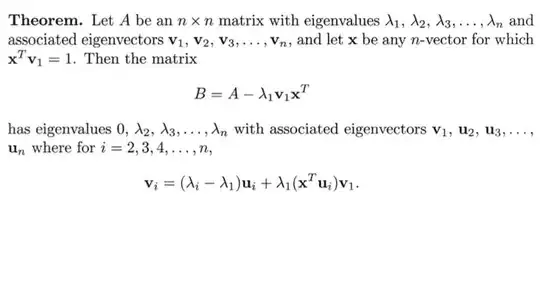
Here is a theorem that you can use:

enter image description here

where $$\vec{x}=\frac{1}{\lambda_1 v_{1,k}}\begin{pmatrix} a_{k1}\\ a_{k2}\\ ...\\ a_{kn} \end{pmatrix}$$

$v_{1,k}$ is the $k$th component of $\vec{v}_1$, $a_{ki}$ is the $ki$th element of $A$. The row $k$ is smallest index such that $v_{1,k}$ is the infinity norm of $\vec{v}$, i.e., the largest component.

Then you can find the largest eigenvalue of $B$, which is the second largest of $A$.

KittyL
  • 17,275
  • 1
    could you please share from which book / notes you took that theorem? thanks in advance! – etothepitimesi Jan 26 '15 at 13:03
  • 3
    I couldn't find the original source. This is similar: http://macs.citadel.edu/chenm/344.dir/08.dir/lect4_2.pdf. It is called Wielandt deflation. – KittyL Jan 27 '15 at 10:02
11

$A=\sum_{i=1}^n \lambda_i v_iv_i^\top$ where $(\lambda_i,v_i)$ are the eigenvalue/vector pairs of $A$.

So, if you know that $|\lambda_1| \ge |\lambda_2| \ge \dots \ge |\lambda_n|$, then you can obtain $\lambda_2$ by computing the largest eigenvalue/vector pair in absolute value of $$B=A-\lambda_1 v_1v_1^\top$$

davcha
  • 1,795
  • What about the k-th largest ? should that be the same as the second? i.e finding the largest e.v for B = Ak-1 - (Lambda_k-1(V_k-1)(V_k-1)) ? – matlabit Feb 25 '16 at 16:31
  • To get the k-th largest using that method, you need to remove all the previous eigenvectors. So, that's quite long... Not very efficient compared to other methods, such as QR, etc. – davcha Sep 26 '16 at 07:57
0

The method is called deflation. The link provided by KittyL seems failed. Just in case someone need a ref, here is anthor source for the method:

https://services.math.duke.edu/~jtwong/math361-2019/lectures/Lec10eigenvalues.pdf enter image description here

glg
  • 21
  • 3