Given the Thomae Function:
$$t(x)=
\begin{cases}
1 & \text{if }x=0, \\
1/n & \text{if }x=m/n \in \mathbf Q\setminus\{0\}\text{ is in lowest terms with }n>0,\\\
0 & \text{if }x\notin\mathbf Q.
\end{cases}
$$

I am trying to do the following exercise:
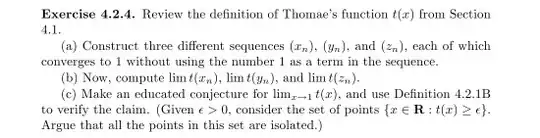
Exercises 4.2.4. Review the definition of Thomae's function $t(x)$ from Section 4.1.
(a) Construct three difference sequences $(x_n)$, $(y_n)$ and $(z_n)$, each of which converges to $1$ without using the number $1$ as a term in the sequence.
(b) Now, compute $\lim t(x_n)$, $\lim t(y_n)$ and $\lim t(z_n)$.
(c) Make an educated conjecture for $\lim_{x\to1}t(x)$, and use Definition 4.2.1B to verify the claim. (Given $\epsilon>0$ consider the set of points $\{x\in\mathbf R \colon t(x)\ge\epsilon\}$. Argue that all the points in this set are isolated.)
I have no difficulties with part a) and b), and the conjecture for part c) is that $$\lim_{x \to 1} t(x) = 0$$ I am pretty sure with this conclusion. However, I do not know how to use the definition 4.2.1B, which is the topological version of the functional limits and it is stated as following: $\lim_{x \to 1} t(x) = 0$ if $\exists \delta \gt 0$ such that whenever $x \in V_{\delta}(1)$,$\forall \epsilon \gt 0$ $t(x) \in V_{\epsilon}(0)$ . That is what we want to prove.
Please help me prove that $\lim_{x \to 1} t(x) = 0$ using topological definition of functional limits. I thank you very much for your help.
EXTRA QUESTION:
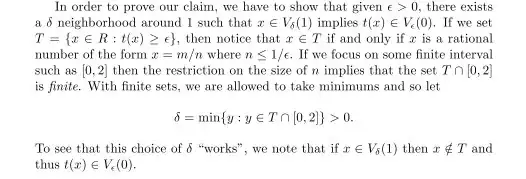
I found this kind of solution:
However, there are 3 things I do not understand:
- If $\epsilon = 2$, then $n \le \frac{1}{\epsilon}=\frac{1}{2}$. Then there is no $n$ since $n$ must be a natural number. How do we explain this situation?
2.I do not understand why we take $\delta=\min\{y: y \in T \cap \left[0,2\right]\}$
- Why if $x \in V_{\delta}(1)$, then $x \notin T$ ? This is the most peculiar question that baffles me for hours.
I thank you very much for your explanation.


