I was messing around with my calculator the other day when I saw something interesting happen. Whenever I repetitively took the cosine of any number, it always ended up on a particular number (Dottie's number). It wasn't difficult to figure out why it would be so, but what was difficult was how many steps a number takes to reach there. Since my calculator can only accurately calculate upto 9 digits, I can't say much, but I think it should take infinite steps.
So, excluding the case of Dottie's number itself,
$$\text{if } A \in \mathbb{R} \ \text{and} \ \underbrace{\cos \cos \ldots \cos}_{\text{n times}}\ (A)=0.739085\ldots$$
Prove that
$$n=\infty$$
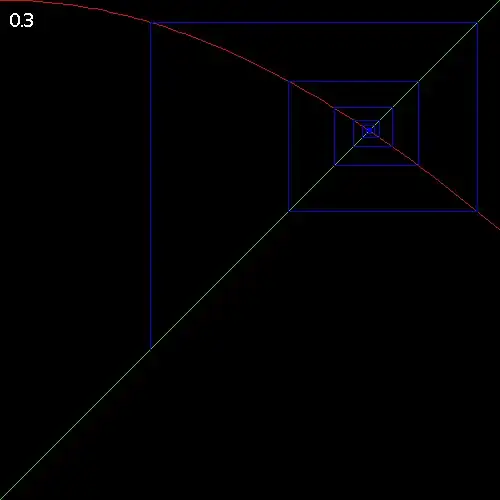
EDIT: I wrote a simple program to show the iteration graphically. The result gives a nice spiral as expected. This one is for $0.3$

- 1,721
-
1What if $A$ is the Dottie number? Then $n=1$ by definition. – Hayden Jan 09 '15 at 19:23
-
2@Hayden, even more generally: suppose $x=A+n\pi$. Then, $\cos(x)=(-1)^n A$; for $n$ even with we have 1 iteration, for $n$ odd we have $\cos(\cos(x))=A$ (2 iterations). – Jason Jan 09 '15 at 19:35
4 Answers
It will either require $0$, $1$, $2$, or infinitely many steps. Here's why. Denote the Dottie number by $x$, and the initial point of our iteration by $y$.
If $y=x$ then we are already at the Dottie number after $0$ iterations.
Define
$$A=\{ y : \cos(y) = x \text{ and } y \neq x \} = \{ x + 2 \pi k : k \in \mathbb{Z} \setminus \{ 0 \} \} \cup \{ -x + 2 \pi k : k \in \mathbb{Z} \}.$$
If $y \in A$, then we'll have $\cos(y)=x$ and we'll be at the Dottie number in $1$ iteration.
If $y \not \in A \cup \{ x \}$, then $\cos(y) \neq x$, and so after $1$ iteration we have $\cos(y) \in [-1,1]$. If $\cos(y)=-x$, then $\cos(\cos(y))=\cos(-x)=\cos(x)=x$, and so we'll be at the Dottie number in $2$ iterations.
Otherwise, we now have $\cos(\cos(y)) \in [0,1]$. $\cos$ is an injective function from $[0,1]$ to $[0,1]$, so if $z \in [0,1]$ then $\cos(z)=x$ if and only if $z=x$. So in this case we will not hit the Dottie number in any finite number of steps.
This last point can be proven by induction. Suppose $\cos^{(2)}(y) \neq x$; this is the base case. Take as the inductive hypothesis that $\cos^{(n)}(y) \neq x$, where $n \geq 2$. Since $n \geq 2$, $\cos^{(n)}(y) \in [0,1]$, on which $\cos$ is injective. Using the inductive hypothesis and the injectivity we conclude that $\cos^{(n+1)}(y)=\cos(\cos^{(n)}(y)) \neq \cos(x)=x$. So $\cos^{(n+1)}(y) \neq x$. By induction $\cos^{(n)}(y) \neq x$ for all $n \geq 2$.

- 104,572
The question of exact iterations has been settled. Let us look at it from a numerical standpoint.
Assuming that the current iterate is $\epsilon$ away from Dottie's number,
$$D+\epsilon'=cos(D+\epsilon)=\cos D\cos\epsilon-\sin D\sin\epsilon\approx\cos D-\frac{\epsilon^2}2\cos D-\epsilon\sin D\approx D-\epsilon\sin D.$$
The $\epsilon^2$ term quickly becoming neglectible, and we see that the error follows a geometric law of ratio $-\sin D$.
$$\epsilon^{(k)}\approx(-\sin D)^k\epsilon.$$
This shows that one iteration brings $\log_{10}\sin D\approx0.1716$ decimal per iteration, i.e. about $53$ iterations to get $9$ correct decimals.
By contrast, Newton iterates are $$A'=A-\frac{A-\cos A}{1+\sin A},$$ giving $$ 0\\ 1\\ 0.75036386784\cdots\\ 0.739112890911\cdots\\ 0.739085133385\cdots\\ 0.739085133215\cdots\\ 0.739085133215\cdots\\ 0.739085133215\cdots\\ $$ The error is governed by $$D+\epsilon'=D+\epsilon-\frac{D+\epsilon-\cos(D+\epsilon)}{1+\sin(D+\epsilon)}\approx D+\epsilon-\frac{D+\epsilon-\left(1-\frac{\epsilon^2}2\right)\cos D+\epsilon\sin D}{1+\sin D}\\\approx D+\epsilon^2\frac{D}{2(1+\sin D)}.$$ More generally, $$\epsilon^{(k)}\approx\epsilon^{2^k}\left(\frac{D}{2(1+\sin D)}\right)^{2^k-1}.$$
In exact arithmetic it would never get there, but because there is roundoff error in your calculator you end up after finitely many steps with some approximation of the correct number.

- 470,583
-
What if there is some number out there that can reach there in finite steps? Can this be disproved mathematically? – AvZ Jan 09 '15 at 19:29
-
@AvZ, $x=A+\pi$. Then, $\cos(x)=-\cos(A)=-A \implies \cos(\cos(x)) = \cos(-A)=\cos(A)=A$. – Jason Jan 09 '15 at 19:36
-
@Jason, Ah, I forgot about that. But excluding these solutions, Are there any solutions which reach there in finite steps? – AvZ Jan 09 '15 at 19:40
I think if you proceed by contradiction, you can figure it out: let's say $n$ is finite: so we can write $\cos^{(n)}(A) = d$ (taking the cosine $n$ times) where $d$ is Dottie number, i.e. $d = cos(d)$. So, what we're saying is $\cos^{(n)}(A) = cos(d)$. One solution of that is $\cos^{(n-1)}(A) = d$. So, if you can reach $d$ is $n$ steps, then you can reach it in $n-1$; and so on. This is obviously a contradiction unless $n$ is infinity.

- 273