I know that for a torus (with one hole) the parametric equations describing it are $x= (c + a\cos v)\cos u, y= (c + a\cos v)\sin u, z= a\sin v$, where $c$ is the radius from the center of the hole to the center of the torus tube and $a$ is the radius of the tube. My question is what would be the corresponding parametric equations describing a $2$-torus, i.e. a torus with $2$ holes. How about an $n$-torus?
Asked
Active
Viewed 4,655 times
7


-
Though this link is not an answer, https://math.stackexchange.com/questions/152256/implicit-equation-for-double-torus-genus-2-orientable-surface , but the two questions are related – Mountain Dec 24 '23 at 15:26
2 Answers
7
A few words concerning nomenclature: The surface of a donut is a $2$-torus, or a closed surface of genus $1$. A donut with $2$ holes is not a $2$-torus but a closed surface of genus $2$. An $n$-torus for arbitrary $n\geq1$ is the manifold obtained from ${\mathbb R}^n$ by identifying points whose coordinates differ by integers.
A $1$-torus is nothing else but the circle $S^1$. The map $$u:\quad\phi\mapsto(\cos\phi,\sin\phi)\qquad (-\infty<\phi<\infty)$$ used to ”parametrize" $S^1$ is actually a covering map: It is locally (i.e., for short $\phi$-intervals) a diffeomorphism, but to each point $z\in S^1$ belong infinitely many $\phi$'s with $u(\phi)=z$.
In the same way the parametrization you gave for the $2$-torus is a covering map: Each point $(x,y,z)$ on the torus is produced infinitely many times. When you want to compute the area of the torus you have to restrict this map to $[0,2\pi]\times[0,2\pi]$, even though it is defined on all of ${\mathbb R}^2$.
Now the closed surfaces of genus $\geq2$: Here no elementary parametrization is possible. In the theory of Riemann surfaces it is shown that such a surface $S$ possesses a "universal" covering map $\pi: \ D\to S$ $\ (D$ is the unit disk in the $z$-plane), where again each point $p\in S$ is produced infinitely many times. Here the different $z$'s that produce the same point $p\in S$ are not related by translations $z\mapsto z+2\pi j +2i\pi k$, as in the case of the $2$-torus, but by a group of Moebius transformations.

Christian Blatter
- 232,144
-2
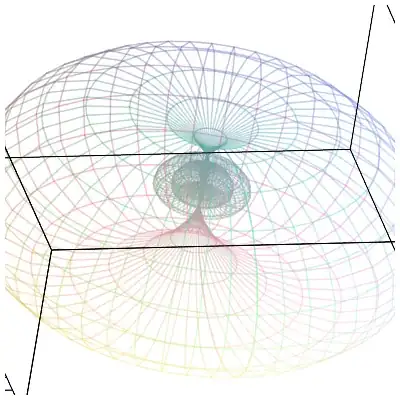
$0$ holes, $3$ donuts
$$\Big(\big(-\cos(\theta)^2+\sin(\theta)^2\cos(\phi)^2+\sin(\theta)^2\sin(\phi)^2+h+\sin(\theta)\big)^2+\\ \big(-\sin(\theta)-h+2\cos(\theta)\sin(\theta)\big)\big(\sin(\theta)+h-2\cos(\theta)\sin(\theta)\big)\text,\\ 2\sin(\theta)\cos(\phi)\big(1+h-2\cos(\theta)\big)\\ \big(-\cos(\theta)^2+\sin(\theta)^2\cos(\phi)^2+\sin(\theta)^2\sin(\phi)^2+h+\sin(\theta)\big)\text,\\ 2\sin(\theta)\sin(\phi)\big(1+h-2\cos(\theta)\big)\\ \big(-\cos(\theta)^2+\sin(\theta)^2\cos(\phi)^2+\sin(\theta)^2\sin(\phi)^2+h+\sin(\theta)\big)\Big)$$
$h$ is the height.
$3$ donut:

Mohsen Shahriari
- 7,071

-
The person asking the question specifically asked for a 2-torus, one with two holes. – Cedric Martens Mar 21 '25 at 15:54