13

This has been asked at least twice here, but both questions have accepted answers which are wrong. I don't really know any good way to draw attention to the question besides asking again and being a bit more careful about not accepting incorrect or incomplete answers, so here goes.

Say I am standing at the origin of the real line, and I know my car is somewhere on the real line. The PDF is a normal curve. I want to search for it optimally walking at a fixed pace. The problem is, if I look right and it really was left, I'm going to, at some point, have to back track to find it. So let's see if we can model this more formally.

The set of times is $\mathbb R^+$, so I want a continuous, rigid (so that one "second" becomes one "unit") transformation $f$ with $f(0) = 0$.

A few definitions:

  • Let $S_f(t)$ (success of $f$) be the probability that the car is found by time $t$. It equals $\int_{\min f}^{\max f}N(\mu, \sigma)(x)dx$, Where the $\min$ and $\max$ are taken on $[0,t]$. So it's the amount of area under the normal curve that is covered.
  • For a fixed $x \in \mathbb R$ where the car might be, let $T_f(x)$ be the amount of time it takes to find $c$. This is $\min \{t: f(t) = c\}$.
  • Define $P_f(p)$ for $0 < p < 1$ to be the amount of time it will take to have found the car with probability $p$. That is, $P_f(p) := \min \{t \in \mathbb R^+ : S_f(t) \geq p \}$.

I think there are a few valid interpretations of this problem:

  1. For a fixed amount of time $t$, find $f$ to maximize $S_f$. I don't think $f$ is independent of $t$, because backtracking takes time, and taking a function that backtracks and telling it, "you don't have time to backtrack all the way back," would tell it not to backtrack at all.
  2. Find an $f$ whose expected value of $T_f$ where $x$ is normally distributed is smallest. I think this is closest to the real world problem.
  3. For a fixed probability $p$, find $f$ such that $P_f(p)$, which returns an amount of time, is minimal.
  4. Let's put these together. Say you're willing to abort once you have reached a $p$ chance of finding the car. This models reality in the Bayesian sense that once I should have found my car with probability $99.99\%$ by now, then maybe my model needs to be revised and I should look on another street. Consider $J_f(x) := \min(T_f(x), P_f(p))$. Now find $f$ such that the expected value of $J_f$ is smallest over normally distributed $x$.

So the first question is whether I interpreted this question correctly. The second is how to solve any of them.

djechlin
  • 5,452
  • Can you post a possible solution to a slightly simpler problem: say you are told $|X|<c$, where $X$ is the distance to the car. –  Jan 03 '15 at 01:38
  • @Eupraxis1981n what's the distribution then? It's not a normal one. You are saying that $P(|X| > c)$ is extremely small when c is a few standard deviations with a normal curve. Has to be a different distribution for an absolute bound, and I think uniform tends to be the most natural, in which case your solution from the other thread I believe is fully valid. – djechlin Jan 03 '15 at 16:50
  • @Eupraxis1981 on a ridiculous side note, you could just "reroll the die" when it lands out of bounds. That would make a valid distribution, not sure how to compute it mathematically or anything. – djechlin Jan 03 '15 at 17:12
  • I don't understand what you mean by "the probability that it's at a point follows a normal curve." If the car is on $\mathbb{R}$, then the probability of it being at any point is zero. – Emily Jan 03 '15 at 17:18
  • @Arkamis *probability density? – djechlin Jan 03 '15 at 17:20
  • Probability density functions are not bounded by 1. The best you could do while trying to use a "normal curve" is to say that "the probability that the car is to the left of some given point is given by the area under a normal pdf up to that point." – Emily Jan 03 '15 at 17:22
  • First off, thanks for asking a precise version of the question. Now, any valid $f$ is characterized by an increasing sequence of times $t_1<t_2<t_3<\cdots$ such that for time $t_1$ you walk right, then for time $t_2$ you walk left, then for time $t_3$ you walk right again, and so on. It should be straightforward to compute $S$, $T$, and $P$ in terms of the $t_i$. I agree that interpretation (2), minimizing $\mathbb E[T]$, is the most natural interpretation of the problem. –  Jan 03 '15 at 17:33
  • @AAA I was referring to a truncated normal, not something more exotic. Do you have any thoughts on the approach you could take with (2) or my slightly modified version using a truncated normal? FYI: I simulated a search scheme where you alternatively go $k$ units to the right, then $2k$ units to the left, $3k$ to the right, etc, in order to cover the real axis. There is an optimum value of $k$, $k^$ in this case, and its around 2 for a standard normal distribution. Expected search time increases to $\infty$ as you decrease $k$ and increases linearly as you increase $k$ past $k^$ –  Jan 04 '15 at 03:53
  • @Eupraxis1981 no it won't, what if you find your car right away? You don't keep searching. – djechlin Jan 04 '15 at 15:18
  • I updated my answer, by the way. (I continue to wish this feature request would get implemented...) –  Jan 05 '15 at 18:14

1 Answers1

9

Any valid search scheme is characterized by an increasing sequence of time intervals $\tau_1<\tau_2<\tau_3<\cdots$ such that for time $\tau_1$ you walk left, then for time $\tau_2$ you walk right, then for time $\tau_3$ you walk left again, and so on. Then your turning points are $$\begin{align} t_1&=\tau_1 & x_1&=-\tau_1 \\ t_2&=\tau_1+\tau_2 & x_2&=-\tau_1+\tau_2\\ t_3&=\tau_1+\tau_2+\tau_3 & x_3&=-\tau_1+\tau_2-\tau_3\\ &\vdots & &\vdots \\ t_n&=\sum_{i=1}^n\tau_i & x_n&=\sum_{i=1}^n(-1)^nt_i \end{align}$$ and we have $$f(t)=x_n+(-1)^{n+1}(t-t_n)\qquad\text{when $t_n\le t\le t_{n+1}$}.$$ Conversely, the first time the point at location $x$ is passed is $$g(x)=t_n+(-1)^{n+1}(x-x_n)\qquad\text{when $x_n\le x\le x_{n+1}$ or $x_n\ge x\ge x_{n+1}$}.$$


Let $\underline f(t)=\min_{s\le t}f(s)$ and $\overline f(t)=\max_{s\le t}f(s)$. To maximize $S_f(t)$ for a fixed $t$, it only makes sense to turn around at most once, because any $[\underline f(t),\overline f(t)]$ achieved by turning around multiple times can be achieved in less time by turning around only once. So we may take $\tau_1\le t/2$ (because turning around buys you nothing if $\tau_1>t/2$), and $\tau_{n>1}=\infty$. Then we have $\underline f(t)=-\tau_1$ and $\overline f(t)=t-2\tau_1$, and the task is simply to maximize the probability mass lying in the interval $[-\tau_1,t-2\tau_1]$. For the standard normal distribution, this gives $$S_f(t) = \frac12\operatorname{erf}\left(\frac{\tau_1}{\sqrt2}\right)+\frac12\operatorname{erf}\left(\frac{t-2\tau_1}{\sqrt2}\right)$$ which is maximized when $$\tau_1=\max\left(\frac23t - \frac13\sqrt{t^2+6 \log 2},0\right).$$ Asymptotically, as $t\to\infty$ we get $\tau_1\to t/3$: you should walk in one direction for time $t/3$, then turn around and walk the other way for the rest of the time, so that you cover a symmetrical range. On the other hand, for $t\le\sqrt{2\log 2}$ we have $\tau_1=0$: turning around is not worth the wasted time.


Come to think of it, this should also solve question (3), because a solution that maximizes $p$ subject to $t\le t_\max$ also minimizes $t$ subject to $p\ge p^*$, where $p^*$ is the optimum value of the former problem. So you just have to substitute the optimum $\tau_1$ into the expression for $S_f(t)$ to get $S^*(t)$, the highest possible probability of finding the car within time $t$. And then solve $S^*(t)=p$. It doesn't seem to yield an elementary solution, though.


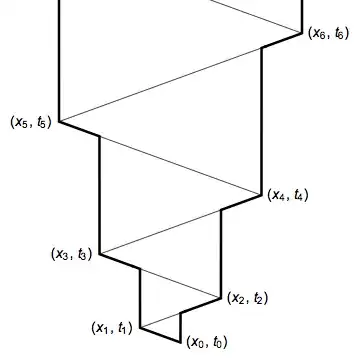
Question (2) is a fair bit trickier. Here is a space-time diagram of the situation, with $x$ on the horizontal axis and $t$ on the vertical:

enter image description here

The thin line is $x=f(t)$, and the thick line is $t=g(x)$. We seek to minimize $T_f = \mathbb E[g]$, the expected value of the vertical coordinate of $g$ when the horizontal coordinate is normally distributed. I will not attempt to write down an explicit expression for this quantity. Instead, let us consider its variations under infinitesimal changes of $\tau_n$. At the optimum, any such variation should be zero.

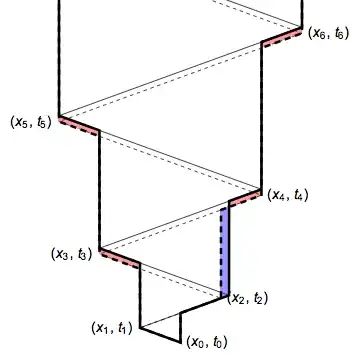
Suppose you increase both $\tau_n$ and $\tau_{n+1}$ by the same amount $\delta t$. For a small $\delta t$-length interval of points near $x_n$, this decreases $g(x)$ from about $t_n+2\tau_{n+1}$ to about $t_n$. However, for all the points visited afterwards, $g(x)$ increases by $2\delta t$. These are shown in blue and red below for $n=2$.

enter image description here

Let $\phi(x)$ denote the probability density at $x$, and $\Phi(a,b)$ the probability mass lying between $a$ and $b$. The probability of the blue region is $\phi(x_n)\delta t$, while that of the red is $1 - \Phi(x_{n-1}, x_n)$. Therefore, the change in $\mathbb E[g]$ is $$\phi(x_n)\delta t\cdot(-2\tau_{n+1}) + \big(1-\Phi(x_{n-1},x_n)\big)\cdot2\delta t.$$ Looking at the diagram again, what we have just computed is $\delta t$ times the partial derivative of $\mathbb E[g]$ with respect to $x_n$, holding the rest of the $x_m$'s constant. At the optimum all the first derivatives should be zero, so $$\phi(x_n)\tau_{n+1} = 1 - \Phi(x_{n-1},x_n)$$ for all $n\ge 1$. It appears that the natural parametrization of the problem is in terms of $x_n$, so we substitute $\tau_{n+1}=|x_{n+1}-x_n|$ and get a nice sequence of equations each involving only three variables: $$\begin{align} |x_2-x_1|\phi(x_1) &= 1 - \Phi(x_0,x_1), \\ |x_3-x_2|\phi(x_2) &= 1 - \Phi(x_1,x_2), \\ |x_4-x_3|\phi(x_3) &= 1 - \Phi(x_2,x_3), \\ &\vdots \end{align}$$

Now all we have to do is solve this infinite system of nonlinear equations. But I don't know how to do that.


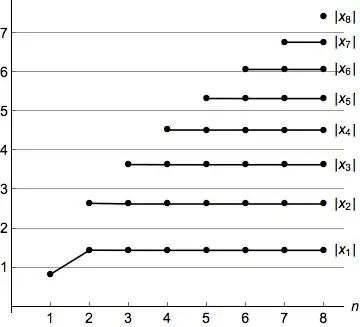
Well, here's an idea: take the first $n$ equations, eliminate $x_{n+1}$ by assuming $|x_{n+1}|-|x_n|=|x_n|-|x_{n-1}|$, and solve the system numerically.

enter image description here

Seems to work pretty well. For $n=8$, we get $$\begin{align} x_1&=-1.44085,&x_2&=2.62758,&x_3&=-3.6322,&x_4&=4.52034,\\ x_5&=-5.32668,&x_6&=6.07158,&x_7&=-6.76811,&x_8&=7.42555. \end{align}$$

I'm not sure this is really a rigorous technique, and I certainly haven't proved convergence or anything like that. But this is good enough for me.

  • +1 Great post! Thanks for lending your thoughts to this. –  Jan 04 '15 at 20:20
  • P.S. To $8$ significant digits, $|x_1|=1.4408541$. I put this in the Inverse Symbolic Calculator but nothing nearby seems particularly relevant. –  Jan 05 '15 at 18:02
  • Ha, I'm glad you took a liking to this problem. "Now all we have to do is solve this infinite system of nonlinear equations." is a gem. I'll try to catch up on your research soon. Upvoting in the mean time. – djechlin Jan 05 '15 at 18:17
  • 1
    @AAA This link actually has a nice discussion of this exact problem: http://link.springer.com/chapter/10.1007%2F0-306-48212-6_8#page-1. Looks like the optimal solution for the normal has been solved in an asymptotic sense (see second bullet on second page of the free "preview". –  Jan 08 '15 at 12:54
  • 1
    @Eupraxis1981: Ah, fantastic, thanks for finding this! For the normal distribution they cite Beck and Beck, "The linear search problem rides again" (1986), which I'll have to read carefully when I have time. Beck and Beck's first equation $$(x_n+x_{n+1})\phi(x_n)=G(x_n)+G(x_{n-1})$$ looks a heck of a lot like my last system of equations, and their conclusion states that the first turning point is at $1.440854099983617$, so I guess I was on the right track. –  Jan 08 '15 at 13:27
  • You might like this too..http://dutraeconomicus.files.wordpress.com/2014/02/the-theory-of-search-games-and-rendezvous-steve-alpern.pdf –  Jan 08 '15 at 13:56