How many unit squares can overlap a given unit square without overlapping each other?
@calculus has managed to arrange 7 squares (see this GeogebraTube page). This seems like the maximum possible, but how to prove it formally?
How many unit squares can overlap a given unit square without overlapping each other?
@calculus has managed to arrange 7 squares (see this GeogebraTube page). This seems like the maximum possible, but how to prove it formally?

Apparently $8$ squares are possible. Start with the example suggested by Peter Woolfitt and try to pack everything as tightly as possible.
In the following picture, each white square is tilted with respect to the gray square by a multiple of $\frac{\pi}{8}$ and the intersections are the obvious ones, i.e. each two squares intersect either in a whole side or in a single point.

Now perturb the angles and positions slightly so that the overlapping conditions are satisfied.

In case someone wants to play with this example, here is the Mathematica code used to produce the pictures. First, some useful functions:
ClearAll[A, T, sq]
A[phi_] := {{Cos[phi], -Sin[phi]}, {Sin[phi], Cos[phi]}}
T = {{0, 0}, {1, 0}, {1, 1}, {0, 1}, {0, 0}};
sq[v_, phi_] := Line[Table[A[phi].t + v, {t, T}]]
The first picture:
Graphics[{Opacity[0.2], Polygon[T], Opacity[1], Gray, sq[{0, 0}, 0],
  Black, sq[{0, 0}, 3 Pi/4], sq[{0, 0}, 5 Pi/4], sq[{0, 1}, 5 Pi/8],
  sq[{0, 1}, Pi/8], sq[{1, 0}, -Pi/8], sq[{1, 0}, -5 Pi/8],
  sq[{1, 1}, 0], sq[{1/2, (1 - Sqrt[2])/2} - {0.1, 0.1}, Pi/4]}]
The perturbation:
Graphics[{Opacity[0.2], Polygon[T], Opacity[1], Gray, sq[{0, 0}, 0],
  Black, sq[{0, 0} + {0.01, 0.02}, 3 Pi/4], sq[{0, 0} + {0.02, 0.01}, 5 Pi/4],
  sq[{0, 1} + {0.01, -0.01}, 5 Pi/8 - 0.05], sq[{0, 1} + {0.03, -0.01}, Pi/8 - 0.05],
  sq[{1, 0} + {-0.01, 0.03}, -Pi/8 + 0.05], sq[{1, 0} + {-0.01, 0.01}, -5 Pi/8 + 0.05],
  sq[{1, 1} - {0.01, 0.01}, 0], sq[{1/2, (1 - Sqrt[2])/2} - {0.12, 0.12}, Pi/4]}]

This is a comment, but too large to fit in the comments section
Pure area arguments are unlikely to work as shown by this near miss for $8$ squares:
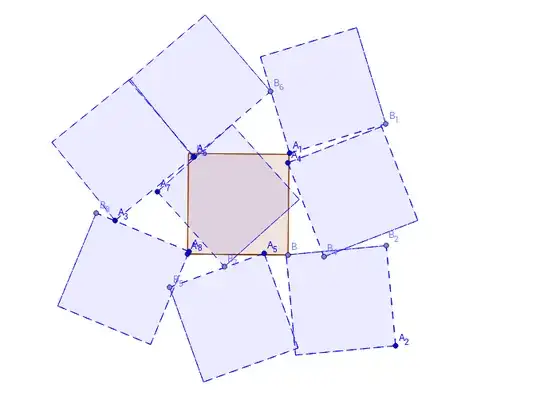

In any case, I don't think the difference is always one. For example, if we look at the family of axis-parallel unit-squares, the kissing-number is 8 but the overlapping-number is 4.
– Erel Segal-Halevi Aug 12 '15 at 13:50