I could solve the classical problem of maximizing the area (fixing the perimeter) or maximizing the perimeter (fixing the area) of an inscribed rectangle, but I don't know how to solve strightforwardly the problem of finding the rectangle circumscribed to an ellipse of max area (fixing the perimeter) or max perimeter (fixing the area). How can I set up the problem and solve it smoothly?
Asked
Active
Viewed 1,445 times

1 Answers
4
The locus of points that see an ellipse under a right angle is a circle having radius $\sqrt{a^2+b^2}$: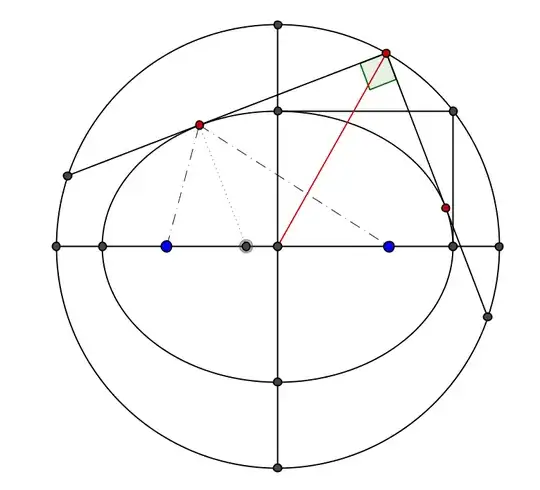
Since the tangent to the ellipse in the point $P=(a\cos\theta,b\sin\theta)$ is given by: $$ P+\lambda(-a\sin\theta,b\cos\theta),$$ by solving: $$ a^2(\cos\theta - \lambda\sin\theta)^2 + b^2(\sin\theta+\lambda\cos\theta)^2=a^2+b^2$$ with respect to $\lambda$ we find two vertices of a circumscribed rectangle associated with $P$ (and the other two vertices are simply given by the symmetric with respect to the origin). Now our min/max problem depends just on $\theta$.

Jack D'Aurizio
- 361,689
-
Thanks for the hint. Can you prove the first statement: "The locus of points that see an ellipse under a right angle is a circle having radius ..." – mathlearner Dec 17 '14 at 22:17
-
@mathlearner: it is a consequence of Poncelet's porism, but it can be proved also by imposing that the tangent lines in $P_\theta=(a\cos\theta,b\sin\theta)$ and $Q_\varphi$ are orthogonal, with some calculations. – Jack D'Aurizio Dec 17 '14 at 22:20
-
Would you mind going in some more detail with the proof using Poncelet? – mathlearner Dec 17 '14 at 22:23
-
@mathlearner: Poncelet's lemma gives that an $n$-agon is inscribed in a conic $\Gamma_1$ and circumscribed to a conic $\Gamma_2$, then starting from any point $P_1$ in $\Gamma_1$, drawing a tangent to $\Gamma_2$ until intersecting $\Gamma_1$ in $P_2$ and so on, the path closes and gives a $n$-agon. This is just the case $n=4$: it is sufficient to consider the circumscribed rectangle through the vertices of the ellipse. – Jack D'Aurizio Dec 17 '14 at 22:30
-
I didn't quite get that, could you please try to re-explain it? – mathlearner Dec 17 '14 at 22:47
-
@mathlearner: http://mathworld.wolfram.com/PonceletsPorism.html – Jack D'Aurizio Dec 17 '14 at 22:48
-
@mathlearner: see also http://math.stackexchange.com/questions/33520/the-locus-of-two-perpendicular-tangents-to-a-given-ellipse (in particular Henry's answer). – Jack D'Aurizio Dec 18 '14 at 00:36