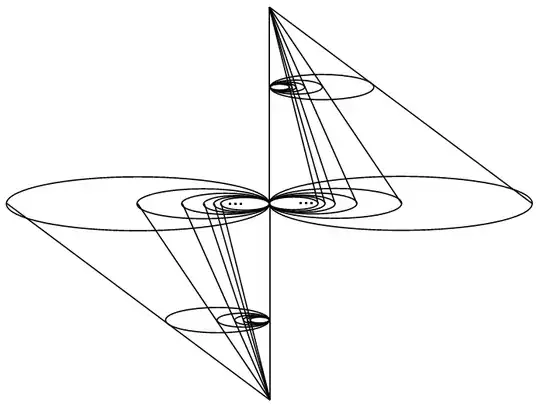
I came across this example Spanier's Algebraic Topology book (by way of the Munkres Topology book). I kind of have an intuitive idea of why the space isn't simply connected but can't figure out a formal way to prove it isn't.
The construction of the space is as follows:
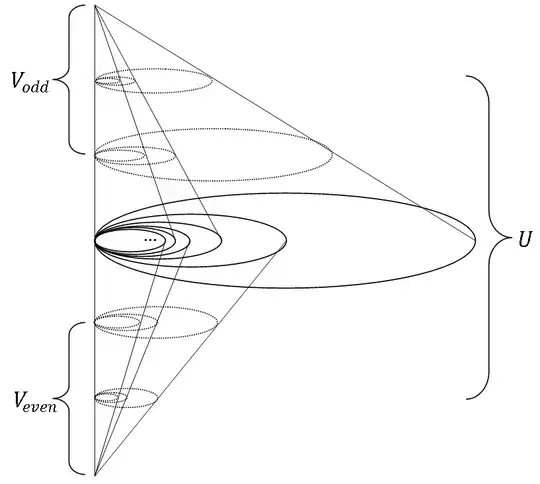
Let $C_n$ be the circle of radius $1/n$ centered at $(1/n , 0)$ and take $X$ to be the union of all the spaces $C_n$. If we imbed $\mathbb{R}^2$ in $\mathbb{R}^3$ as points where $z = 0$ then we take $Y$ to be the closed lines from $(0,0,1)$ to $X$. We will take $Y'$ to be the reflection of $Y$ through the origin. $Y \cap Y'$ is a single point and both $Y$ and $Y'$ are simply connected but their union is not.
I can defintely see why both $Y$ and $Y'$ are simply connected because they can be retracted to the point at the top of the cones and I can sort of guess that the reason $Y \cup Y'$ isn't simply connected is that you have these two separate points and you can't contract to both of them all at once and part of the issues that keeps you from doing this is how there are infinitely many circles on each side (and if it was only finitely many then we would have a simply connected space).
The ways that I have thought about solving this mostly have been finding a homotopy equivalence to a familiar space where I know the fundamental group already or finding suitable open set $U$ and $V$ so I can use the Seifert van Kampen theorem.