2

Suppose that an ellipse is rolling along a line. If we follow the path of one of the foci of the ellipse as it rolls, then this path formes a curve - namely an undulary. Now consider the following diagram
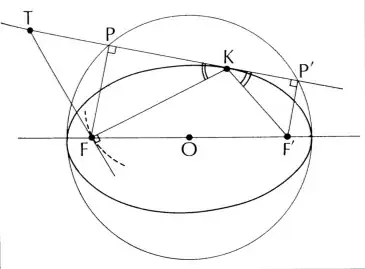
enter image description here

The points $F$ and $F'$ are the forci of the ellipse, which is rolling along the line $KT$. The line $FT$ is the tangent to the curve traced out by $F$. Now the following folds:

$FT$ is is perpendicular to $FK$, so the normal to the locus of $F$ passes through $K$.

Why is this always the case? I read this in 3 several books, but every time without a proof. Is it that obvious? Can anyone explain it or give a proof/source?

Best regards!

Paul85
  • 207
  • 3
  • 8
  • In "Differential Geometry and It's Applications" from John Oprea I read the following sentence: "A general property of this sort of roulette is the fact that the direction of the normal to the curve traced by F passes through the point of contact with the line." That is exactly the property I want to proof. Any ideas? – Paul85 Nov 18 '14 at 09:22
  • $K$ is the center of the "infinitesimal rotation" of the point $F$. So the velocity of $F$ is perpendicular to $FK$. – Emanuele Paolini Nov 18 '14 at 09:25

1 Answers1

1

Let $F(t)$ be the curve described by point $F$ and $K(t)$ the curve described by point $K$. When $K$ is on the line (ground) its velocity is zero by assumption (rolling on the line): $$ K'(t) = 0. $$ But we know that $|F(t)-K(t)|$ is constant (the ellipse is rigid) so: $$ 0 = \frac{d}{dt} (F(t)-K(t))^2 = (F(t)-K(t)) \cdot (F'(t) - K'(t)) = (F(t) -K(t)) \cdot F'(t) $$ which means that the velocity of $F$ (which is along the tangent line to the curve $F(t)$) is orthogonal to the segment $FK$.

Emanuele Paolini
  • 22,203
  • 2
  • 40
  • 70
  • First of all thanks for your answer. I've an additional question. You said that $|F(t) - K(t)|$ is constant. Is it? I think we only know that $|F_{1}(t) - K(t)| + |F_{2}(t) - K(t)|$ is constant and equal to $2a$ where $a$ is the length of the major axis, by definition of the ellipse (and $F_{1}$, $F_{2}$ are the forci of the ellipse). – Paul85 Nov 18 '14 at 13:06
  • $F$ and $K$ are fixed on the ellipse, so their distance is fixed. At time $t$ it happens that $K(t)$ is on the line, at other times the tangent point will be different. – Emanuele Paolini Nov 18 '14 at 13:18