5

I am having the hardest time figuring out what sin and cos are doing when you enter in calculator.

What I do understand about them

1) They are both essentially finding the max and min values for their respective axis. cos being x and sine being y.

-this makes PERFECT sense. Yay!

2) You can find what other lengths of a triangle are. (value(sin(theta)) (value(cos(theta)) **most cases theta needs to be in radians i understand that.

-this makes sense. Yay!

Ok, so what the heck is going on when you do sin($\pi$/6). How does that equal 1/2? I understand that basically the sine of $\pi$/6 (y min and max) would be 1/2, ok but why? when you do cos(0), x = 1 because r = 1 (why is r = 1?). This is where I am confused. Again, I can do this stuff on calculator but I am a programmer and if things don't make sense my head spins and I need to understand what is going on.

user2345215
  • 16,803
Jordan M
  • 237
  • 2
  • 7
  • Perhaps this animation will help: http://en.wikipedia.org/wiki/Sine#mediaviewer/File:Circle_cos_sin.gif – vadim123 Nov 02 '14 at 20:01
  • This might help: http://math.stackexchange.com/questions/349143/how-do-we-find-specific-values-of-sin-and-cos-given-the-series-definition – xavierm02 Nov 02 '14 at 20:02
  • I looked at that already, and it helped me SORT of understand it but when I convert pie/6 to degrees I get 154 and 154 degrees is not y = 1/2 – Jordan M Nov 02 '14 at 20:03
  • I think the most basic thing to know is that "$\sin = \text{opposite}/\text{hypotenuse}$" and "$\cos = \text{adjacent}/\text{hypotenuse}$". Given these definitions, you can draw pictures to figure out the sine and cosine of some special angles like $\pi/6$. – littleO Nov 02 '14 at 20:11
  • 1
    I knew that. I understand what it's asking for triangles, but the whole circle thing threw me off and when I was picturing what (π/6) is (I found out I found the wrong degree which was source of my confusion) it started to not make sense. @MathIsHardNoItsNot helped me sort it out. – Jordan M Nov 02 '14 at 20:12

2 Answers2

3

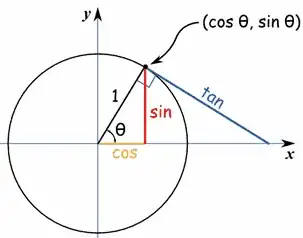
If you draw the unit circle (the circle of radius $1$ centered at the origin) in the $XY$-plane, and you start at $0$ radians (i.e., the positive $x$-axis), as you increase radians to, say, $\frac{\pi}{6}$ (by moving counterclockwise), $\cos{\frac{\pi}{6}}$ represents the $x$-value of $(x,y)$ coordinate on the unit circle that intersects with the line from the origin that forms $\frac{\pi}{6}$ radians with the $x$-axis. Similarly, $\sin{\frac{\pi}{6}}$ represents the $y$-coordinate of this point.

Here is a picture to accompany my explanation, which I found at this website.

enter image description here

layman
  • 20,819
  • yes this is what I thought, but when I did the math and converted pie/6 to degrees I get 154. So you would think that 154 degrees would be at the 1/2 y value, which it's not? unless I am not seeing it correctly. – Jordan M Nov 02 '14 at 20:04
  • 1
    To convert from radians to degrees, you multiply by $180^\circ/pi$. Thus, $\pi/6$ radians is $$\frac{\pi}{6} \cdot \frac{180^\circ}{\pi} = 30^\circ$$ – N. F. Taussig Nov 02 '14 at 20:06
  • @JordanM Actually, I think you converted from radians to degrees wrong. If you have $\frac{\pi}{6}$ radians, to convert this to degrees, you need to multiply by $\frac{180^{\circ}}{\pi}$, which gives you $\frac{180^{\circ}}{6} = 30^{\circ}$. – layman Nov 02 '14 at 20:06
  • 1
    Ah, you know what I was looking at (7π/6) which is -1/2. Which kind of makes sense that it too would be at 210 (I was wrong about the 154 as well) degrees. Thanks for the help, I def understand it better now. – Jordan M Nov 02 '14 at 20:09
0

A different way to look at it is about 1) triangles When you draw a right triangle let's say a 30-60-90 triangle and the angle theta is on the 30 degrees,

we know that if the hypotenuse is 2, then the other side lengths are 1 and $\sqrt3$ and we look from the position of the angle and say that : sin= $\frac{opposite}{hypotenuse}$ and csc is reciprocal of that cos= $\frac{adjacent}{hypotenuse}$ and sec is reciprocal of that tan= $\frac{sin}{cos}$ and cot is reciprocal of that

Good question!

John Rawls
  • 3,125