Brzozowski's algebraic method is safe as long as you don't have epsilon transitions. It even works if your transitions are labelled by languages not containing the empty word. It may also work if some transitions contain the empty word, as long as you can eliminate them, as in the example below:
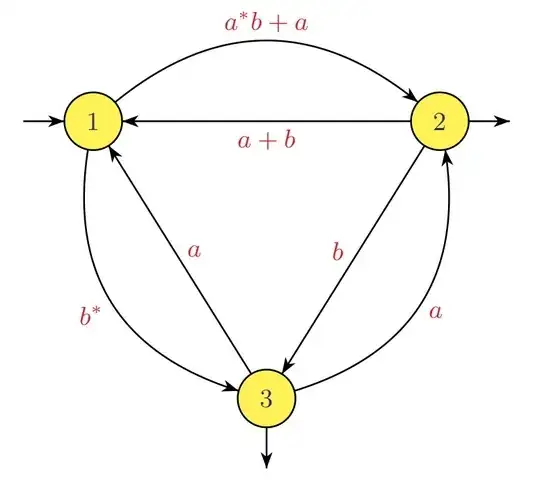
the system can be written as
\begin{align*}
X_1 &= (a^*b + a)X_2 + b^*X_3 \\
X_2 &= (a+b)X_1 + bX_3 + 1 \\
X_3 &= aX_1 + aX_2 + 1
\end{align*}
Replacing $X_3$ by $aX_1 + aX_2 + 1$, and observing that $a + b^*a =
b^*a$, we obtain the equivalent system
\begin{align*}
X_1 &= (a^*b + a)X_2 + b^*(aX_1 + aX_2 + 1) = b^*aX_1 + (a^*b + b^*a)X_2 + b^* \\
X_2 &= (a+b)X_1 + b(aX_1 + aX_2 + 1) + 1 = (a + b + ba)X_1 + baX_2 + b + 1\\
X_3 &= aX_1 + aX_2 + 1
\end{align*}
We deduce from the second equation
$$
X_2 = (ba)^*((a + b + ba)X_1 + b + 1)
$$
and replacing $X_2$ by its value in the first equation, we obtain
\begin{align*}
X_1 &= b^*aX_1 + (a^*b + b^*a)(ba)^*((a + b + ba)X_1 + b + 1) + b^*\\
&= (b^*a + (a^*b + b^*a)(ba)^*(a + b + ba))X_1 + (a^*b +
b^*a)(ba)^*(b + 1) + b^*
\end{align*}
Finally, the language recognised by the automaton is
$$
X_1 = \bigl(b^*a + (a^*b + b^*a)(ba)^*(a + b + ba)\bigr)^*[(a^*b +
b^*a)(ba)^*(b + 1) + b^*]
$$
since $1$ is the unique initial state.
Now, if you want to implement this algorithm, you may end up with more complicated regular expressions. For instance, the sentence "observing that $a + b^*a = b^*a$" might be difficult to implement. Other useful simplifications
like $a^* + 1 = a^*$ or even $K + K = K$ or $K + L = L + K$, where $K$ and $L$ are regular expressions, are also not easy to implement and require more sophisticated rewriting systems.


