I'm trying to link Combinational Logic Circuits ( computers based on logical gates only ) with everything I have learned recently in Theory of Computation.
I was wondering whether combinational logic circuits can implement computations in the same way finite state machines can. They seem radically different :
Finite State Machines, however, have a well-defined memory in the form of the states that it can be in. Combinational logic circuits, however, don't have a well-defined memory so to implement algorithms that need memory they kinda use some weird method of serial connection ( see how $C_{out}$ of previous adder is connected to $C_{in}$ of current adder in the image bellow ) .
However radically different might seem, they both seems to be doing computations. For instance, both can implement an algorithm for binary addition ( and even binary multiplication ) however different those implementations might be :
FSM :
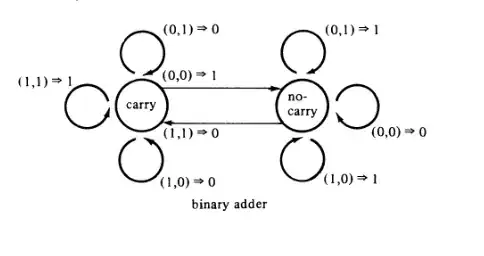
Combinational Logic Circuit ( C, as in $C_{in}$ and $C_{out}$, stands for Carry ) :
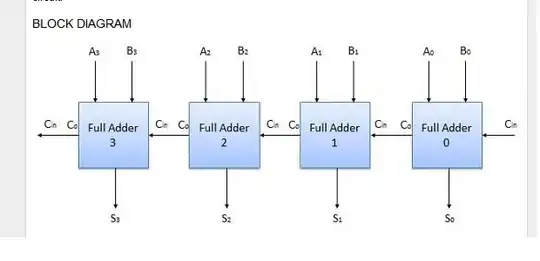
I'm even thinking ( although still very uncertain ) that we can convert every FSM into a corresponding Combinational Logic Circuit.
So, i'm asking myself :
Can Combinational Logic Circuits also be considered a instantaneous kind of model of computation ? Can we apply all concepts we learn in Computability Theory and Computational Complexity Theory, like space complexity and computability, to it ?
On one hand, it seems like they don't fit as a model of computation because they don't have elementary operations ( like reading/writing of a tape, function reduction, steps on the proof search of logical programming paradigma ), they implement their computations instantaneously.
But on the other hand, they seem to be fit as a model of computation because we can model all kinds of computation with them ( binary addition is one example ), and they can be viewed abstractly ( by only focusing on the truth-tables and the logical gates and forgetting about the physical circuit that might implement it ).
So, what do you guys think ?
Also, if it can indeed be considered as a (instantaneous kind of ) model of computation, do you guys have any example of other similar ( also a instantaneous kind of ) model of computation ?
Thanks a lot in advance


