It sometimes helps to start by seeing what an algorithm does, rather than immediately jumping to computing the timing. In your case, you're generating a preorder traversal of a binary tree:
visit (node x)                // x is the root node of the tree being visited
   if x exists
      print the value in x
      visit (x's left subtree)
      visit (x's right subtree)
For example, consider this binary tree:
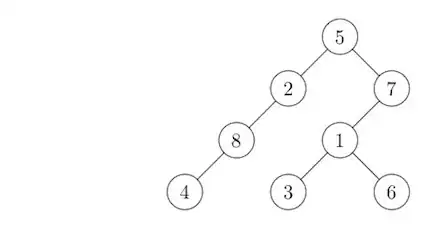
Starting at the root, we print its value, $5$, and then recursively visit the left subtree (the $2, 8, 4$ piece). The root of that subtree is the $2$ node, so that would be printed next. Continuing this way, we print $5, 2, 8, 4$ and backtrack from the $4$ node to the $8$ node, continuing until we find a right subtree to visit, namely the right subtree of the $5$ node. We then visit the $7, 1, 3, 6$ subtree, from left to right at each subtree. The traversal will then be
$$
5\quad2\quad8\quad4\quad7\quad1\quad3\quad6
$$
Now that we see what the algorithm does, let's see how long it takes. There are two important parts: printing the node values and then recursively printing the values in the left and right subtrees. For a tree with $n$ nodes we'll print $n$ values. We get to each of these print statements as part of a function call, so there will also be $n$ function calls. The total amount of work done, then will be $2n$ so $T(n)=\Theta(n)$. Note that the timing will not depend on the shape of the tree, only on the number of nodes in the tree.


