1

I'm so bad at solving the problem of the type:

"If $A$ is an NP-complete problem, $B$ is reducible to $A$, then $B$ is..."

That I have to come here and ask these silly questions each and every time I encounter them.

Is there a good way of using the Venn Diagram shown below to tackle these kind of problem? enter image description here
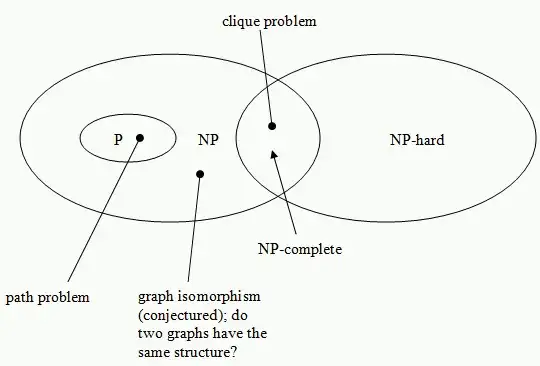
For example, how can I prove that If $A$ is an NP-complete problem, $B$ is reducible to $A$, then $B$ can be NP-hard using the above diagram?

If not possible, what would be another way to drill this into my head?

lucasoliveira
  • 144
  • 1
  • 11
Olórin
  • 859
  • 2
  • 12
  • 22

2 Answers2

1

As Raphael said the definitions are important, especially if you try to create proofs. These definitions are not always captured in the Venn diagram.

The definition of NP-complete is not made clear from the diagram and will not help you to reason about

"If A is an NP-complete problem, $B$ is reducible to $A$, then $B$ is...".

You cannot see from the diagram that this must mean that $B$ is NP.

To answer your question if it is not possible how you will be able to drill it into your head is much more complicated. But again the first step needs to be the definitions.

If you know that NP-completeness implies two properties of $A$ by definition, then you can take the next step.

What does $B$ reducible to $A$ means when regarding these two properties. Do the properties of $A$ tell anything about $B$?

The second property says that any problem in NP reduces to $A$ in polynomial time. So if $B$ reduce to $A$ in polynomial time then $B$ is in NP.

snorberhuis
  • 241
  • 2
  • 4
1

The Venn diagram doesn't help very much.

Let's take your example of "If A is an NP complete problem, B is reducible to A, then B is..." NP-completeness tells you that everything in NP is reducible to A but that's not the question you're trying to solve. The question you're trying to solve is the converse: whether everything reducible to A is in NP. (It happens that it is but that's a theorem, not something that you can see immediately from the definitions.)

To use an analogy, your Venn diagram tells you that every elephant has four legs but you're trying to determine whether everything that has four legs is an elephant.

David Richerby
  • 82,470
  • 26
  • 145
  • 239