4

If P = NP, why does P = NP also then equal NP-Complete?

I.e. Why would it then be the case that P = NP = NP-Complete?

Assuming P != NP , there were problems in NP not in NP - Complete. When P = NP, all NP problems are actually now P.

Shouldn't there still be P = NP problems not in NP - Complete?
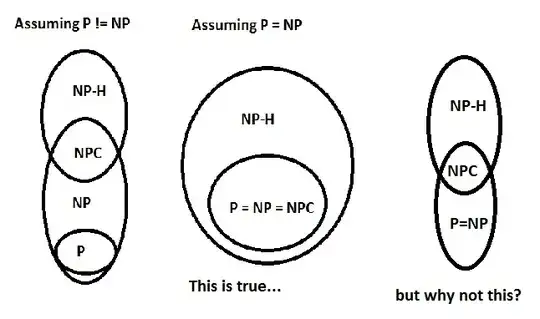
enter image description here

Raphael
  • 73,212
  • 30
  • 182
  • 400
LazerSharks
  • 141
  • 1
  • 5

1 Answers1

4

If $P=NP$ then every non-trivial language $L$ is NP-hard, where non-trivial means that $L$ is neither the empty language nor the language of all words. This follows immediately from the definition of NP-hardness (exercise!). In particular, every non-trivial language in NP is NP-hard, and so NP equals NPC plus the two trivial languages.

Yuval Filmus
  • 280,205
  • 27
  • 317
  • 514