So I've been trying to crack this for a long time and almost feel like I am going in loops about this question.
Given the following NFA:
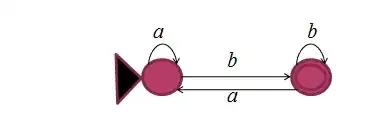
Using the GNFA algorithm get the regular expression.
I understand that you would have the following for the first step(adding empty states):

The next step would be removing the state [q1] I would get:
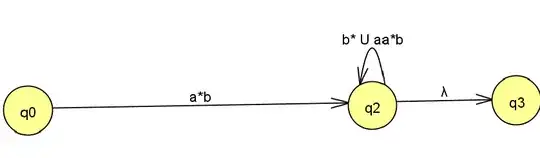
Finally removing [q2] would get:
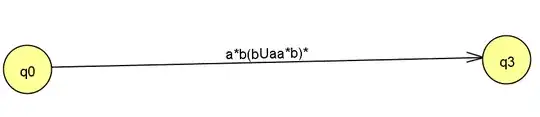
However the answers others have got is: $(a \cup bb^*a)^*bb^*$ Which does not make sense as I got, $a^*b(b \cup aa^*b)^*$? A GNFA(generalised nondeterministic finite automaton) is described as follows:
A GNFA is similar to an NFA but must obey certain rules:
- It has only one accept state
- The initial state has no transitions coming into it
- The accept state has no transitions coming out from it
- A transition can denote any regular expression, rather than just a symbol from the alphabet Note that a symbol is a kind of regular expression.
Furthermore, We may convert an NFA into a GNFA as follows:
- Add a new start state with an ε-transition to the old start state
- Add a new accept state with ε-transitions from the old accept states
- If arrows have multiple labels, or if there are multiple arrows between two states, replace them with the union (or) of those labels


