It seems you want to make the IV secret for security purposes, in direct opposition to common knowledge and NIST recommendation that non secret keying material (such as a non-secret initialization vector) be... non secret.
So that goes against some of the wisdom espoused a few years ago by Bart Preneel in this video, which says that IVs should be kept secret. Note: I don't know how well known or trustworthy he is, but the video was linked to me a while back by someone I trust. – Nate Diamond
Starting with the assumption that "you should use a random and secret IV" from the video in your comment of a lecture by Bart Preneel in March of 2012, referencing a paper from 1998, we need to see why using a non secret IV is a problem, and what the solution is.
The problem with a non secret IV is padding attacks, attacks on implementations, and the possibility of modifying the IV if the plaintext is known, in order to change the decrypted plaintext. These include chosen ciphertext attacks and adaptive chosen ciphertext attacks.
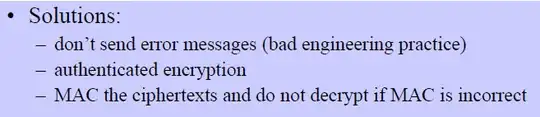
The actual solution to this problem is message authentication, not making the IV secret. A secret IV really only protects the first block. Message authentication protects the entire message. Message authentication can be done through HMAC on the ciphertext, or by use of an authenticated encryption mode.
The first modification in your question allows a new attack, as shown by Mikero. The second modification, I believe you do not even need to decrypt EIV to access the message, as the ciphertext of $IV1 \oplus IV2$ is now the IV for the actual message. The additional work brings no extra security, you can instead use a pseudorandom block for the first block, and ignore it after decryption if you want it to work that way.
To answer the question. Part 1: no it is not safe. Part 2: yes it is safe, but not helpful. Use a MAC or authenticated mode instead of trying to solve an IV problem that already has a solution. This image is directly from the video you referenced: