A de Bruijn Sequence, as defined in N.G. de Bruijn's A combinatorial problem, Proc. K. Ned. Akad. Wet., vol. 49, pp 758-764, 1946 (with attribution to Ir. K. Posthumus) is
an ordered cycle of $2^n$ digits 0 or 1, such that the $2^n$ possible ordered sets of $n$ consecutive digits of that cycle are all different.
The example given for $n=3$ is the sequence 00010111, yielding sets 000, 001, 010, 101, 011, 111, 110, 100.
Given that, a de Bruijn Sequence of length $2^n$ is obtained from any m-sequence of length $2^n-1$ (that is, the cyclic output of a LFSR with a primitive polynomial of degree $n$ starting from a non-zero state) by inserting a single 0 in the single subsequence with $n-1$ consecutive 0.
Update per comment: We can implement a circuit that outputs a de Bruijn Sequence of length $2^n$ using $n$ D-type flip-flops connected as for a maximal-length Fibonacci LFSR with $n$ stages, by adding an additional XOR term equal to the NOR of the outputs of the $n-1$ flip-flops on the feedback's side. In the following drawing (which outputs the example sequence above), the added gates are NOR1 and XOR2.
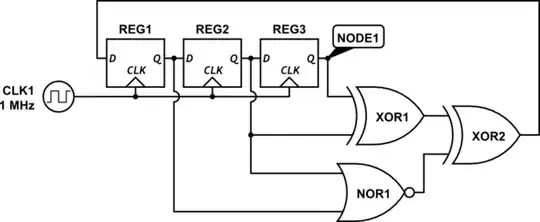
Note 0: When the number of stages $n$ gets large, the NOR gate with $n-1$ inputs gets annoying; one can trade this for a $\lceil\log_2(n)\rceil$-bit counter with reset, counting the number of consecutive zeroes in the output, giving a $1$ when reaching $n-1$ consecutive zeroes, and that output the additional XOR term.
Note 1: A de Bruijn generator is used in the paper only for the control generator of the ASG, deciding which of the other two are clocked. It would be questionable to also use a de Bruijn generator for any of the other two generators: notice that if the control generator has $c$ bits, a slave generator $x$ bits, and both are de Bruijn, the overall period of the slave's output is $2^{\max(c,x+1)}$, rather than $2^c\cdot(2^x-1)$ when the slave is a maximal-length LFSR.
Note 2: I do not see why the ASG's security would be weakened if the control generator was a maximal-length LFSR rather than a de Bruijn generator, with both slaves maximal-length LFSRs, provided $\gcd(2^{c-1}-1,2^x-1)$ is small [as well as $\gcd(2^x-1,2^y-1)$], where $c$ (resp. $x$, $y$) are the number of bits of the control generator (resp. the slave generator clocked when the control generator outputs $0$, the other slave generator). The original paper hints at another paper (submitted to IEEE Transactions on Information Theory, but I could not locate it) covering the case of maximal-length LFSR as control generator. It also seems to be the case in this article on the ASG, and some of its references.
Late addition: This is also easy in software. Assume $x^\mathtt n+x^\mathtt k+1$ is a primitive trinomial over $GF(2)$ (suitable constants $\mathtt n$ and $\mathtt k$ can be obtained from Jörg Arndt's Complete list of primitive trinomials over GF(2) up to degree 400). If x is an unsigned integer variable at least $\mathtt n$ bits wide, then the C expression
x = ((((x>>k)^x)&1)<<(n-1))|(x>>1);
readily implements a LFSR with period $2^\mathtt n-1$ (when starting from any positive x less than $2^\mathtt n$). We can change this to
x = ((((x>>k)^x^!(x>>1))&1)<<(n-1))|(x>>1);
which implements a NLFSR with period $2^\mathtt n$ (when starting from any non-negative x less than $2^\mathtt n$).


