9

Is hot glue suitable for FDM printing, or some process similar to it?

I think it has all of the required properties, and could produce a flexible transluscent print. It's cheap, hotends are cheap, and the technology has been around for a while.

I couldn't find any examples or anyone talking about such a material for use, on here or the general Internet. I wonder if there are tradeoffs or challenges that make it not worth pursuing.

YetAnotherRandomUser
  • 1,233
  • 3
  • 17
  • 27
  • Because here are only answers with the mindset of "don't do it, because it doesn't sound it could work, but nobody knows it for sure.": If you are interested in this, then try to do it. Even a failure and researching the reasons why it cannot work with evidence is something good. – Horitsu Jul 24 '18 at 05:05
  • 1
    i've seen these on youtube. the prints aren't great, but they resemble the model... – dandavis Jul 26 '18 at 18:28
  • 1
    Have any of these answers answered your question? – Davo Jan 15 '19 at 17:49
  • 1
    @Horitsu - I can't see what the problem is... this question has been highly voted and received four (fairly comprehensive) answers. The site is only as good as the community around it. Maybe you should contribute a bit more, if you feel that the site lacks good answers? – Greenonline Apr 13 '24 at 14:20
  • @Greenonline this was 6 years ago (3d printing was not new anymore but also far away from the knowladge of today), and to the exact time there were way less answers with less value. and yes i just wanted to encourage somebody to do another research branch on this topic. Sorry for encouraging others, i will not do it anymore, ok? – Horitsu Sep 19 '24 at 09:00
  • @Horitsu Please do encourage people! I recently did the same on a question if something could be printed tilted. Just try and report, you can receive more accurate answers to improve. I don't think the comment prior to yours was meant negatively. Good to point out the time frame, this might have been missed! – 0scar Sep 19 '24 at 12:42

4 Answers4

5

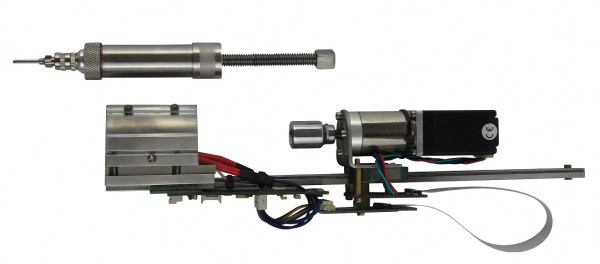
Yes, we have Hyrel users who print with Hot Melt Adhesive 3796 from 3M (essentially a high performance hot glue) with our Krakatoa series print heads.

Hyrel3D Krakatoa series, KRA print head

These heads don't print with filament; the user fills a metal reservoir with paste, gel, or even powder or granules, loads the reservoir onto the head, loads the head onto the printer, applies heat if necessary (some models up to 250C), and then prints the gcode with positive displacement. The KR2 is like the KRA above, but it is made specifically for higher temperature, higher viscosity materials, with tighter tolerances and multiple gaskets.

I have used this model head to print materials including hot glue, polycaprolactone, porcelain, vasoline, toothpaste, plasticine, and metal clays.

Watch Hyrel3D KR2 and TAM Overview for an overview of this head.

Note: I sell this equipment, and have used it since 2012.

Greenonline
  • 6,748
  • 8
  • 40
  • 68
Davo
  • 2,440
  • 1
  • 14
  • 28
4

You could mount a hot glue gun to a 3D positioning frame, but you would immediately notice the following:

  • Hot glue sticks are fat, so you lose a lot of precision for each feed/retract increment. I.e., it's a lot harder to get precise feeds with a fat stick because the stick size is so much larger than the nozzle.
  • Hot glue sticks are short, so you would to create a filament to spool the stuff or come up with a glue stick feeder.
  • Hot glue melts at 120 °C and common plastics such as nylon melt at much higher temperatures. So hot glue would make an AWFUL structural part like a stepper mount. Even PLA barely deals with stepper temperatures. Note that temperature tolerance is irrelevant for costume parts.
  • Hot glue is soft, which makes it a great glue, but not very stiff for, say, making parts for a 3D printer. However, the parts might be fine for use only in costumes, etc.

But, if you then used your 3D glue printer to dispense glue for gluing stuff together, well...that might be valuable. :D

OyaMist
  • 489
  • 2
  • 6
2

If the user, TheSmasherOr (who suggested the edit) posts their own answer, then this wiki answer can be deleted


From this (rejected) suggested edit:

There have been some new and interesting discoveries by Stefan Hermann on this subject; it seems that Hot Melt EVA Plastic can indeed be turned into a sort of Filament and used inside a 3d printer. This filament has to be oiled after melting as to not stick to itself and everything it touches.

After all of the conditions are met though it can be perfectly good to use in FDM 3D printers to make what you would normally make using one. although it is quite difficult to bridge and make overhangs due to the goopy nature of EVA.

More on this topic can be found in this ~19 minute video by Stefan Hermann of the CNC Kitchen YouTube channel:

Greenonline
  • 6,748
  • 8
  • 40
  • 68
0

I think not. Unless you intend to make a very special printer that feeds on glue stick, you must make filament from it. Should be doable.

But my experience with cold hot glue, is that it is not very durable. It's a bit elastic but nothing like elastic filament. It breaks instead. So when you have your filament, I think you will have a bit of trouble handling it, feeding it into the printer etc. If you, for instance, clog the nozzle the slightest, the extruder will tear the filament to shreds very quickly.

Gunslinger
  • 702
  • 5
  • 12