4

Currently I am using a 12 volts, 20 amperes power supply (Model S-240-12)
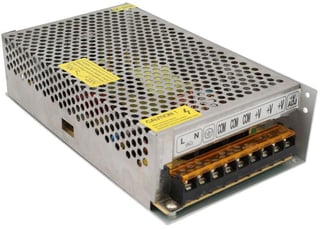
enter image description here

The stepper motors and the extruder need 5 amp, and the heated bed build plate needs 11 amp.

enter image description here

Technically you only need to use a 12 Volts, 16 amperes power supply, but I understand that you use the one with 20 amp because pulse currents from extruders and stepper motors can be stressful to supplies loaded to the max, so for reliability and performance, it is better to use a supply rated for 25% more than you need

In the place where I buy the spare parts for my 3d printer they also sell 12 V power supplies capable of delivering 25 amp and 30 amp and they told me that if I use those ones you are going to be able to speed up the heating of the heated bed. Is that true? I understand that the heated bed is only going to take the 11 amp that it needs so is not going to make any difference to use power supplies capable of delivering more current

Nau
  • 303
  • 3
  • 11

6 Answers6

7

Changing the PSU with one with a higher amperage will not make the bed heat up any faster unless the PSU is underrated for the amperage required and the voltage is dropping as a result of the load. This can be checked by measuring the output voltage with a multimeter (when the PSU is loaded e.g. by a heating heat bed). In this case, the PSU has a marginal higher Amperage than the printer consumes (even has some room for the over-voltage; under the assumption that it is a good working PSU). Increasing the voltage will decrease the heat up time. There is a screw next to the 12 V connectors that can change the output voltage of the PSU. Usually, it is safe to increase the voltage up to 14 V, but that depends on your whole setup (and 14 V is applied to the whole setup, increasing the current for all parts, including your printer controller board, this board must be rated for the 14 V). Please do check the stability of the voltage during load.

Although it can be done, it is not something I used. What is an extra minute on a print of several hours?

You can do the math: say the heat bed has a resistance of 1.2 Ω. We only need two formulas:

  • $U=R\times I$ - potential Difference U is Resistance R times Current I
  • $P=U\times I=I^2\times R=\frac {U^2} R$. The power P of an item the potential difference times the current through the item.
  • at 12 V that will draw 10 Amps (12 V / 1.2 Ω) resulting in a 120 Watt bed: $P= 12^2 \text V \times 10^2 \text A= {10^2 \text A}\times {1.2\ \Omega}=\frac{12^2 \text V} {1.2\ \Omega} $),
  • at 14 V that same bed will draw 11.7 Amps (14 V / 1.2 Ω) resulting in a 163.3 Watt bed.

Use at your own risk!

What you could do to decrease time to heat the bed without changing the PSU or the voltage is to insulate the bottom of the heat bed with heat bed cotton sheets or cork (placemats from IKEA ;) ), put a sheet of cork onto the heat bed before printing and start heating the bed through the LCD panel of the printer or any attached printer controller programs over USB prior to printing.

Trish
  • 22,760
  • 13
  • 53
  • 106
0scar
  • 37,708
  • 12
  • 68
  • 156
1

A more powerful PSU only would solve the problem in two cases: Either your PSU is anemic and underpowered in the first place, or you want you'd separate the bed's power supply from the rest of the machine - by using a higher Voltage for the bed. This would however need you to regulate the heating by having the board control not the bed directly but, control a (Normally Open for safety!) MOSFET, which in turn throttles the power to the bed.

In that case, you can use the resistance R of the bed with whatever voltage your alternate PSU provides to get the power that is turned into heat from the bed using $P_\text{bed}=\frac{U_\text{bed}^2}{R_\text{bed}}$. Our MOSFET can regulate the power that is turned into heat in the bed as it is a Variable Resistance: The total potential differential stays the same, but the voltage available to the heated bed is governed by the resistance of the bed and the MOSFET's resistance. Since the two are in line, they have the same Current flowing through them:

$$U_\text{supply}=U_\text{bed}+U_\text{MOSFET}=I_\text{total}\times(R_\text{bed}+R_\text{MOSFET})$$

That results in what is commonly called a Voltage Divider: the voltage that is available for the bed comes from a derivate of that: $$U_\text{bed}=U_\text{supply}(\frac{R_\text{bed}}{R_\text{MOSFET}+R_\text{bed}})$$

Why the hazzle?

Often, a board also might have a potentiometer for each power exit, and these are generally nothing else but variable resistances - and give us the same effect as a MOSFET for controlling the voltage available to a bed. If available, turning the Bed-Potentiometer a tiny bit will provide just a little higher voltage to the bed and allow slightly faster heating.

Trish
  • 22,760
  • 13
  • 53
  • 106
-1

May I recommend an alternative approach, which does not require any change of hardware? The time required to heat the bed is not huge, so either via USB from your computer or from the front panel, instruct your printer to heat the bed first, while you're setting everything else up (loading gcode files, changing filaments, or whatever). This way tasks are completed in parallel.

Carl Witthoft
  • 3,073
  • 1
  • 12
  • 18
-1

I glued (high temperature silicone) an isolation (cork 5-8mm) on the bottom side of my heatbed. It avoids loosing heat thru the bottom side. Effect: minimal faster heatup and less energy consuming over the time of use.

Horitsu
  • 668
  • 4
  • 16
-3

Also a thing that helped to preheat faster: make sure no draft is cooling down bed. It sounds obvious but cold-end fan and window draft, even psu fan draft can contribute significantly to preheat time. Eliminating draft source changed bed preheat time from 10 down to 5 minutes in my case...

Const
  • 101
  • 1
-4

I hate to sound like the Toolman Tayler from that old TV show. "But, it comes down to More Power!" Power is the ability to do work (move a mass certain distance) within certain amount of time. Power = mass x distance x Time.

It can also be expressed in electrical terms, as the ability to heat something within certain amount of time. Power = Voltage x Current

Since most systems have a fixed voltage, it is still possible to increase power by increasing the current, since,

Voltage = Resistance x Current,

And Power = Voltage x Current,

So, Power = (Resistance x Current) x Current.

So by switching a power supply with the same voltage, but higher current, it will provide additional power to the system. The larger current available would be able to flow through the heating elements, heating them up faster.

However the caveat will be the amount of heat dissipation in the system, the large surface of the bed, will carry away enough of the heat due to air convection, that it may not make much of a difference. Or perhaps the heating element may not handle the larger amount of current and burn out.

It would be worth testing it out, in my humble opinion. Hopefully without causing a fire somewhere. :-)