There are many possible ways to encode data into a quantum neural network (QNN). In one of the first papers to suggest the use of variational circuits to classify data [1], the authors suggest the following general architecture for a QNN:
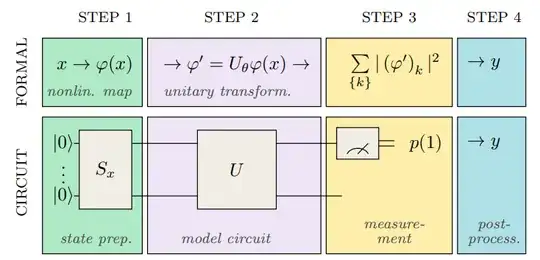
The circuit starts with the $|0\rangle$ state, encodes a data point $\textbf{x}$ using a circuit $S_\textbf{x}$, and transforms it using a parametrized unitary $U(\theta)$ (using rotations to encode parameters). The result of the classification is then given by the measurement of one of the qubit.
Now, what does the circuit $S_\textbf{x}$ look like? You have several possibilities, discussed and compared in a recent paper [2]. The two main ones are amplitude encoding and angle encoding.
Amplitude encoding (also called wavefunction encoding) consists in the following transformation:
$$
S_\textbf{x}|0\rangle=\frac{1}{||\textbf{x}||}\sum_{i=1}^{2^n} x_i |i\rangle
$$
where each $x_i$ is a feature (component) of your data point $\textbf{x}$, and $\{|i\rangle\}$ is a basis of your $n$-qubit space (like $|0..00\rangle, |0..01\rangle,...,|1..11\rangle$). The advantage of this encoding is that you can store $2^n$ features using only $n$ qubits (so in the IBM case, 32 features). The disadvantage is that in general this circuit $S_{\textbf{x}}$ will have a depth of $O(2^n)$ and be very hard to construct.
Angle encoding (also called qubit encoding) consists in the following transformation:
$$
S_{\textbf{x}} |0\rangle=\bigotimes_{i=1}^n \cos(x_i)|0\rangle + \sin(x_i)|1\rangle.
$$
It can be constructed using a single rotation with angle $x_i$ (normalized to be in $[-\pi,\pi]$) for each qubit, and can therefore encode $n$ features with $n$ qubits (so in your case only $5$ features). But it can be very easily constructed and has a depth of only 1. Note that there is a slight variant of this encoding, referred as dense angle encoding, that can encode $2n$ features in $n$ qubits
$$
S_{\textbf{x}} |0\rangle=\bigotimes_{i=1}^n \cos(x_{2i-1})|0\rangle + e^{ix_{2i}}\sin(x_{2i-1})|1\rangle.
$$
by using a phase gate after each rotation.
The question of what encoding you should use and which one can provide a quantum advantage is still an open research problem, since for the moment, there's no proof or empirical evidence that QNN are useful at all for machine learning tasks.
[1] Maria Schuld, Alex Bocharov, Krysta Svore and Nathan Wiebe, Circuit-centric quantum classifiers, 2018
[2] Ryan LaRose and Brian Coyle, Robust data encodings for quantum classifiers, 2020


