This answer focuses on identifying families of solutions to the problem described in the question.
I've made two provisional conjectures in order to make progress with the problem:
The result can be stated for three $2n$-gons rather than two $n$-gons and one $2n$-gon.
Solutions have mirror symmetry. Or equivalently, in any solution there are two pairs of $2n$-gons which have the same degree of overlap. [This turns out to be false - see 'Solution family 5' below. However, this condition is assumed in Solution families 1-4.]
[Continuation 6: in an overhaul of the notation I've halved $\phi$ and doubled $m$ so that $m$ is always an integer.]
If we define the degree of overlap, $j$, between two $2n$-gons $(n>3)$ as the number of edges of one that lie wholly inside the other, then $1 < j < n$.
If
$$
\phi = \frac{\pi}{2n}
$$
is half the angle subtended at the centre of the $2n$-gon by one of its edges, then the distance between the centres of two overlapping $2n$-gons is
$$
D_{jn} = 2\cos{j\phi}
$$
Consider a $2n$-gon P which overlaps a $2n$-gon O with degree $j$. Now bring in a third $2n$-gon, Q, which also overlaps O with degree $j$ but is rotated about the centre of O by an angle $m\phi$ with respect to P, where $m$ is an integer.
The distance between the centres of P and Q, which I'll denote by $D_{kn}$ for a reason that will become apparent, is
$$
D_{kn} = 2D_{jn}\sin{\tfrac{m}{2}\phi} = 4\cos{j\phi} \, \sin{\tfrac{m}{2}\phi}
$$
We now demand that P and Q should overlap by an integer degree, $k$, so that
$$
D_{kn} = 2\cos{k\phi}
$$
This will ensure that all points of intersection coincide with vertices of the intersecting polygons, and thus provide a configuration satisfying the requirements of the question (with the proviso that the condition does not guarantee that there is a common area of overlap shared by all three polygons).
We have omitted mention of the orientation of the polygons, but it is easily shown that this is always such as to achieve the desired overlap.
Combining the two expressions for $D_{kn}$ gives the condition
$$
2\cos{j\phi}\, \sin{\tfrac{m}{2}\phi} = \cos{k\phi}
$$
or (since $n\phi=\pi/2$)
$$
2\cos{j\phi}\, \cos{(n-\tfrac{m}{2})\phi} = \cos{k\phi} \tag{1}
$$
The configurations we seek are solutions of this equation for integer $n$, $j$, $k$ and $m$.
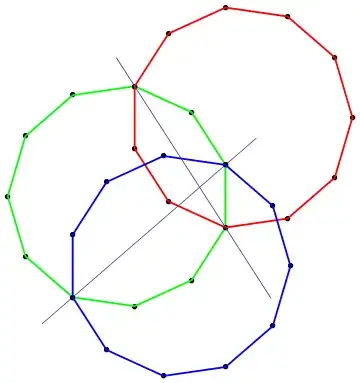
In the first example in the question $n = 12, j = 8, k = 6, m = 12$.
In the second example $n = 15, j = 6, k = 10, m = 6$.
[Continuation 6: for solutions under the constraint of conjecture 2, $m$ is always even, but in the more general case $m$ may be odd.]
I'll now throw this open to see if anyone can provide a general solution. It seems likely that $j$, $k$ and $m/2$ must be divisors of $2n$ [this turns out to be incorrect], and I have a hunch that the solution will involve cyclotomic polynomials [this turns out to be correct].
Continuation (1)
I've now identified 3 families of solutions consistent with conjecture 2 (mirror symmetry), all involving angles of 60 degrees. There may be others.
Solution family 1
This family is defined by setting $j=2n/3$. This means that half the angle subtended at the centre of O by its overlapping edges is $\tfrac{\pi}{3}$ radians or 60 degrees. Since $\cos{\tfrac{\pi}{3}} = \tfrac{1}{2}$ it reduces equation 1 to
$$
\cos{(n-\tfrac{m}{2})\phi} = \cos{k\phi}
$$
so there are solutions with
$$
n-\tfrac{m}{2} = k
$$
(where $\tfrac{m}{2}$ is an integer) subject to $2 \le k \le n-1\,\,$, $1 \le \tfrac{m}{2} \le n-2\,\,$ and $3|n$.
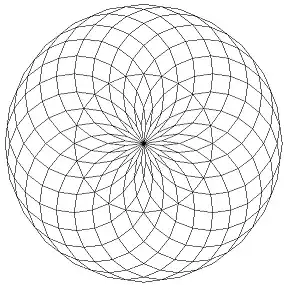
The first example in the question belongs to this family. The complete set of solutions for $n=12$ combine to make this pleasing diagram:
Solution family 2
This family has $m=2n/3$. This makes $\cos{(n-\tfrac{m}{2})\phi}=\cos{(\pi/3)} = \tfrac{1}{2}$, which reduces equation 1 to
$$
\cos{j\phi} = \cos{k\phi}
$$
so (given that $j<n$ and $k<n$)
$$
j = k
$$
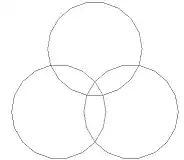
These solutions have threefold rotational symmetry. The only restriction is that $n$ must be divisible by 3. Example ($n=9, j=k=4, m=6$):
Solution family 3
This family is the most interesting of the three, but yields only one solution. It is defined by setting $k=2n/3$ so that $\cos{k\phi}=\cos{\tfrac{\pi}{3}} = \tfrac{1}{2}$. Equation 1 then becomes
$$
2\cos{j\phi}\,\cos{(n-\tfrac{m}{2})\phi} = \tfrac{1}{2}
$$
which may be written in the following equivalent forms:
$$
\cos{(n+\tfrac{m}{2}-j)\phi} + \cos{(n+\tfrac{m}{2}+j)\phi} = -\tfrac{1}{2} \tag{2}
$$
$$
\cos{(n-\tfrac{m}{2}-j)\phi} + \cos{(n-\tfrac{m}{2}+j)\phi} = \tfrac{1}{2} \tag{3}
$$
Solutions to these equations can be found using the following theorem relating the roots $z_i(N)$ of the $N$th cyclotomic polynomial to the Möbius function $\mu(N)$:
$$
\sum_{i=1}^{\varphi(N)} {z_i(N)} = \mu(N)
$$
where $\varphi(N)$ is the Euler totient function (the number of positive integers less than $N$ that are relatively prime to $N$) and $z_i(N)$ are a subset of the $N$th roots of unity.
Taking the real part of both sides and using symmetry this becomes:
$$
\sum_{i=1}^{\varphi(N)/2} { \cos{(p_i(N) \frac{2\pi}{N})} } = \tfrac{1}{2} \mu(N) \tag{4}
$$
where $p_i(N)$ is the $i$th integer which is coprime with $N$.
The Möbius function $\mu(N)$ takes values as follows:
$\mu(N) = 1$ if $N$ is a square-free positive integer with an even number of prime factors.
$\mu(N) = −1$ if $N$ is a square-free positive integer with an odd number of prime factors.
$\mu(N) = 0$ if $N$ has a squared prime factor.
Equation 4 thus provides solutions to equations 2 and 3 if $\varphi(N) = 4$, $\mu(N)$ has the appropriate sign and the cosine arguments are matched.
The first two conditions are true for only two integers:
$N=5$, with $\mu(5)=-1$, $p_1(5) = 1, p_2(5) = 2$
$N=10$, with $\mu(10)=1$, $p_1(10) = 1, p_2(10) = 3$.
We first set $N=5$ and look for solutions to equation 2.
Matching the cosine arguments requires firstly that
$$
2j \frac{\pi}{2n} = (p_2(5)-p_1(5))\frac{2\pi}{5}
$$
from which it follows that
$$
5j = 2n
$$
$n$ must be divisible by 3 to satisfy $k=2n/3$, so the smallest value of $n$ for which solutions are possible is $n=15$, with $k=10$ and $j=6$. All other solutions will be multiples of this one.
Matching the cosine arguments also requires that
$$
(n+\tfrac{m}{2}-j) \frac{\pi}{2n} = p_1(5) \frac{2\pi}{5}
$$
which implies $m=6$.
This is the solution illustrated by the second example in the question.
Setting $N=10$ and looking for solutions to equation 3 yields the same solution.
Continuation (2)
Solution family 4
A fourth family of solutions can be obtained by writing equation 1 as
$$
\cos{(n+\tfrac{m}{2}-j)\phi} + \cos{(n+\tfrac{m}{2}+j)\phi} + \cos{k\phi} = 0 \tag{5}
$$
and viewing this as an instance of equation 4 with $\varphi(N)/2 = 3$ and $\mu(N) = 0$. There are two values of N which satisfy these conditions, $N = 9$ and $N = 18$, which lead to three solutions:
For $N = 9$:
$$
n=9, j=6, k=8, m=2
\\n=9, j=4, k=4, m=6
$$
For $N=18$:
$$
n=9, j=2, k=2, m=6
$$
However, these are not new solutions. The first is a member of family 1 and the last two are members of family 2.
Continuation (3)
Solution family 5
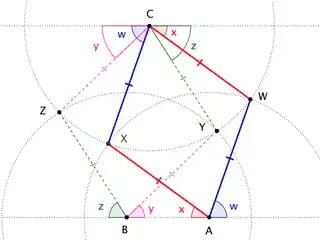
Rotating a $2n$-gon about a vertex by an angle $m\phi$ moves its centre by a distance
$$
2\sin{ \tfrac{m}{2}\phi} = 2\cos{(n-\tfrac{m}{2})\phi} = D_{n-m/2,n}.
$$
If $m$ is even the rotated $2n$-gon thus overlaps the original $2n$-gon with integer degree $n-\tfrac{m}{2}$, and a third $2n$-gon with a different $m$ may overlap both of these, providing another type of solution to the problem.
Solutions of this kind may be constructed for all $n \ge 3$. The diagram below includes the complete set of such solutions for $n=5$. A similar diagram with $n=12$ (but with a centrally placed $2n$-gon of the same size which can only be added when $3|n$) is shown above under Solution family 1.
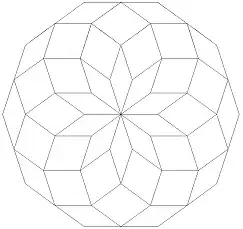
This family of solutions provides exceptions to conjecture 2: not all groups of three $2n$-gons overlapping in this way show mirror symmetry.
Continuation (4)
If we relax the condition set by conjecture 2, allowing solutions without mirror symmetry, we need an additional parameter, $l$, to specify the degree of overlap between O and P (which is now no longer $j$).
The distances between the centres of the three $2n$-gons are now related by the cosine rule:
$$
D_{nk}^2 = D_{nj}^2 + D_{nl}^2 - 2 D_{nj}D_{nl}\cos{m_k\phi},
$$
where a subscript $k$ has been added to $m$ to acknowledge the fact that $j$, $l$ and $k$ can be cycled to generate three equations of this form. These can be written
$$
\\ \cos^2{J} + \cos^2{L} - 2 \cos{J} \cos{L} \cos{M_k} = \cos^2{K}
\\ \cos^2{K} + \cos^2{J} - 2 \cos{K} \cos{J} \cos{M_l} = \cos^2{L}
\\ \cos^2{L} + \cos^2{K} - 2 \cos{L} \cos{K} \cos{M_j} = \cos^2{J}
$$
where
$$
J = j\phi,\, L = l\phi,\, K = k\phi,
\\M_j = m_j\phi,\, M_l = m_l\phi,\, M_k = m_k\phi
$$
The same result in a slightly different form is derived in the answer provided by @marco trevi.
$M_j$, $M_l$ and $M_k$ are the angles of the triangle formed by the centres of the three polygons. Since these sum to $\pi$ we have
$$
m_j + m_l + m_k = 2n
$$
The sine rule gives another set of relations:
$$
\frac{\cos{J}}{\sin{M_j}} = \frac{\cos{L}} {\sin{M_l}} = \frac{\cos{K}}{\sin{M_k}}
$$
In general the $m$ parameters are limited to integer values (as can be seen by considering the symmetry of the overlap between a $2n$-gon and each of its two neighbours). But they are now not necessarily even.

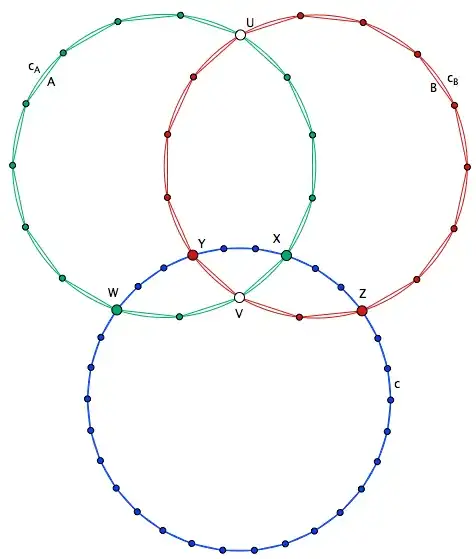


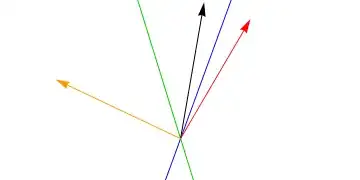

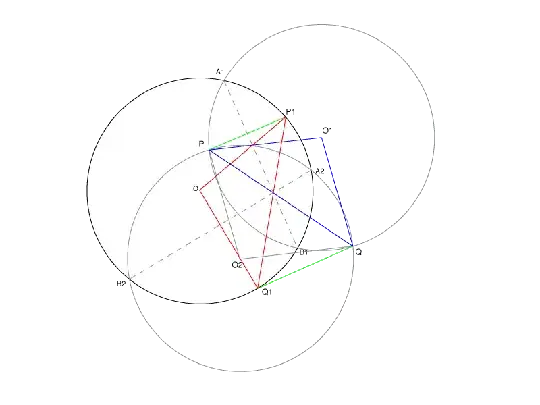
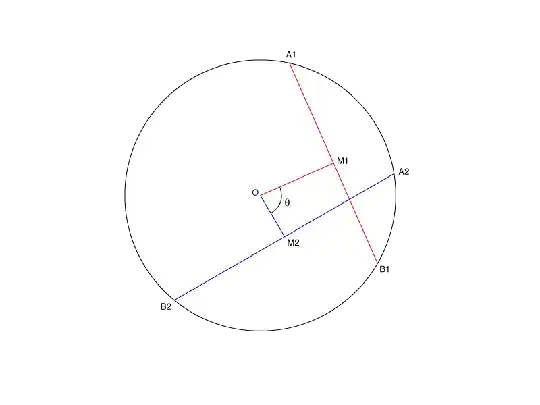 Reflecting $C$ about $\overline{A_1B}_1$ gives another circle $C_1$; doing the same with $\overline{A_2B}_2$ gives a circle $C_2$. These circles might or might not intersect; let's suppose they do. Then they will meet at two points $P$ and $Q$.
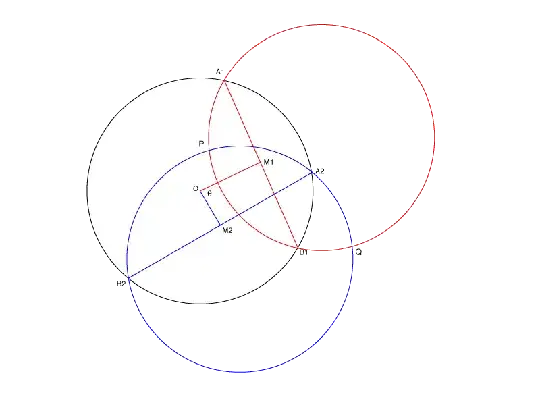 Reflecting $P$ about the two chords, we get two points $P_1$ and $P_2$ which lay on the original circle $C$. Doing the same with $Q$, we get two other points $Q_1$ and $Q_2$. By symmetry, one can see that $\overline{PQ}=\overline{P_1Q}_1=\overline{P_2Q}_2$ and also $P\widehat{O}_1Q=P\widehat{O}_2Q=P_1\widehat{O}Q_1=P_2\widehat{O}Q_2$, where $O_1$ and $O_2$ are the centers of $C_1$ and $C_2$.
Here's the picture for $P_1$ and $Q_1$:
Reflecting $P$ about the two chords, we get two points $P_1$ and $P_2$ which lay on the original circle $C$. Doing the same with $Q$, we get two other points $Q_1$ and $Q_2$. By symmetry, one can see that $\overline{PQ}=\overline{P_1Q}_1=\overline{P_2Q}_2$ and also $P\widehat{O}_1Q=P\widehat{O}_2Q=P_1\widehat{O}Q_1=P_2\widehat{O}Q_2$, where $O_1$ and $O_2$ are the centers of $C_1$ and $C_2$.
Here's the picture for $P_1$ and $Q_1$: