6

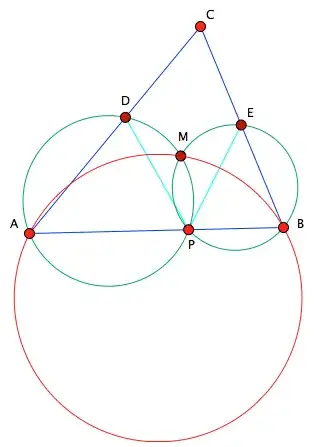
Consider an acute triangle $ABC$ and non-constant(*) point $P$ on $AB$. Take then points $D$ and $E$ on $AC$ and $BC$ respectively such that $\angle DPA=\angle EPB=\angle ACB$. Let $M$ be the intersection point, other than $P$, of the circumcircles of $\triangle APD$ and $\triangle BPE$. Find the locus of $M$

(*)I mean that P is moving on AB

John Bentin
  • 20,004

2 Answers2

5

Hint: $$\angle AMB = \angle AMP + \angle PMB = \angle ADP + \angle PEB =\angle ABC + \angle BAC$$

ir7
  • 6,289
  • How can I use this? Is this a sufficient condition for M to move in a circle that passes through A,B? –  Sep 11 '14 at 19:50
  • So the angle AMB is constant. Does that maybe mean that the circle passing through A,B,M will be also constant or something like that? –  Sep 11 '14 at 19:57
  • @Matheo Yes. Consider $M'$ a different point belonging to the same locus. Then angle $AM'B$ will be equal to angle $AMB$, so $M'$ sits on the circle that circumscribes triangle $AMB$. – ir7 Sep 11 '14 at 20:12
  • @Matheo This is for $P$ on the segment $AB$. If $P$ is not on the segment, then you need to show that $AMB$ is constant equal to $ACB$. – ir7 Sep 11 '14 at 20:43
4

According to my experiments, that locus is a circle through $A$ and $B$.

Figure

MvG
  • 44,006
  • I think only the arc of the red circle which lies on the same side of the line $AB$ as $C$ will be in the locus. – Semiclassical Sep 11 '14 at 13:44
  • @Semiclassical: If you take $P$ on the segment $AB$ you are correct. Locus computation in Cinderella assumed the whole line $AB$, in which case you can get the whole circle. – MvG Sep 11 '14 at 14:52
  • You're quite right. (I let myself be fooled by an implementation error in Geogebra into thinking that only the segment AB would produce a valid intersection.) – Semiclassical Sep 11 '14 at 15:32