I found this statement in one paper I read recently:
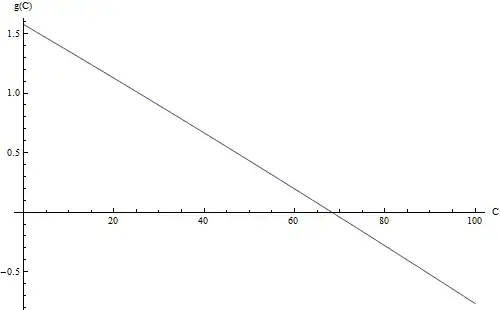
This problem can be solved by finding the zero of functions:
f(B) = -37.5 × C / 1000 - 373.41 × B^(-0.6269) + 9.1256 × Ln(C + B) - 50.029
f(B) = -37.5 × C / 1000 - 373.41 × B^(-0.6269) + 7.3637 × Ln(C + B) - 34.502
f(B) = -37.5 × C / 1000 - 373.41 × B^(-0.6269) + 7.0724 × Ln(C + B) - 29.970
Newton’s method was used to find the zero of these functions.
Here is the link to the PDF (page 6): http://tao.cgu.org.tw/pdf/v174p815.pdf. The other equations in that paper (the ones that form the above equations) are easy to solve, but not sure how the Newton's method was used to solve the three equations above (that paper said they were solved with that method).
I appreciate if someone could explain me if they indeed were solved with Newton's method. If so, an example using one of these equations would be great.
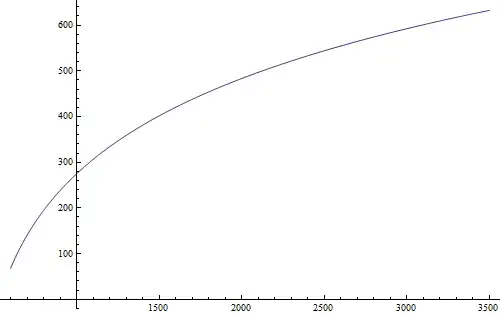
I would like to add a bit more of information that can be useful to make things a bit clearer. The image below shows how C (curves 1, 2 and 3 in the attached image) varies with B (water depth or seafloor in the image):

Basically, the intersection of the gas hydrate stability curves (in the paper I mentioned these are expressed by the logarithmic curves eg. Tst100) and the geothermal gradient profile (in the paper it is expressed as 37.5*B/1000) provides an estimate of the thickness of the GHSZ. The three equations above should solve that (3 different cases as the attached image). I need to find the values of C based on B.
Any help is grateful, thanks in advance,