Let $X$ be a smooth projective curve of genus $g\geq2$ over an algebraically closed field $k$ and denote by $K$ a canonical divisor.
I have some clues about the geometrical interpretation of the Riemann-Roch Theorem for smooth algebraic curves, but also some doubts which I would like to clarify. Recall that the RR formula is $$ h^0(X,\,D)-h^0(X,\,K-D) = d-g+1\,. $$
Assume that $X$ is not hyperelliptic, so that the canonical map is actually a canonical embedding $$ \phi_K : X \to \mathbb{P}^{g-1} \qquad P\mapsto\{ \; s\in H^0(X,\,K) \mid s(P)=0 \; \} $$ giving a preferred realization of the curve inside a $(g-1)$-dimensional projective space.
The key feature of such an embedding is that there is a bijective correspondence between hyperplanes $W\subset \mathbb{P}^{g-1}$ and effective divisors in the linear system $ |K| \cong \mathbb{P}H^0(X,\,K) $.
The picture shows the canonical embedding in $\mathbb{P}^2$ of a non hyperelliptic curve of genus $3$.
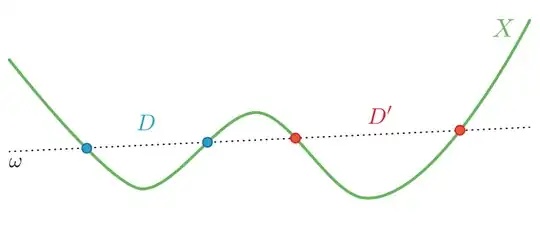
Let $D=\sum_{i=1}^d P_i$ be an effective divisor consisting of $d<g$ distinct points of $X$. We define $$ \phi_K(D) := \operatorname{span}\{\phi_K(P_1), \dots, \phi_K(P_d)\}. $$
The vector space $H^0(X,\,K-D)$ can be interpreted as the space of canonical divisors containing $D$, and here comes my first question:
(1) Is it correct to identify $\mathbb{P}H^0(X,\,K-D)$ with the set of hyperplanes of $\mathbb{P}^{g-1}$ passing through $\phi_K(D)$ ? If so, how can one see it formally?
Let $r(D) := \dim |D|$ denote the dimension of the complete linear series associated to $D$. Further, denote by $D'=K-D$ the residual divisor of degree $d'=2g-2-d$.
If (1) is correct, then it follows that $r(D)$ equals the number of hyperplanes of $\mathbb{P}^{g-1}$ passing through $\phi_K(D')$. Now, notice that the RR can be rewritten as
$$ r(D)=[g-1]-[d' - r(D')] $$
so that we deduce that $r(D')$ counts the number of independent linear relations on the points of $D'$ and we can give the following geometrical interpretation of the Riemann-Roch:
The integer $r(D)$ is the number of hyperplanes passing though $\phi_K(D')$, hence it equals the difference between the dimension $g-1$ of the ambient space and the dimension of the space spanned by the points of $\phi_K(D')$.
Of course my second question is:
(2) Do you agree with this geometrical interpretation?

