11

(a) Given $\epsilon > 0$, show that the unit disc contains finitely many dyadic squares whose total area exceeds $\pi - \epsilon$, and which intersect each other only along their boundaries.

(b) Show that the assertion is false for $\epsilon < \pi / 2$ if we demand that the dyadic squares be disjoint.

(c) Formulate (a) in dimension $m = 3$ and $m \geq 4$.

(d) Do the analysis with squares and discs interchanged. That is, given $\epsilon > 0$ prove that finitely many disjoint discs can be drawn inside the unit square so that the total area of the discs exceeds $1 - \epsilon$.

I have done parts (a) to (b), and at least sketched out the proof for (c), but part (d) is totally eluding me. For a start, I'm not even sure it's true, but since it's given as a problem in a printed book (Real Mathematical Anlsyis, by Pugh), I am inclined to think it is valid.

Does anyone have any suggestions on how to approach this? Or even better, a proof sketch? I've tried a number of different ways, involving suprema, self-similarity, and what have you, but none seems to lead anywhere constructive.

Noldorin
  • 6,788
  • 1
    Here's an idea. (It might be a total dead end, just the first thing that comes to mind.) If you have three mutually tangent circles of radii $r_1, r_2, r_3$ what proportion of the gap between them can you fill with another circle? – Frederick Feb 14 '14 at 23:54
  • @Frederick: Good idea! I considered that quite briefly, but wrote it off as too intricate... now that you mention it, I'll give it a proper go. Thanks. – Noldorin Feb 14 '14 at 23:56
  • 2
    Please edit your question and turn that image into typed text. One point of a Q&A site is for questions being found by searches, which works poorly for images. – MvG Feb 15 '14 at 05:50
  • Someone's already done it, it seems. Thanks @alexwchan! :) – Noldorin Feb 15 '14 at 14:13

2 Answers2

7

Let $a\le 1$ be supremum of all finite disc packing areas in the unit square. Consider the square minus an inscribed disc. Because its boundary is a zero-measure set (or whatever argument also worked for the first part of the problem), it can be exhausted arbitrarily well by finitely many dyadic squares, that is for $\epsilon>0$ we find a finite set of squares such that the squares fill a proportion $1-\epsilon$ of this shape. For each small square find a finite disc filling that fills a proportion of $a-\epsilon$ of their respective area. Then the total area filled by all discs is $$\tag1\frac\pi4+\left(1-\frac\pi 4\right)(1-\epsilon)(a-\epsilon). $$ As $\epsilon\to 0$, the expression in $(1)$ goes $\to a+\frac\pi4(1-a)$ which must be $\le a$. Hence $a=1$.


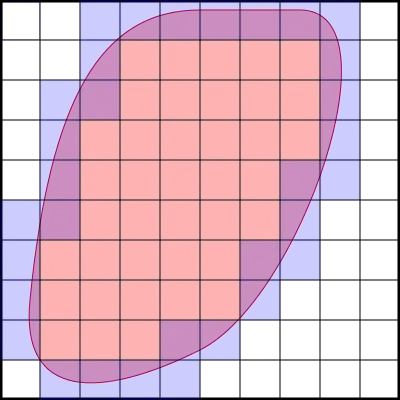
More generally, consider a convex shape $S$ of positive area $A$ inside the unit square. Let $a\le 1$ be the supremum of all subsets of the unit square that can be obtained as disjoint union of finitely many scaled and translated copies of $S$. Then $a=1$. To see this, partition the square into $n\times n$ smaller squares (see picture). There are three types of such small squares: $e$ exterior squares (white in the picture), $i$ interior squares (light red in the image) and $b$ boudary squares (blue/purple). Of course $e+b+i=n^2$ and $\frac1{n^2}i\le A\le \frac1{n^2}(i+b)$. The boundary of $S$ intersects the vertical lines at most $2(n-1)$ times (along the two paths from its top to its bottom) and the same holds for the vertical lines. Every boundary square has at least two such intersection points on its edges and each intersection point belongs to at most four small squares. We conclude that $b\le 8(n-1)$ and hence $ \left|A-\frac{i+b}{n^2}\right|\le \frac b{n^2}<\frac 8n$. If we pick a fiite paking that covers almost $a$ of the unit square (say, it covers $\ge a-\epsilon$), we can put a scaled-down copy of this packing into each of the $e$ "white" squares and, together with the original shape $S$, obtain a finite packing of the unit square that covers at least $$ e\cdot\frac{a-\epsilon}{n^2}+A=\left(1-\frac{i+b}{n^2}\right)(a-\epsilon)+A\ge \left(1-A-\frac 8n\right)(a-\epsilon)+A.$$ As $n\to\infty$ and $\epsilon\to 0$ the right hand side converges to $a+(1-a)A$. As this limit must be $\le a$, we conclude $a=1$.

enter image description here

  • Sorry for being dense, but where did the formula (1) come from? Even if you use an optimal infinite packing for each of the $2^{2n}$ dyadic squares and dyadic squares cover the entire unit square, you cover only the area $\alpha$, which means you did not make any progress. Am I missing something? – Moishe Kohan Feb 15 '14 at 13:35
  • @studiosus I use a scaled down (almost) optimal packing only for those tiny squares that are not coverd by the big disc enscribed ot the big square. – Hagen von Eitzen Feb 15 '14 at 15:04
  • Oh, I missed this part. Nice! – Moishe Kohan Feb 15 '14 at 15:19
  • 1
    I'll be honest, but I don't understand anything here. I think the number of pronouns in the first paragraph probably doesn't help. :/ – Noldorin Feb 15 '14 at 16:33
  • @HagenvonEitzen: I think your use of the inequality $b\le 8(n-1)$ is unnecessary. Please have a look at my question here. Can you please explain why you used the inequality $b\le 8(n-1)$ in your answer. I have proved the theorem without using that inequality. Please tell whether I am missing anything in my proof. Thanks in advance. – lorilori Dec 23 '22 at 08:14
1

As @Frederick suggested, the key ingredient that you need is that the area of the residual set of the Apollonian packing equals zero, see this question and my answer. With this in mind, let's solve Part d. Consider packing on the unit square $Q$ by "dyadic" circles with the fixed denominator $2^n$. To get to the Apollonian packing, also draw horizontal lines through the points of tangency (line will be disjoint from the open disks bounded by the circles), so that, apart from the four corners of $Q$ (I will call them $C_1(n), C_1(n), C_3(n), C_4(n)$), we obtain a subdivision of the unit square into the above dyadic circles and circular triangles with zero angles. The areas of the corners $C_i$ will go to zero as $n\to\infty$, of course. Now, go back to the fixed $n$. Use the Apollonian packing for each of the circular triangles with zero angles. Since the residual set of each such packing has zero measure, we represented $Q$ minus the corners $C_i(n)$, minus measure zero set, as a disjoint union of round disks as required.

Moishe Kohan
  • 111,854
  • 1
    This makes zero sense to me as well, to be frank. I know nothing about measure theory. This question is asked at the end of Chapter 1 of the book, and we haven't even gotten onto limits of functions yet. There are several chapters to go before measure theory. – Noldorin Feb 15 '14 at 16:36