11

I am taking a first course in topology, and I am struggling with simplicial complexes. Specifically the triangulation of subspaces of $ \mathbb{R}^n $ confuses me. If you could help me on the following points I would be very grateful.

  • In general how do you construct a triangulation of a subspace? I have been given a very basic example, where the 2-sphere is triangulated, but how do we go about doing this for more complicated subspaces, such as the "Dunce hat" space? Additionally how do we prove or disprove the existence of such a triangulation?

  • Do you have any book recommendations which would help with triangulation specifically and with simplicial complexes in general?

EDIT: drew a picture for barycentric subdivison, but drawing it took ages. will find an easier way for the next one.
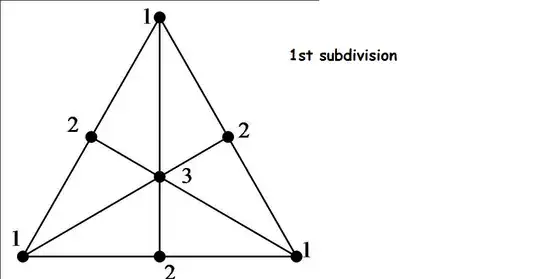
1st barycentric subdivision

Clearly this does not give a simplicial complex. I can see how the next subdivison does.

JC784
  • 243
  • 3
  • 14

1 Answers1

7

There is no general recipe for this, but here is a construction which might help you. Suppose that $X$ is obtained by gluing certain simplices along faces (via affine maps). The result (which is a cell complex) may or may not be a simplicial complex, as you can see by looking at the dunce hat. You can, however, imitate the 2nd barycentric subdivision for $X$ as follows. Subdivide each face of $X$ barycentrically; you obtain a new complex $X'$, which still can fail to be simplicial (this happens in the dunce hat case). However, if you subdivide $X'$ barycentrically again, you obtain a cell complex $X''$ which carries a natural structure of a simplicial complex as intersection of any two faces is either empty or a face. Try it with the dunce hat and see what you get. You can also use this if faces of $X$ are not simplices, but, say, polygons: You first triangulate each polygon and then repeat the 2nd barycentric subdivision construction above. (There are more efficient way, but this one will work.) Try it with the torus obtained by gluing opposite sides of the square in the standard fashion.

Moishe Kohan
  • 111,854
  • An example is the Delta complex which only consists of one edge whose end points are identified. The first subdivision gives two edges with the same endpoints, so we have a regular Delta complex (means without self-identifications). Taking the subdivision again yields a simplicial complex with four edges. The smallest triangulation for the circle has three edges, though. – Stefan Hamcke Feb 13 '14 at 16:45
  • @StefanHamcke: Very true, I did not claim that this construction is the most efficient one, it is just a construction that works. – Moishe Kohan Feb 13 '14 at 19:23
  • I dont for a second doubt you are correct, but i am having a hard time understanding and linking this to my limited knowledge. If i include as an edit above my attempt at triangulating the dunce hat, can you help me see why it fails or succeeds? – JC784 Feb 14 '14 at 17:01
  • 2
    @JC784: Yes, but please, make sure you draw figures, separately of the first and the 2nd subdivision. I think you simply misunderstood what the barycentric subdivision is. By the way, Hatcher's Algebraic Topology book is a great source, freely available online. – Moishe Kohan Feb 14 '14 at 19:05
  • i think i understand barycentric subdivision, it just hasn't been mentioned at all in the course i am taking. Neither have cell complexes. I'll draw some stuff and put it up – JC784 Feb 14 '14 at 20:17
  • @JC784: That's very sad! Take a look at Hatcher's book. – Moishe Kohan Feb 14 '14 at 20:23
  • This stuff with simplicial complexes and surfaces is new on the syllabus this year, i think it leads into a course next year called "Topology and Groups" – JC784 Feb 14 '14 at 20:35
  • @JC784 I'm almost certain we must be at the same uni now given this exact question and "Topology and Groups". I don't understand this solution with Barycentric subdivision- what is it- why are we even doing it and why is it a solution? – Arcane1729 Mar 07 '16 at 12:48