10

I'm new to spherical geometry and I enjoy doing ruler-and-compass constructions, so I'm trying to teach myself to do them in stereographic projection. I'm finding it challenging, to put it mildly.

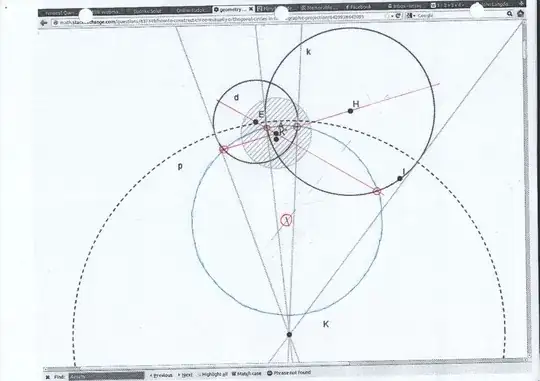
The following picture shows three mutually orthogonal great circles projected onto the plane (On the sphere it would look like this.):

enter image description here

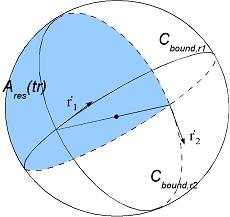
The grey circle with the shading is the intersection of the sphere with the plane. The two purple circles are orthogonal and divide the sphere into four equal biangles (segments -- like so). The dotted circle is what I want but I made it by eye and can't figure out how to construct it properly. It's orthogonal to both purple circles, as the green tangent lines show (sort of -- I'm aware it's not terribly accurate).

So I have two questions:

  1. How can I construct the dotted circle with ruler and compass? If the answer is, in fact, staring me in the face then a gentle hint would do!

  2. Is there a good source, online or in a book, of practical instructions / guidance for doing this kind of thing by hand?

Any pointers would be very gratefully accepted.

[EDIT: Late last night it occurred to me that I had everything I needed to solve the problem except the following technique: given an arbitrary point in the plane, construct the projection of the great circle of which that point is a "centre" (i.e., the equator for which the given point is the North or South pole).

This would enable me to bisect (on the sphere!) one of the circle arcs that the required circle must cross; by symmetry it must clearly cross there (halfway), so this constructs a point on the circle. Then either do this three times and construct the circle on these three points or, more elegantly, construct the tangent to the purple circle at that point and the centre of the required circle will be where the tangent crosses the line pointed out by Will Jagy.]


OK, thanks to both Will Jagy and Willemien for coming up with solutions to this. I'm illustrating both for clarity here. They are closely-related but different. Although my intuition isn't all the way there yet, I'm convinced that these are both correct constructions. Certainly GeoGebra measures the circles to be identical, orthogonal to the two given circles and to cross the primitive at diametrically-opposed points.

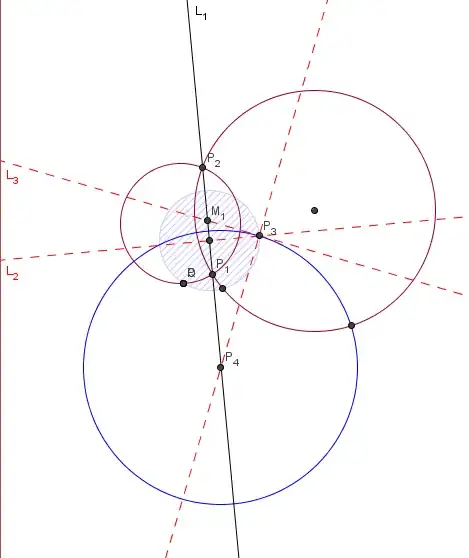
First Willemein's solution:
enter image description here

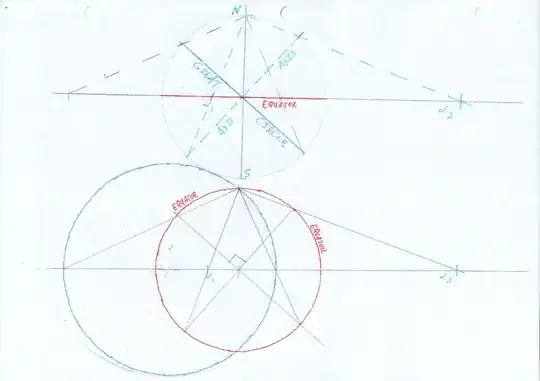
Second, Will Jagy's (I actually did this first, and had to walk myself through it a bit more, so it's more annotated):
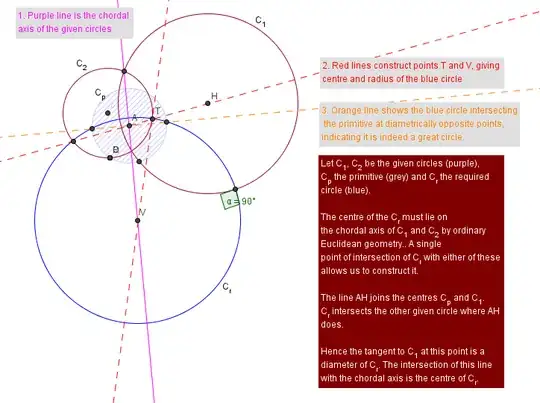
enter image description here

helveticat
  • 1,104
  • for geometrical ruler and compass constructions in general there is no better book than good old Euclid's Elements , and your problem, the gray circle and d are not really orthogonal and can you formulate your problem in plane geometry without mentioning spherical geometry – Willemien Jan 13 '14 at 22:47
  • Would it be enough to take two orthogonal circles and choose the third circle, orthogonal to both, that passes through a given point? – Will Jagy Jan 13 '14 at 22:54
  • Well, for now, Heinrich Dorrie, 100 Great Problems of Elementary Mathematics. Section 31, pages 151-154, Monge's Problem, to draw a circle that cuts three given circles perpendicularly, – Will Jagy Jan 13 '14 at 22:58
  • http://store.doverpublications.com/0486613488.html – Will Jagy Jan 13 '14 at 23:19
  • Formulating the problem purely in Euclidean terms is a good idea. I'll give it some thought. – helveticat Jan 14 '14 at 07:30
  • saw your edit and didn't understand it, can you reformulate it without using projection, (what is that anyway?) and indeed your first question was underdeterment (there are an infinite number of circles that are orthogonal to 2 other ortogonal circles) but all are on the radical axis pS in your drawing it looks like circlle p goes trough the centre of one cicle d, this is not possible – Willemien Jan 14 '14 at 08:33
  • "there are an infinite number of circles that are orthogonal to 2 other ortogonal circles" -- true for arbitrary circles in the plane, but not for great circles on a sphere. Given two orthogonal great circles (say, the equator and the Greenwich Meridian) there's only one great circle orthogonal to both. It's the projection of this that I'm trying to construct, given projections of the others. – helveticat Jan 14 '14 at 11:11
  • @helveticat, in case you are still interested and, well, conscious, I give a quick method to solve this in one answer, and a diagram pair that explains why it works in another answer. – Will Jagy Jan 18 '14 at 20:22

5 Answers5

6

Your two purple circles intersect. Draw a line between the two intersections. This is called the chordal or the radical axis... The center of any circle that is perpendicular to your two given purple circles lies along that line.

page 153 in Dorrie.

Will Jagy
  • 146,052
  • Thanks for this, I'll check it out. However, the dotted circle is unique, since there's only one configuration of three orthogonal great circles on the sphere, modulo rotations. We're therefore also going to need a point on the circle (or something equivalent). Another clue occurred to me as I was falling asleep last night -- I'll add it to the end of the question. – helveticat Jan 14 '14 at 07:35
  • To clarify: for every point p on the required circle, its antipode p' must also lie on the circle. Invert p in the primitive circle and then reflect it across the diameter of the primitive perpendicular to the line of inversion; this gives p'. But we don't, at this point, have any point on the circle. If we had one intersection point with either of the purple circles, plus your centre line, we could construct the tangent at p and we'd be done. – helveticat Jan 14 '14 at 08:07
  • @helveticat, for example, if you are projecting from a point in the center of a triangle made by the three great circles, the result would be three circles of equal radius (call it $1$) with the centers a distance of $\sqrt 2$ apart. – Will Jagy Jan 14 '14 at 18:42
  • Oh that's a good observation, thanks! – helveticat Jan 15 '14 at 20:41
2

I think I solved it and the whole construction is rather more simple than I originally expected

First of all the whole construction only depends on the grey circle and where the two purple circles intersect.

  • The point inside the grey circle is P1
  • The point outside the grey circle is P2

Then the construction is as follows:

  • draw line L1 trough P1 and P2

(Test: this line should go trough the centre of the gray circle)

  • draw line L2 trough the centre of the gray circle and perpendicular to L1
  • Point P3 is one of two points where L2 intersects the grey circle (any will do)
  • Midpoint M1 is the midpoint of the segment P1 - P2
  • draw line L3 trough M1 and P3
  • draw line L4 trough P3 perpendicular to L3
  • P4 is where L1 and L4 intersect

The circle you need has centre P4 and goes trough P3

DONE

PS this construction does asume that the grey circle is the equator of the sphere (there seem to be two definitions of stereographic projection) but in the question it surely looked like this, every great circle divides the equator in equal parts so if it was not this cicle the circle is is easely found by:

  • draw line La trough a centre of one of the purple circles and the centre of the grey circle.
  • draw line Lb perpendicular to line La trough the centre of the grey circle

  • the radius of the equatorial circle is the distance between the centre of the grey circle and where Lb intersects with the purple circle (the one that was choosen for La)

Willemien
  • 6,730
  • "Also you should know a point on the third circle" -- this is the sticking point. Everything you say is correct, but I can't see how to determine a point on the third circle. – helveticat Jan 15 '14 at 20:37
  • @helveticat discard the earlier comment, there is indeed only one circle in stereographic projection that is orthogonal to two others, i am still trying and failing in the construction, I added a bonus to the question, hope i will be able to be worthy of it myself :) – Willemien Jan 17 '14 at 14:05
  • @Willemien, did it, posted as third answer. The heart of it is, given stereographic projection out of the North Pole, the image of the Equator in our plane, and a circle in the plane, how to confirm that it is the projection of a great circle, and, if so, how to find the projections of the two points that are the endpoints of the axis of rotation of that great circle on the sphere. – Will Jagy Jan 17 '14 at 21:39
  • @WillJagy I think I cracked it, can you check my construction and if what i wrote gives the same circle you constructed. greatest difference i that i only use the intersections of the other circles (and even they depend on eachother) – Willemien Jan 18 '14 at 00:24
  • @Willemien, not sure yet. I fiddled with it a little, got it down to drawing two lines, that gives four points that must be on the final circle. – Will Jagy Jan 18 '14 at 00:38
  • @Willemien, I guess you do not have a scanner, but maybe you have a printer. You could enlarge the original image put by helveticat, using control plus or similar web browser command, print out, and see where your solution circle comes out. I posted mine as applied to the original drawing, deleted two other answers. – Will Jagy Jan 18 '14 at 01:09
  • Thanks for this -- as I said to Will in another comment, I've been distracted from this by other things but I'm really grateful for the work you've both put in. I suspect your two solutions are probably equivalent but I'll come back today or tomorrow once I have a chance to try both constructions by hand. – helveticat Jan 19 '14 at 10:35
  • I've updated my question with comparative pictures. I believe your and Will's answers are different and both correct. I really appreciate the effort you both put into this. Given that you put up bounty and then found an answer the question, how do you think we should proceed? I'm pretty new to ME and not sure of the etiquette in this case! – helveticat Jan 19 '14 at 16:31
  • nor sure you have to select one as the right answer, I will award the bounty to Will ( cannot award it to myself, will remove the rest from my post – Willemien Jan 19 '14 at 18:46
  • @Willemien, thanks for the bounty..On the subject of computer page scanners, i bought mine precisely because of an earlier question on compass and straightedge; it was not expensive, and has been very helpful with answering on MSE. See http://math.stackexchange.com/questions/173016/inscribing-a-rhombus-within-a-convex-quadrilateral where my first answer was a description, some SE employee converted it into Geogebra pictures. Once I got the scanner working at home, I was able to post my own drawings there. – Will Jagy Jan 19 '14 at 19:28
  • I use geometer's sketchpad, but just haven't figured out how to copy images from it, also i think the question was about a construction so let him follow the construction, ps added to my answer that you need to have the right grey cicle (there seem to be two different definitions of stereographic projection) and I can not just assume the more limited one, you don't use the diameter of the gray circle so maybe your solution is better – Willemien Jan 19 '14 at 19:36
  • @Willemien, if you can save a jpeg of one of your sketchpad constructions, you can then upload to MSE, just click on the little icon of a painting on an answer box. I would guess there is some way to make such a jpeg, either a feature of Sketchpad or of your computer or of your web browser. Oh, on books, you might borrow Geometry and the Imagination by David Hilbert and Cohn-Vossen, I do not recall the original German title. My city public library is very good about requesting any books, including mathematics, from many university libraries in my state. – Will Jagy Jan 19 '14 at 19:47
  • Anschauliche Geometrie. Note that Hilbert does project onto the plane tangent to the South Pole, which does make his pictures less cluttered. I prefer to project onto the plane of the Equator, because that agrees with the definition of the unit circle as the unit magnitude complex numbers, the South Pole as $0$ and the North Pole itself as $\infty.$ – Will Jagy Jan 19 '14 at 19:55
  • @Willemien since Will has the bounty, I'll accept your answer so you get the reputation. I'd forgotten Hilbert & Cohn-Vossen has a section on this stuff; I've pulled it off the shelf for a look now. I've also been meaning to work through Coxeter's Non-Euclidean Geometry, and I guess it's time I actually did so... Anyway thanks once again to both of you, working this problem with your help has been immensely educational and rather satisfying. – helveticat Jan 19 '14 at 20:50
2

A good idea when there are "too many circles" involved is to think of inversion. (You should find an introduction to inversion and how to perform the corresponding elementary constructions in almost any introductory text to elementary geometry).

If you invert with one of the intersection points of the purple circles as center, then these turn into two (ionmtersecting) straight lines. You still are looking for a circle (or line, but that does not happen) that is othogonal to both these lines. You may notice that a circle is orthogonal to two intersecting lines iff its center is the point of intersection. So in the inverted image, you have infinitely many (concentric) circles as solutions. If you invert back, each of these turns into a solution of the original problem.

Why so many solutions? The problem is that there are many ways to obtain the given two circles as projections of great circles of some sphere (i.e. if we allow the sphere to vary) and with each comes a different third great circle.

  • Can you add more details, the question is on how to construct the circle, and you don't give enough details for that, also the circle we are looking for is the circle that is a stereographic projection of a great circle from a sphere, probably only one such a cicle in the set you describe. – Willemien Jan 17 '14 at 20:39
2

on original drawing. The final circle is in light blue. The four points I found with the two red lines, and circled, are required to be on the final circle. So I did that.

I finally figured out the short version of the consistency test. A circle in one of these drawings is the stereographic projection of a great circle on the sphere if and only if its two intersection points with the grey shaded circle are endpoints of a diameter of the grey shaded circle.

enter image description here

So, if a circle in the plane really is the stereographic projection of a great circle on the sphere, that great circle has an axis of revolution; that axis meets the sphere in two points. It is not difficult to find the places that those two points project to in the plane. They are along the line between the two centers, as in the jpeg above. The trick is then simply that those two points must lie on the the other circle, as well as on the third circle. Hence the quick way i found four points on the third circle.

Will Jagy
  • 146,052
  • Sorry for the radio silence, I've been out of town & rather preoccupied. This does look like a valid solution to me. I really want to try Willemien's suggestion as well -- it seems like it's equivalent but I don't have time to confirm yet. I promise to come back on this by tomorrow! – helveticat Jan 19 '14 at 10:30
  • I've updated my question with comparative pictures. I believe your and Willemien's answers are different and both correct. I really appreciate the effort and have learned a lot! – helveticat Jan 19 '14 at 16:30
1

In case anyone ever again looks at this... in my diagram giving the simple final construction, i claim that, given the "primitive" which is the Equator, and the sterographic projection of a great circle from the North Pole, the projected circle must meet the Equator in a diameter of the Equator, also it is easy to find the projections of the two endpoint of the rotational "axis" of the given great circle. So, below I give two views. The top is edge on, along the sphere diameter that is the intersection of the plane of the Equator and the plane of the (blue) great circle. The rotational axis of the blue circle is in green, and the projections $\alpha_1, \alpha_2$ given. The other view is from above the plane of the equator, showing the Equator and the stereographic projection of the blue circle. Note that the blue circle does meet the Equator in a diameter of the Equator. Given that diagram, just two circles, it is quite easy to find the projections of $\alpha_1, \alpha_2,$ with the same arrangement of line segments as the diagram above. If we have a second and third great circle on the sphere, orthogonal to the blue one, then $\alpha_1, \alpha_2$ must lie on both circles, therefore on both projected circles.

enter image description here

Will Jagy
  • 146,052