24

What symbol would I use if I wanted to express that, in the context of some binary relation $P$ implied from context, that $\exists (a,b)\in P: a\ne b$, but not to the extent that $\forall (a,b) \in P: a\ne b$.

The use of this would be if one were discussing a more restricted system, but then move to discussing a less restricted one. Like, "if we know for sure that $a\cdot b=b\cdot a$, then .... However, if $a\cdot b \mathrel{\rlap{=}\,?} b\cdot a$, then the previous reasoning doesn't apply, so ...". ("$\mathrel{\rlap{=}\,?}$" instead replaced with the real symbol)

AJMansfield
  • 1,043
  • Perhaps you mean $A \ne B$ – DanielV Nov 30 '13 at 00:23
  • I don't understand the question. The notation "$\exists a \in A,\exists b \in B, (a \ne b)$" does not imply $\neg(\exists a \in A,\exists b \in B, (a = b))$. So what is wrong with this notation for what you are trying to express? – Trevor Wilson Nov 30 '13 at 00:24
  • @DanielV what I was after would be something that wouldn't necessarily require explicitly stating what sets $a$ and $b$ are in. Edited to make it clearer. – AJMansfield Dec 01 '13 at 18:01
  • @TrevorWilson I was looking to see if there was some kind of shorthand for the statement. – AJMansfield Dec 01 '13 at 18:02
  • I believe you are trying to introduce something like modal logic. I've never seen a use for it, but if this subject interests you then you should look it up. I believe they also have a (compound?) symbol for what you are trying to describe. – DanielV Dec 01 '13 at 18:28
  • I'm afraid I still don't understand. What does it mean to say $(a \ne b)$ after $a=b$ in the first paragraph? – Trevor Wilson Dec 01 '13 at 18:51
  • I'm pretty sure that the introduction of any symbol for "not necessarily equal" would defy the axioms of most non modal logics, btw, so finding a symbol for it outside of modal logic is probably impossible. – DanielV Dec 01 '13 at 19:22
  • @TrevorWilson I edited it again, does that help? – AJMansfield Dec 01 '13 at 19:37
  • The thing after i.e. is still not equivalent to the thing before, but I can ignore the thing after. What I am confused about is why you don't just say "there are distinct $a$ and $b$ such that $P(a,b)$"? Nothing about this says that there isn't also an $a$ such that $P(a,a)$, so I don't understand what the "but not to the extent that..." part is about. – Trevor Wilson Dec 02 '13 at 05:55
  • ...or did you perhaps not really mean it when you wrote "$\exists a,b \mathbin{\colon} P(a,b) \wedge a \ne b$"? If you had just written "$\exists a ,\exists b, P(a,b)$" then this would not imply that there are distinct $a$ and $b$ such that $P(a,b)$ holds. Perhaps this is what you are after? – Trevor Wilson Dec 02 '13 at 06:16
  • @TrevorWilson What I meant by $\exists a,b$ is, for domains $a\in A,b\in B$, that $\exists (a,b)\in A\times B$, not that $\exists a\in A,b\in B: a\ne b$. Thanks, I didn't realize that the notation I had used meant that $a,b$ are distinct. – AJMansfield Dec 02 '13 at 15:07
  • Your notation in the first paragraph of your question only means that $a$ and $b$ are distinct because it says so explicitly: $a \ne b$. Also, what do the sets $A$ and $B$ in your last comment have to do with the binary relation $P$ in the question? Is $P = A \times B$, or maybe just $P \subset A \times B$? – Trevor Wilson Dec 02 '13 at 15:55
  • @TrevorWilson You are right, sorry I just read your comment over again. What I want is a way to say "for the next part we are no longer constraining $a$ and $b$ to be equal". – AJMansfield Dec 05 '13 at 21:22
  • Your example should read "However if $a\cdot b\ne b\cdot a$" and nothing else, because you explicitly treated the case $a\cdot b=b\cdot a$ before. I guess that you should use another example. Also note that $a\text{ not necessarily equal to }b$ is not very different from $\text{any }a,b$. –  Sep 07 '16 at 09:09

6 Answers6

19

tl;dr: the formal notation for this is:$~~~~\neg\square(a=b)$


Explanation:

Modal logic formally defines the following dual operators:

  • Operator "$\square$" meaning "it is necessary", and
  • Operator "$\lozenge$" meaning "it is possible".

For any proposition P, the following are true:

  • $\square P \leftrightarrow \neg \lozenge \neg P~~~~~~~~$, i.e. : "P is necessarily true" is equivalent to "P cannot possibly be false"
  • $\lozenge P \leftrightarrow \neg \square \neg P~~~~~~~~$, i.e. : "P may be true" is equivalent to saying "P is not necessarily false"

Therefore, if you're happy to concede that your 'equality' is a logical statement, then you can express such statements formally as follows: $$ \lozenge(A = B) ~~~~~~~~~~~~~~~~~~~~~~~~~~~~~~~~~~~~~~~~~~~\text{(i.e. $A$ can be a $B$)}$$ or $$ \lozenge(A \neq B) ~~~~~~~~~\text{(i.e. $A$ can be something other than $B$)}$$ depending where you want to place the emphasis.
Or if you really want to express it in terms of necessity: $$ \neg\square(a = b) ~~~~~~~~~\text{(i.e. it is not necessary that a = b)}$$ etc.


PS. I suppose, if you preferred a "one-symbol-only" binary operator, like your $\overset?=$, you could define in your article the symbols $\overset{\square}=$, $\overset{\lozenge}=$, $\overset{\square}\neq$, and $\overset{\lozenge}\neq$ respectively in terms of the modal operator syntax stated above, and I'm sure these would be straightforward to follow in your text.


Having said that, if a strict logical statement is not needed in context, my preferred alternative answer here is the one given below by Dragon (i.e. \not\equiv: $\not\equiv$ ); to me this is fairly straightforward and intuitive, without requiring further explanation: stating that two quantities are not equivalent implies that they are independent variables that could nonetheless simply happen to take on an equal value.

10

You may find $\equiv$, used to denote $\forall x (f(x)=g(x))$, to be useful, eg.:

$$a\cdot b \not\equiv b\cdot a$$

For reference, see Identity (mathematics) on Wikipedia.

Dragon
  • 241
9

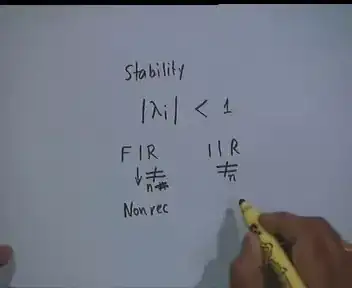
There is a lecture series on Digital Signal Processing available on Youtube, in which a symbol appears which quite elegantly states "not necessarily equal to" by subscripting the "not equals" sign with the letter n.

Symbol for "not necessarily equal to"

Screenshot source: Prof. S.C Dutta Roy, Department of Electrical Engineering, IIT Delhi

3

It might be easiest to write out "however, if $a$ does not necessarily equal $b$" or "however, if $a$ doesn't have to equal $b$" ... upon a quick Google search, there doesn't seem to be a clear symbol for what you need, and it doesn't take that long to write it out.

Given that you won't be using this phrase as often as you would "there exists" or "for all" or "if and only if", it seems unnecessary to have a separate symbol for it.

1

I think this is a good point, as this kind of sentence is quite common in mathematics. However, one such symbol does not exist yet. So you should propose a new symbol for it, with a bit of creativity. Your equal sign with a question mark on it is not too bad, but I'm sure you can do better!

Abramo
  • 7,155
-1

∴ is the symbol for "Therefore". However peculiar, there is no "Not therefore"/"Therefore not" symbol. But, I would suggest this as possibility: Therefore Not/Not Therefore Symbol (Unofficial/Example)

though it may seem silly, "One can alter this to other needed forms" such as: "Therefore not Equal To", for example, by applying logical bits, in this case a low bar: Therefore not Equal To (Unofficial/Example)
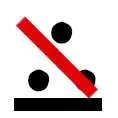
as per the logic in ≤ and ≥.

Often we find ourselves in a situation where a mathematical or logical expression is not found, not to mention a symbol for it. This then requires us to "adapt" by or making a whole new symbol, or alter an existing one this is "close to" what we try to express.

Note, IF you do such a thing, make SURE that the expression and it's symbol is LOGICAL, WELL NAMED, and EXPLAINED, and post the symbol with name and explanation the correct instance: How to propose new notation , which I do not have to say to you, but just to be sure, to be on the safe side, I will do this either way. If only because one, though knowing this, just might overlook it, "As it speaks for itself", which to YOU, the creator in this case, it does ... but therefore not to someone else, and to make it generally accepted as notation ... .

Note, these are mere ideas, suggestions. The Three Dot "Therefore" symbol exists and is generally accepted, thus the logic dictates to build on it. I did this by reverting to Equals => Equals Not, with the diagonal bar (which should be black, but I made it red to make it more clear. I have severe Aspergers and severe ADHD.).

I hope this may help you.

Kindest regards: Nominem.

(PS: Apologies for the several edits, my ADHD has a marvelous moment of leadership, leading to a few confuzzlements in my brizznit. Please, forgive me ... it is beyond my control. Nominem)

311411
  • 3,576