Can someone please help me understand how, in the solution below, we can get to $g(1)<0$ and $g(0)>0$ from the fact that $g(1) \neq 0 $ and $ g(0) \neq 0 $?
Thanks.
Rudin Chapter 4, question 14 (Exercise 4.14)
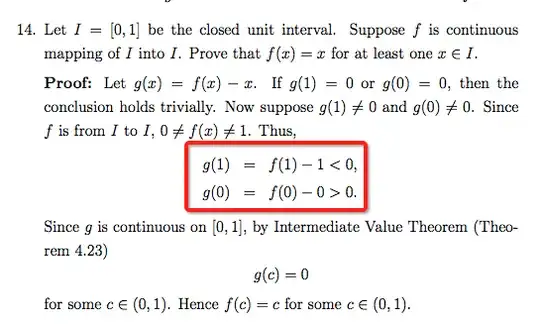
Can someone please help me understand how, in the solution below, we can get to $g(1)<0$ and $g(0)>0$ from the fact that $g(1) \neq 0 $ and $ g(0) \neq 0 $?
Thanks.
Rudin Chapter 4, question 14 (Exercise 4.14)

I think that is because f is a map to [0,1]
and therefore f can get a max value of 1 and min value of 0
because we assume that $f(1)\ne1$ it clear that $f(1)<1$
and $f(0)\ne0$ so it clear that $f(0)>0$
and we get
$g(1)= f(1)-1 <1-1 =0$
$g(0) =f(0)-0 =f(0) >0$
have a nice day


One of the hypothesis is that $f$ maps $I$ onto $I$, this means that for all $x\in I$, it holds that $0\leq f(x)\leq 1$. If $f(1)-1\neq 0$ and $f(0)-0\neq 0$, then $f(1)<1$ and $f(0)>0$, thus $g(1)<0$ and $g(0)>0$.
