I got a Runge-Kutta method here and I solve this system using it.
So here's Runge-Kutta stuff \begin{align} k_1 &= f(t_n, y_n) \\ k_2 &= f(t_n + h/2, y_n + hk_1/2) \\ k_3 &= f(t_n+h, y_n - hk_1 + 2hk_2) \\\hline y_{n+1} &= y_n + h(k_1 + 4k_2 + k_3)/6 \end{align} where $h$ is step
Here's my test system \begin{align} y'_1 &= -5y_1 - 10y_2 + 14e^{-x} \\ y'_2 &= -10y_1 - 5y_2 + 14e^{-x} \end{align} with exact solution $y_1(x) = y_2(x) = e^{-x}$
UPD: The initial condition here is $y_1(0) = y_2(0) = 1$
I need to solve it on $[0;4]$.
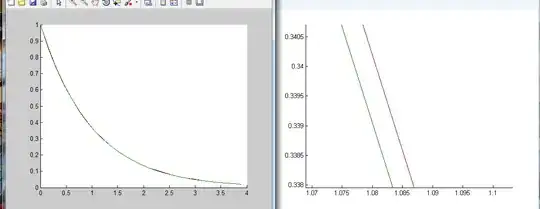
Well, I thought I solved it right, because I checked how the exact solution and these approximate solution plots looks like (on the left, on the right I zoomed plot until saw difference)
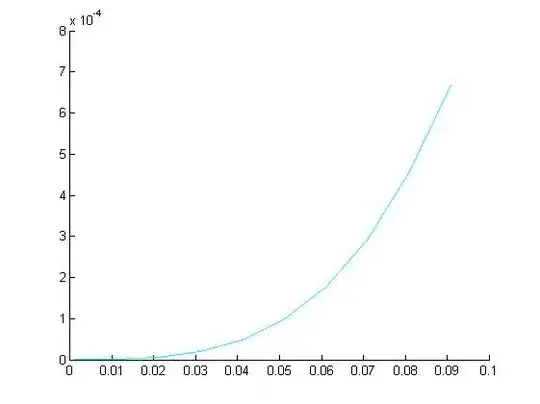
Also I checked how the plot of the difference between exact solution and approximate solution depending on step (let's call it e/h) looks like.
So $e/h$ it looks like this
But when I checked e/h^4 dependence it looked like these
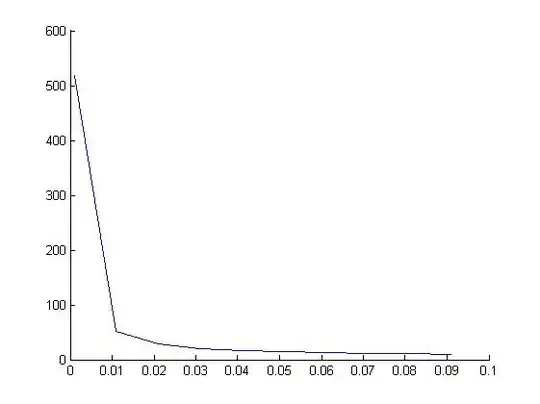
I showed it to the teacher and she said that my solution is wrong, it's not suppose to be like these! I show my code to her asked for help but she said that she doesn't understand matlab :c
Have I really done something wrong? And if yes what I've done wrong? And if not how to prove that I'm right?
Here's my code btw
Runge-Kutta method
  function [ res_y ] = RungeKutta(dim, size, grid, step, f1,f2,y1, y2)
k1=zeros(dim);
k2=zeros(dim);
k3=zeros(dim);

h = step;

res_y(1,1) = y1;
res_y(2,1) = y2;

for i=1: size

   k1(1)= f1(grid(i),y1,y2);
   k1(2)= f2(grid(i),y1,y2);

   k2(1)= f1(grid(i)+h/2, y1+h*k1(1)/2, y2+h*k1(2)/2);
   k2(2)= f2(grid(i)+h/2, y1+h*k1(1)/2, y2+h*k1(2)/2);

   k3(1)= f1(grid(i)+h, y1-h*k1(1)+2*h*k2(1), y2-h*k1(2)+2*h*k2(2));
   k3(2)= f2(grid(i)+h, y1-h*k1(1)+2*h*k2(1), y2-h*k1(2)+2*h*k2(2));

   res_y(1,i+1) = y1 + h*(k1(1) + 4*k2(1) + k3(1))/6;
   res_y(2,i+1) = y1 + h*(k1(2) + 4*k2(2) + k3(2))/6;

   y1 = res_y(1,i+1);
   y2 = res_y(2,i+1);
end


end
Main method
    a = 0; b = 4;
    h = 0.1; % step
    t = a:h:b; %grid
    n = 2;
    m = size(t,2);
 hold on;
     plot(t, exp(-t),'b-')
     plot(t, exp(-t),'r--')
 hold off;

y1=1; y2 = 1;

f1_ptr = @f1;% out = -5 * y1 - 10 * y2 + (14)*exp(-x);
f2_ptr = @f2;% out = -10 * y1 - 5 * y2 + (14)*exp(-x);

res_y = RungeKutta(n,m-1,t,h,f1_ptr, f2_ptr,1,1);

hold on;
plot(t,res_y);

hold off;


%e/h and e/h^4 plots
fig_a = figure;
set(fig_a,'name','e/h','numbertitle','off')
hold on;
counter = 0;
for h=0.001:0.01:0.1
    y1=1; y2 = 1;
    t = a:h:b;
    m = size(t,2);
    counter = counter + 1;
result_appr = RungeKutta(n,m-1,t,h,f1_ptr, f2_ptr,y1,y2);
result_exact = exp(-t);


result_difference = abs(result_appr(1, :) - result_exact);
e1(counter) = max(result_difference);
e2(counter) = max(result_difference);

hh = h*h*h*h;

ehh1(counter)=e1(counter)/hh;
ehh2(counter)=e2(counter)/hh;


end;
h=0.001:0.01:0.1;
    plot(h,e1,'c');
    plot(h,e2,'c');
hold off;
fig_b = figure;
set(fig_b ,'name','e/h^4','numbertitle','off')
hold on;
    plot(h,ehh1,'r')
    plot(h,ehh2,'b')
hold off;
f1 function
function [ out ] = f1( x, y1, y2, alpha, beta )
if nargin == 3
    alpha = 5;
    beta = 10;
end
out = -alpha * y1 - beta * y2 + (alpha + beta - 1)*exp(-x);
end
f2 function
function [ out ] = f2( x, y1, y2, alpha, beta )
if nargin == 3
    alpha = 5;
    beta = 10;
end
out = -beta * y1 - alpha * y2 + (alpha + beta - 1)*exp(-x);
end


res_y(2,i+1) = y2 + h*(k1(2) + 4*k2(2) + k3(2))/6but it changed nothing. Well, my firends in university always asking me for help. Actually here in my town and in coutry our CS education nowadays it's not good, as you can see :) – Danil Gholtsman Nov 23 '13 at 16:10e/h^4not suppose to look like it looks like here – Danil Gholtsman Nov 24 '13 at 10:53