0

For a normal random variable with mean 0.3 and standard deviation 0.03, its PDF would be as follows (I used MATLAB to draw it):
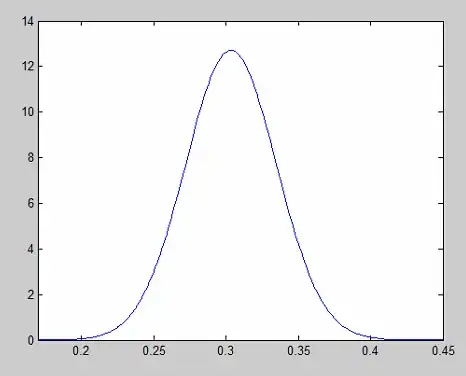
enter image description here

My first question is that why these probabilities are larger than 1? for example $P(X=0.3)=13.3$? should

But when I draw its CDF,all the probabilities are between 0 and 1!

enter image description here

Why PDF values are greater than one but CDF values are not? Thanks for your help.

Alex
  • 597
  • The density function doesn't directly give you the probability. The probability of a (measurable) set is the integral of the PDF over that set. – Daniel Fischer Oct 02 '13 at 18:46
  • Thanks, I am so confused about PDF! what does $P(X=0.3)=13.3$ mean in the first figure? – Alex Oct 02 '13 at 18:51
  • 1
    It means that the probability to get a number in a small interval around $0.3$ is approximately $13.3$ times the length of that interval. While for intervals at some distance from $0.3$ the probability to get a number in the interval is much smaller than the length of the interval. – Daniel Fischer Oct 02 '13 at 18:53
  • Thanks for your explanation. So does it mean PDF is similar to histogram? another question is how can I find the probability that X is equal to 0.3, i.e. $f_X(0.3)$? – Alex Oct 02 '13 at 18:56
  • related: http://math.stackexchange.com/questions/105455/how-can-a-probability-density-be-greater-than-one-and-integrate-to-one – Henry Aug 21 '16 at 23:04
  • Please post the m-file that generates the pdf and pdf – gatorback Jun 27 '18 at 14:28

1 Answers1

2

If $\rho$ is the probability density function, that does not mean $P(X = a) = \rho(a)$.

In particular, for this continuous distribution, you have $P(X = 0.3) = 0$... not $13.3$.

The probability density is a density: the concept is not so much different than the physical concept of density as it relates to mass.

The connection from probability density to actual probabilities is only through an integral: e.g. area underneath a curve. We could construct an approximation, if we like, to get an estimate

$$ P(0.3 < X < 0.3 + \epsilon) \approx 13.3 \epsilon $$

that is pretty good if $\epsilon$ is very small.