87

enter image description here

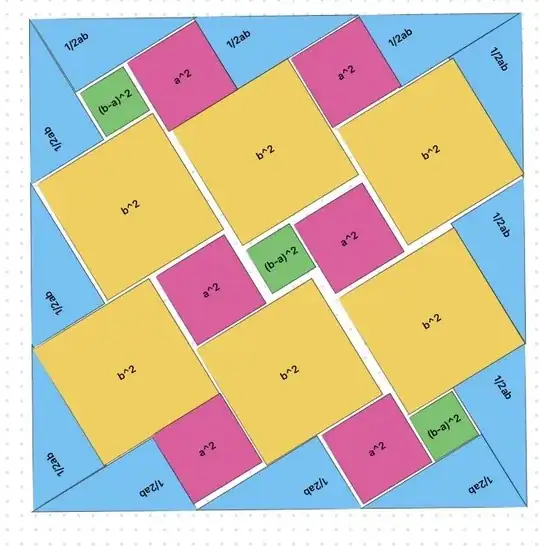
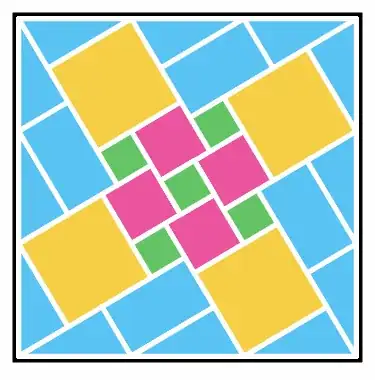
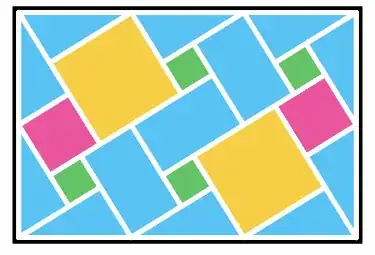
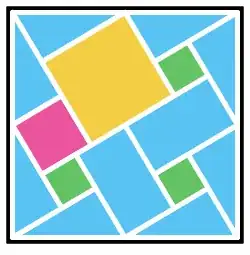
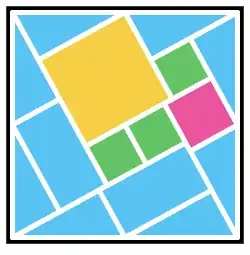
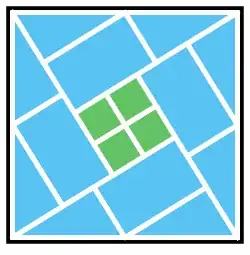
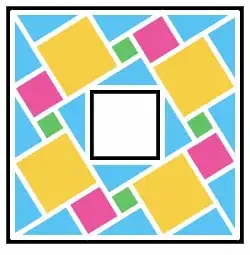
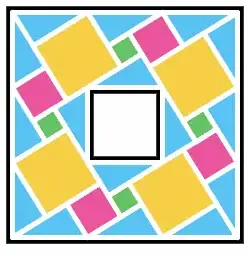
I am writing to you today because I believe I may have developed a new visual proof for the Pythagorean theorem. The proof is based on a geometric dissection method, equating the area of a larger composite square to the sum of its smaller constituent parts. I have attached an image file containing a diagram of the proof and the corresponding algebraic derivation.

The core of my derivation is that the area of the large square, which I represent as $(3c)^2$, is equal to the sum of the areas of the internal shapes: $5(b-a)^2 + 4a^2 + 4b^2 + 10ab$. This equation simplifies to the well-known Pythagorean identity, $c^2 = a^2 + b^2$. I am aware that there are hundreds of documented proofs of this theorem. However, I have not been able to find this specific dissection arrangement in my research.

Could you possibly spare a moment to review my work? I would be deeply grateful for your professional opinion on whether this proof is, to your knowledge, a novel discovery or a variation of a known proof. Thank you for your time and consideration.

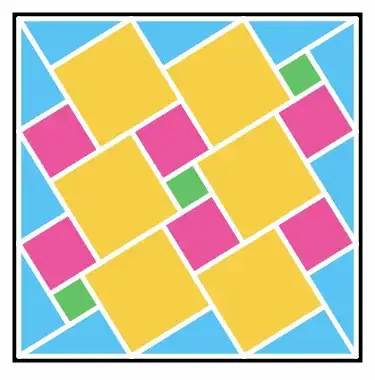
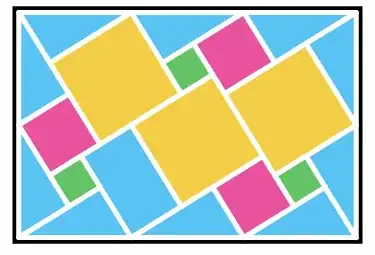
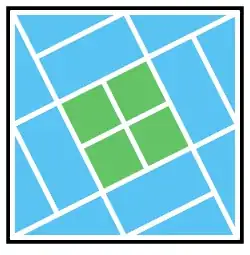
*plus: I have recently been working on geometric proofs of the Pythagorean theorem. Following my recent development of a proof via a "$3c$ side" dissection, I have extended my research and believe I have established a unique dissection for a "$4c$ side" scenario.

I have consolidated my findings and was hoping you might be able to offer your expert assessment. Could you please let me know if you believe this proof is both valid and original? I would be very grateful for your feedback.enter image description here

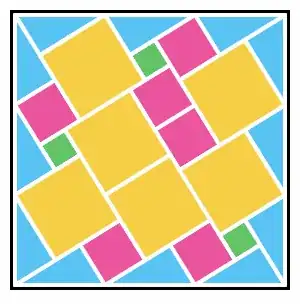
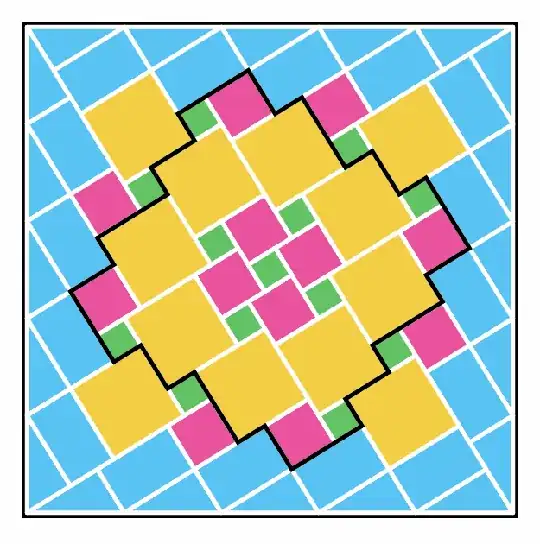
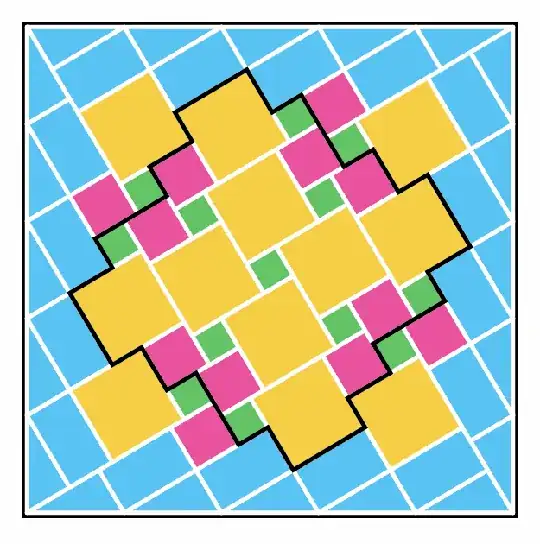
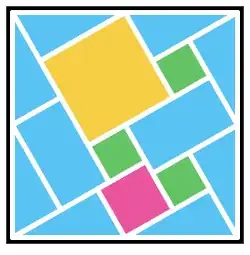
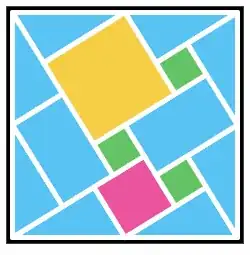
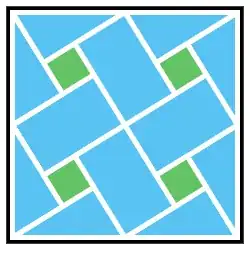
plus: I make $5c$ and new $3c$ tooenter image description hereenter image description here Building on these findings, I am led to conjecture that an infinite series of such proofs might exist. It seems plausible that this method could be generalized for a hypotenuse corresponding to n units (where $n = 3, 4, 5, ...$), thus creating a potentially limitless set of proofs. As many of you in the comments have mentioned, the equation $$c^2(m + n)^2 = (a^2 + b^2)(m + n)^2 = (m^2+n^2)(b-a)^2+2mn(a^2+b^2)+2(m^2+n^2)ab$$ appears to be valid, suggesting that an infinite number of proofs could be constructed from it. My friend Ko and I have analyzed the proof methods, and we hypothesize that all the figures exhibit point symmetry.

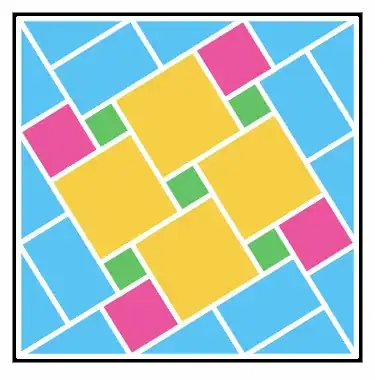
P.S. I was excited to discover a general method for completing n x n composition patterns. It turns out the solution is to form a diagonal chain, as indicated by the black arrows in the diagram. I was genuinely surprised to have figured this out myself! This proof is conjectured to be special in that it requires the minimum number of triangles for an nc-tiling. This proof method I've developed operates based on the following equation(as @Blue mentioned):"

\begin{align}(nc)^2&=n(n-1)(a^2+b^2)+n(a-b)^2+4n\cdot\tfrac12ab\\&=n^2(a^2+b^2)+n\left(-(a^2+b^2)+(a^2+b^2-2ab)+2ab\right)\\&=n^2(a^2+b^2)\end{align} enter image description here

My conjecture is that when tiling a square with a side length of nc (where c is the hypotenuse), if n is a prime number, then this method is the unique way to create no more than the minimum of 4n triangles.

I have some research questions that I'm curious about but can't pursue myself, as I'm not a mathematician.

Regarding the aforementioned "$nc$ tiling," it has been proven that at least one tiling method exists where the number of triangles is minimized as '$n$' approaches infinity. However, I wonder:

Could we determine the number of tiling methods for a specific '$n$'? How many other tiling methods are there? As '$n$' approaches infinity, does the number of these methods also approach infinity? If so, what is the rate at which it approaches infinity? Based on my limited knowledge, it seems like these questions might be provable using series and analytical methods.

and I am an elementary school teacher in Korea, and as mathematics is not my primary field, I am unsure whether these findings warrant publication. If they do, I would greatly appreciate guidance on the process.

P.S. And this is my (and us) paper! click here

kingyoon
  • 827
  • 2
  • 9
  • 2
    Also, there is a collection of proofs for Pythagoras at MSE here and here, and at more places. You should post yours there, perhaps, if it is really different from all the answers there. – Dietrich Burde Jun 12 '25 at 07:50
  • Elisha Scott Loomis, The Pythagorean Proposition, contains over 250 proofs, and is freely available as a pdf at more than one site on the net. Might be worth checking whether your proof is there. – Gerry Myerson Jun 12 '25 at 09:53
  • To further investigate its novelty, I have since used Google's Gemini 2.5 Pro AI to perform a detailed comparison of my proof against the 340-page Elisha S. Loomis text, "The Pythagorean Proposition." The results of the analysis indicate that my specific geometric dissection is a new proof and does not appear among the collection in the book. – kingyoon Jun 12 '25 at 10:04
  • 23
    "I have since used Google's Gemini 2.5 Pro AI to perform a detailed comparison of my proof against the 340-page Elisha S. Loomis text" Do not trust generative AI to do or interpret mathematics (or anything else, really). It's not even clear to me that an LLM can properly understand dissection proofs at all, let alone compare/contrast nuances of different proofs, especially when some are described in words and others are illustrated with diagrams. Look through Loomis (and other compilations) yourself; it's more reliable ... and fun! Anyway, congratulations on the discovery, novel or not. :) – Blue Jun 12 '25 at 10:58
  • 1
    Thanks! Even though I'm Korean and my English isn't perfect, I'll definitely take the time to read it. I appreciate it! – kingyoon Jun 12 '25 at 11:00
  • I have reviewed the Loomis book to the best of my ability. Based on my understanding, and allowing for my limitations in English and graph comprehension, it appears that my proof is not contained within the collection – kingyoon Jun 12 '25 at 11:36
  • 1
    You can probably do that with the other pythagorean triples as well. For instance: $$(5c)^2=13(b-a)^2+12(a^2+b^2)+26ab$$ – Intelligenti pauca Jun 12 '25 at 15:40
  • 2
    Hello all,I was hoping to get the community's feedback. I'm wondering if this might be appropriate for arXiv, and if so, I would also be looking for an endorsement. Any advice on either point would be greatly appreciated. – kingyoon Jun 12 '25 at 15:49
  • 9
    Just stopping by to say how very cool this is. It's rare that an MSE posting brightens my day, but this one (together with Blue's animation) certainly did! – John Hughes Jun 12 '25 at 16:04
  • 3
    @Intelligenci pauca Indeed we have the general identity : $c^2(m + n)^2=(a^2 + b^2)(m + n)^2$ $=(m^2+n^2)(b-a)^2+2mn(a^2+b^2)+2(m^2+n^2)ab$ where we recognize some formulas of the pythagorean triples. – Jean Marie Jun 12 '25 at 22:38
  • The part of the visual proof I don't understand: How do you know the center square has side length $b - a$? – MartianInvader Jun 12 '25 at 22:46
  • @MartianInvader It has the same side length as each of the other four green (littlest) squares, right? And the side length of any of the other green squares is (long triangle leg)+(long triangle leg)-(medium red square length)-(big yellow square length) = b+b-a-b = b-a. – Don Hatch Jun 13 '25 at 06:26
  • 2
    @JeanMarie Ah yes, I thought I saw a pattern emerging in some of the proofs, and you put your finger on it with that identity. The site you mentioned earlier #3 is m=0,n=1; #116 is m=1,n=1; the new proof here is m=1,n=2. The next interesting one may be perhaps m=1,n=3: $(4c)^2=10(b-a)^2+6(a^2+b^2)+20ab$. And then m=2,m=3 is $(5c)^2=13(b−a)^2+12(a^2+b^2)+26ab$ as Intelligenti pauca suggested. Non-coprime m,n (e.g. m=0,n>=2) have pretty tilings but aren't really new since they can be formed by tiling gcd(m,n)² copies of smaller configurations. – Don Hatch Jun 13 '25 at 08:22
  • 1
    @DonHatch That's a very insightful point, and I completely agree. You've perfectly articulated the pattern I was beginning to see. Your explanation about non-coprime cases being scaled versions of smaller configurations makes perfect sense. Moving forward, I will focus my efforts on constructing proofs for cases where m and n are coprime, as that is clearly where the truly novel tilings are to be found. Thank you for the valuable clarification! – kingyoon Jun 13 '25 at 08:47
  • 1
    @DonHatch I do see why the other four green squares have side length $b - a$, but it's not obvious to me why the center square must be the same size as them. What am I missing? Of course, I know it is the same size, but I don't see how to prove it without using the Pythagorean theorem itself. – MartianInvader Jun 13 '25 at 15:50
  • @mellowmelody355, I am not quite sure whether this is appropriate for the arxiv or not.. Even if it's a pretty neat result, I do think there is quite some difference between cool results and publishable results pushing the boundaries of research.. – Shreyansh Jaiswal Jun 13 '25 at 16:07
  • It is beautiful seeing the math community respond nicely to an elegant proof. – Shreyansh Jaiswal Jun 13 '25 at 16:08
  • 2
    @Don Hatch You should transform your comment into an answer that I would be happy to upvote. – Jean Marie Jun 13 '25 at 16:47
  • @MartianInvader WLOG take a line parallel to the edges of one of the yellow squares that passes through two of them and one of the green squares on the border; we know that this line is length 3b-a. Now slide this line over so it passes through the interior of the central shape. This line also passes through two yellow squares, and so the portion passing through the central shape is length (b-a). Now make the same argument for a line perpendicular to this line. This proves that the central shape is also a square with side-length (b-a). – Idran Jun 13 '25 at 19:08
  • @MartianInvader (This argument does assume the opposite edges where the yellow and green squares contact the blue rectangles are parallel and the adjacent edges are at right angles, but that's provable without needing to know anything about the details of the central shape.) – Idran Jun 13 '25 at 19:12
  • @Idran Ah yes there it is, thank you! I now see we can even just draw a segment that includes an edge of the central sqaure and and edge of one other green square, then derive the center square's sidelength by noting that segment must have length $2b-a$. – MartianInvader Jun 13 '25 at 19:47
  • Hi, here's a thought (that might not be very useful). Notice that in your diagrams for $3c$ and $5c$, you have a centre of $1=1^2$ and $9=3^2$ squares of area $(b-a)^2$. I was wondering whether it is possible to rearrange the $4c$ diagram to get a centre of $4$ squares of area $(b-a)^2$. If yes, then that might hint at an idea for generalising for the $nc\times nc$ case. Also, what software are you using to play with these? I tried my hand in it last day and things got very messy very soon (as I was drawing by hand). – Sayan Dutta Jun 14 '25 at 23:31
  • @SayanDutta i use freeform in MacOs! – kingyoon Jun 15 '25 at 08:19
  • @mellowmelody355 thanks! About your question of publication, I think this is a very nice work and there are some journals which are interested in these kinds of work. However, to make it publishable in a reputed journal, you have to formally write a proof to show that your $nc\times nc$ tiling does work. On the other hand, anything can be put on arXiv - if you want an endorsement, I will be glad to help you out (if I can). – Sayan Dutta Jun 15 '25 at 14:48
  • 1
    What ever happened to less is more ... – mick Jun 15 '25 at 21:51
  • Your guess about minimum number of triangles required is true. See my answer for a proof. – Sayan Dutta Jun 17 '25 at 03:16
  • 3
    @JeanMarie Our understanding has evolved since I wrote the comment :-) I'd now say the general form of these proofs is $(p+q)c^2=p(b−a)^2+q(a^2+b^2)+2pab$. (I'm using different letters from m,n to avoid confusion when comparing with the previous suggested form that uses m,n.) I did post an answer, with lots of examples of various p and q, including some non-square cases and even a non-rectangular case. – Don Hatch Jun 17 '25 at 05:18
  • @SayanDutta Thank you for your assistance! I was wondering if you might be able to endorse my paper on arXiv. My endorsement code is 36RFJT, and the paper, which is currently in progress, can be viewed at the link provided in the main text. – kingyoon Jun 17 '25 at 12:54
  • @SayanDutta The link for endorsement is available here! https://arxiv.org/auth/endorse?x=36RFJT – kingyoon Jun 17 '25 at 12:59
  • @mellowmelody355 I regret to inform you that it seems I can only endorse for math.NT. I don't have permission to endorse for math.AG. I'm trying to see if I can find a friend who can do it. I apologise for this. – Sayan Dutta Jun 18 '25 at 04:07
  • 1
    @mellowmelody355 The condition $n \leq p \leq n^2$ for the existence of a $(p, n^2 - p)$ tiling of a $nc\times nc$ square is indeed necessary and sufficient: the yellow and red squares in your $(n, n^2 - n)$ series of solutions are all paired in a way that you can successively apply the substitution from David's answer, increasing $p$ in steps of one all the way up to $n^2$. – Satvik Saha Jun 19 '25 at 00:56
  • 1
    In fact, you can build your $(n, n^2 - n)$ tiling by starting with $n^2$ copies of the $(1, 0)$ solution arranged in an $n\times n$ grid, then carefully applying David's substitution. – Satvik Saha Jun 19 '25 at 00:56
  • The first point in your Directions for future research has been answered in a recent edit in our answer (and also in the previous two comments). – Sayan Dutta Jun 19 '25 at 01:56
  • @mellowmelody355 your endorsement has been given. I made some changes to my account and that worked! Good luck! – Sayan Dutta Jun 19 '25 at 02:06
  • @mellowmelody355 regarding your conjecture "... that when tiling a square with a side length of nc (where c is the hypotenuse), if n is a prime number, then this method is the unique way to create no more than the minimum of 4n triangles", I wrote a program to search for solutions, and it found one other solution with side length 3c: static animated. So it seems the conjecture is false. I will add this to my answer. – Don Hatch Jun 20 '25 at 11:54
  • @DonHatch That's a great observation! I've realized that if an a-b square is always included in a specific row or column, like a rook on a chessboard, then such a composition is always possible. (I apologize, I can't quite articulate this in words; please refer to the paper for more details.) Your example seems to be a good one since the a-b square covers all rows and columns. You're right, my conjecture was incorrect! I've learned something new from you. – kingyoon Jun 20 '25 at 12:09
  • @mellowmelody355: This (delightful!) question is expanding way beyond its initial scope. (You should really ask only one question per post here.) I recommend moving your observations/inquiries about the tiling rules and such to a separate question, where they can be given proper attention. Be sure to link between the two questions; use the "Share" item (next to "Edit") under the question to get the URL. ... BTW: It's great to see the collaborative effort you've sparked here, and the growth of your own work. I'm particularly intrigued by the pythagomino/pythagoromino aspect. :) ... Cheers! – Blue Jun 20 '25 at 19:53