16
  • The followings are two well-known "addition formulas" (or "addition theorems").

$$ \int_{0}^{u} \frac{\mathrm{d}x}{\sqrt{1-x^2}} + \int_0^v \frac{\mathrm{d}x}{\sqrt{1-x^2}} = \int_{0}^{u\sqrt{1-v^2}+v\sqrt{1-u^2}} \frac{\mathrm{d}x}{\sqrt{1-x^2}} $$ (which is just sine addition formula)

$$ \int_{0}^{u} \frac{\mathrm{d}x}{\sqrt{1-x^4}} + \int_0^v \frac{\mathrm{d}x}{\sqrt{1-x^4}} = \int_{0}^{\frac{u\sqrt{1-v^4}+v\sqrt{1-u^4}}{1+u^2 v^2}} \frac{\mathrm{d}x}{\sqrt{1-x^4}} $$ (by Euler)

  • Both of the addition formulas are in the form of $$ \int_{0}^{u} \frac{\mathrm{d}x}{\sqrt{P(x)}} + \int_0^v \frac{\mathrm{d}x}{\sqrt{P(x)}} = \int_{0}^{some\ algebraic\ function\ of\ u\ and\ v} \frac{\mathrm{d}x}{\sqrt{P(x)}}$$ but no addition formula of this simple form exists for $ \int \frac{\mathrm{d}x}{\sqrt{1-x^6}} $ (essentially because $ y^2=1-x^6 $ is a genus $2$ curve). This was first shown by Abel in the 1820s.

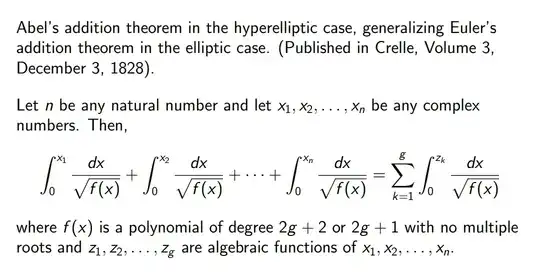
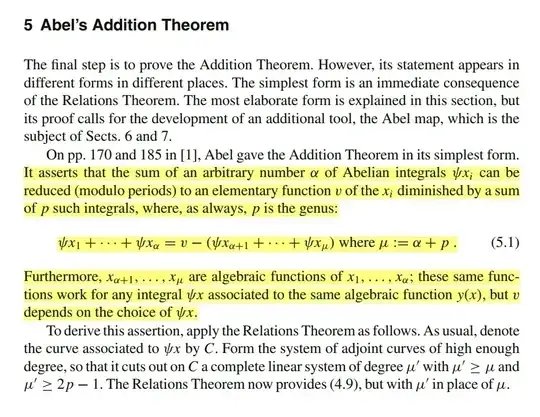
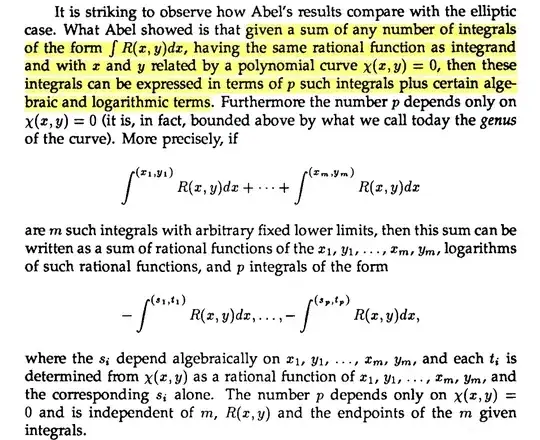
  • In fact, Abel proved the following theorem, which is stated slightly differently in various sources.

Skau, C. F., "Abelian integrals and the genesis of Abel's greatest discovery" (2020) (p.37) 1
Kleiman, S.L., "What is Abel's Theorem Anyway?", The Legacy of Niels Henrik Abel (2004) (p.417) 2
Gray, J. J., "Algebraic Geometry in the late Nineteenth Century", Proceedings of the Symposium on the History of Modern Mathematics, Vassar College, Poughkeepsie, New York, June 20–24, 1989 (p.366) 3
Cooke, R., "Abel's Theorem", Proceedings of the Symposium on the History of Modern Mathematics, Vassar College, Poughkeepsie, New York, June 20–24, 1989 (p.400) 4

  • Most textbooks, if they ever do, mention this as a brief historical note and then quickly turns to the abstract language of Abel-Jacobi maps without giving any explicit examples of this theorem. I want to know how to constructively apply this theorem to the genus $>1$ case.

  • Specifically, I want to know how this theorem applies to $ \int \frac{\mathrm{d}x}{\sqrt{1-x^6}} $, that is, what does the constructive result of Abel's addition theorem explicitly look like, after all the required computations? (I'm totally okay with using non-elementary functions, for instance some multivariable versions of theta or $ \wp $ functions if needed in the process; I just want to know the final result.)

Thinh Dinh
  • 8,233
Tay Choi
  • 263
  • 2
    Check Elliptic functions by Hancock where he proves that any function with algebraic addition formula must be an elliptic function or circular function. – Paramanand Singh Jan 26 '25 at 14:55
  • 2
    Actually, the fact that 'any function with algebraic addition formula must be an elliptic function or circular function' is already mentioned in my question. My question was, how to constructively apply 'Abel's addition theorem in the hyperelliptic case' mentioned in the first source. – Tay Choi Jan 26 '25 at 15:02
  • 1
    From what I have seen, any example of Abel's addition theorem seem to stop at genus 1 $\sqrt{1-x^4}$ (simpler curves satisfy known DE's, so I guess the addition formula for this genus 2 curve will have a complicated form) I am interested to see the answer! :) – Maxime Jaccon Jan 26 '25 at 19:56

1 Answers1

4

Using \begin{align}\tag{1}\label{eq:1} I(u)=\int_0^u\frac {\mathrm d x}{\sqrt{1-x^6}}= u\,{}_2F_1\big(\tfrac16,\tfrac12;\tfrac76;u^6\big)\,, \end{align} we can tabulate the high-precision numerical solutions to $I(w)=I(u)+I(v)$ for $0<u,v<1$ and determine, for each $u,v$, the minimal polynomial for $w$ using Mathematica. The resulting polynomials with integer coefficients are quadratic in $w^2$ and can be reverse engineered (using FindSequenceFunction[] and a bit intuition) to reduce to the unique symmetric polynomial \begin{align}\tag{2}\label{eq:2} u^4+v^4+w^4 +2 \left(u^2 v^2+u^2 w^2+v^2 w^2\right) \left(2 u^2 v^2 w^2-1\right)=0 \,, \end{align} with solution \begin{align}\tag{3}\label{eq:3} w=\pm\sqrt{ \frac{u^2+v^2-2 u v \left[u^3v^3-\sqrt{\left(1-u^{6}\right)\left(1-v^{6}\right)}\right]} {1+4 u^2 v^2 \left(u^2+v^2\right)} } \,. \end{align} The positive solution is correct for $u+v\lesssim1$ (I did not determine the exact condition), while the negative solution hold for $u+v\gtrsim1$ provided that the constant $I_c=4^{1/3}\omega_2=4^{1/3}\Gamma(1/3)^3/(4\pi)$ is added to $I(w)$, where $\omega_2$ denotes a Weierstrass half period.

Finally some Mathematics code:

II[u_] = u Hypergeometric2F1[1/6, 1/2, 7/6, u^6];
ww[u_,v_] := ww[u,v] = w /. FindRoot[II[u]+II[v] == II[w],{w,.99},
    MaxIterations->500,WorkingPrecision->200]
tab = Simplify[Table[{u, v, MinimalPolynomial[RootApproximant[ww[u,v],4],w]},
    {u, 3/29, 16/29, 3/29}, {v, 3/31, 16/31, 1/31}]];
poly = FullSimplify@Table[
    {tab[[k,1,1]],FindSequenceFunction[tab[[k,All,{2,3}]],v]},{k,1,4}]
Simplify[poly==Table[Block[{u=tab[[k,1,1]]},{u,31^4 29^4
    (u^4+v^4+w^4 + 2(2u^2v^2w^2 - 1)(u^2v^2 + u^2w^2 + v^2w^2))}],{k,1,4}]]
$MaxExtraPrecision = 100;
Quiet@Chop[Table[Block[
    {w = +Sqrt[(u^2 + v^2 - 2 u v (u^3 v^3 - Sqrt[(1 - u^6) (1 - v^6)]))/
               (1 + 4 u^2 v^2 (u^2 + v^2))]},
    If[u+v<1, N[II[u]+II[v]-II[w] - 0 4^(1/3) Gamma[1/3]^3/(4 Pi), 20],""]],
    {u, 1/29, 28/29, 1/29}, {v, 3/31, 30/31, 1/31}],150]
  • 1
    Thanks for your work, but as I mentioned in my question, it is known that no addition formula of the form I(w)=I(u)+I(v) (where w is an algebraic function of u and v) exists for $ \int \frac{\mathrm{d}x}{\sqrt{1-x^6}} $ because $ y^2=1-x^6 $ is a genus $2$ curve, so this is not what I'm looking for. – Tay Choi Jan 28 '25 at 21:45
  • Well, but \eqref{eq:2} is an algebraic relation between $u,v,w$, and $I(u)+I(v)=I(w)$. Obviously, the problem can be reduced to elliptic functions. I don’t think the numerics is wrong. – Fred Hucht Jan 28 '25 at 21:55
  • 1
    @Amateur_Algebraist: Thanks for the note, the variable u was not local in the Simplify[...] line. The zeroes are the result of $I(u)+I(v)-I(w)$ for different values of $u,v$, with $w$ from \eqref{eq:3}. – Fred Hucht Jan 28 '25 at 22:13
  • @TayChoi Could you please elaborate in more detail why my approach is incorrect or unsatisfactory? With the same method, I get the correct algebraic relations for the $1-x^2$ and the $1-x^4$ addition (first two equations from your question). The result \eqref{eq:3} is checked with high precision arithmetics. – Fred Hucht Jan 30 '25 at 06:59
  • 1
    Oh yeah you're right! The integral was obviously reducible to the elliptic case since $ \int_{0}^{u} \frac{\mathrm{d}x}{\sqrt{1-x^6}} = \frac{1}{2} \int_{0}^{u^2} \frac{\mathrm{d}x}{\sqrt{x-x^4}} dx $. – Tay Choi Jan 30 '25 at 08:15
  • tbh I was more interested in the case where things can't be reduced to the elliptic case. For example according to 'Abel's addition theorem in the hyperelliptic case', it seems that there should be some $z1$ and $z2$ which are algebraic functions of $x_1$, $x_2$, and $x_3$ such that $ \int_{0}^{x_1} \frac{\mathrm{d}x}{\sqrt{1-x^5}} + \int_{0}^{x_2} \frac{\mathrm{d}x}{\sqrt{1-x^5}} + \int_{0}^{x_3} \frac{\mathrm{d}x}{\sqrt{1-x^5}} = \int_{0}^{z_1} \frac{\mathrm{d}x}{\sqrt{1-x^5}} + \int_{0}^{z_2} \frac{\mathrm{d}x}{\sqrt{1-x^5}} $ . Could you share some knowledge on how to find such z1 and z2? – Tay Choi Jan 30 '25 at 08:15
  • 1
    I will accept your answer since I find the formula itself pretty cool anyway and find your code helpful for other purposes too. – Tay Choi Jan 30 '25 at 08:16