We need two properties of $1$-planar graphs:
- An $n$-vertex planar graph can have at most $4n-8$ edges.
- If the $n$-vertex planar graph is optimal, and has exactly $4n-8$ edges, then all vertex degrees are even.
The first property is addressed in this question. For the second, we argue that when we hit the limit of $4n-8$ edges, it means that the $1$-planar drawing divides the plane into exclusively triangular regions, and each corner of each region includes two of the vertices and one crossing between the edges.
Therefore for any two consecutive edges coming out of a vertex, exactly one must have a crossing. In other words, the crossing and non-crossing edges out of a vertex must alternate! This forces the degree to be even, because there is an equal number of each type of edge coming out of each vertex.
With this in mind, how do we prove that the graph in the question stops being $1$-planar when we contract edge $24$?
Well, the original graph has $10$ vertices and $32 = 4\cdot 10 - 8$ edges, and the contracted graph has $9$ vertices and $28 = 4\cdot 9 - 8$ edges. So both of them, if they are $1$-planar, must be optimal $1$-planar graphs. The original graph, shown below, is actually a good illustration of everything I've said about the properties of such graphs:
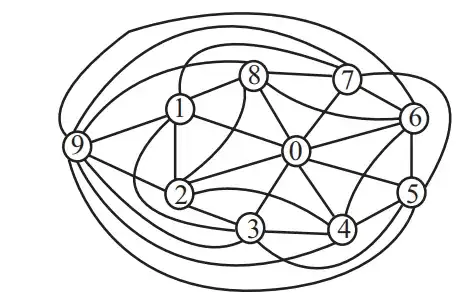
However, in the contracted graph, not all vertex degrees are even: any vertex that was adjacent to both $2$ and $4$ (such as for example vertex $0$) now has odd degree, and in fact the vertex created by contraction also has odd degree. So it does not satisfy the properties of an optimal $1$-planar graph - and therefore, it cannot be $1$-planar.


