I will assume that $p, q \geq 0$, for otherwise the equality is false.
Method 1. Let me demonstrate a method that only relies on contour integration. Consider the contour $\mathcal{C} = \mathcal{C}_{R,\epsilon}$ of the form
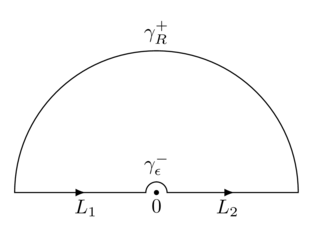
where $\gamma_R^+$ (resp. $\gamma^-_{\epsilon}$) is the CCW-oriented (resp. CW-oriented) upper semicircular arc of radius $R$ (resp. $\epsilon$). Then by the residue theorem,
\begin{align*}
0
&= \oint_{\mathcal{C}} \frac{e^{ipz} - e^{iqz}}{z^2} \, \mathrm{d}z \\
&= \int_{L_1 \cup L_2} \frac{e^{ipx} - e^{iqx}}{x^2} \, \mathrm{d}x + \int_{\gamma^+_{R}} \frac{e^{ipz} - e^{iqz}}{z^2} \, \mathrm{d}z + \int_{\gamma^-_{\epsilon}} \frac{e^{ipz} - e^{iqz}}{z^2} \, \mathrm{d}z.
\end{align*}
The first integral becomes
$$ \int_{L_1 \cup L_2} \frac{e^{ipx} - e^{iqx}}{x^2} \, \mathrm{d}x
= \int_{L_1 \cup L_2} \frac{\cos(px) - \cos(qx)}{x^2} \, \mathrm{d}x, $$
which converges to the OP's integral as $R \to \infty$ and $\epsilon \to 0^+$. For the second integral, note that
$$ \left| \int_{\gamma^+_{R}} \frac{e^{ipz} - e^{iqz}}{z^2} \, \mathrm{d}z \right|
\leq \int_{\gamma^+_{R}} \frac{|e^{ipz} - e^{iqz}|}{|z|^2} \, |\mathrm{d}z|
\leq \int_{\gamma^+_{R}} \frac{2}{R^2} \, |\mathrm{d}z|
= \frac{2\pi}{R} \to 0 $$
as $R \to \infty$. Hence the integral vanishes in the limit. Finally, noting that $e^z = 1 + z + \mathcal{O}(z^2)$ as $z \to 0$,
\begin{align*}
\int_{\gamma^-_{\epsilon}} \frac{e^{ipz} - e^{iqz}}{z^2} \, \mathrm{d}z
&= \int_{\gamma^-_{\epsilon}} \biggl( \frac{i(p-q)}{z} + \mathcal{O}(1) \biggr) \, \mathrm{d}z \\
&= -\int_{0}^{\pi} \biggl( \frac{i(p-q)}{\epsilon e^{i\theta}} + \mathcal{O}(1) \biggr) \, (i\epsilon e^{i\theta}) \mathrm{d}\theta \\
&= (p-q)\pi + \mathcal{O}(\epsilon).
\end{align*}
Hence this integral converges to $(p-q)\pi$ as $\epsilon \to 0^+$. Finally, combining all these computations together, we get
$$ 0 = \lim_{\substack{R \to \infty \\ \epsilon \to 0^+}} \oint_{\mathcal{C}} \frac{e^{ipz} - e^{iqz}}{z^2} \, \mathrm{d}z = \int_{-\infty}^{\infty} \frac{\cos(px) - \cos(qx)}{x^2} \, \mathrm{d}x + (p-q)\pi, $$
proving the desired equality.
Method 2. Assuming OP is aware of the formula
$$ \int_{-\infty}^{\infty} \frac{\sin(ax)}{x} \, \mathrm{d}x = \pi \operatorname{sgn}(a), $$
which can also be proved by contour integration technique or else, we can come up with a very short proof: By integration by parts,
\begin{align*}
\require{cancel}
&\int_{-\infty}^{\infty} \frac{\cos(px) - \cos(qx)}{x^2} \, \mathrm{d}x \\
&= \cancel{\left[ -\frac{\cos(px) - \cos(qx)}{x} \right]_{-\infty}^{\infty}} - \int_{-\infty}^{\infty} \frac{p \sin(px) - q \sin (qx)}{x} \, \mathrm{d}x \\
&= -(p \pi \operatorname{sgn}(p) - q \pi \operatorname{sgn}(q)) \\
&= (|q| - |p|)\pi.
\end{align*}


