12

Question

Let $Z_i\sim\chi_{(1)}^2\sim\Gamma(\frac{1}{2},\frac{1}{2})$ be i.i.d. chi-square random variables. We define: $$ W_n =\Bigl[\sum_{i = 1}^{n-1}\frac{Z_i}{2^{i}}\Bigr] + \frac{Z_n}{2^{n-1}} \mbox{ $\forall n\geq 2$} $$ For example: $W_2 = \frac{1}{2}Z_1+\frac{1}{2}Z_2$, $W_3 = \frac{1}{2}Z_1+\frac{1}{4}Z_2+\frac{1}{4}Z_3$ and so on.

I would like to determine the distribution of $W_{\infty}$ defined as: $$ W_{\infty} = \lim_{n\to\infty}W_n = \sum_{k = 1}^{\infty} \frac{Z_k}{2^{k}} \mbox{ where $Z_k\sim \Gamma\Bigl(\frac{1}{2},\frac{1}{2}\Bigr)$ are i.i.d.} $$ More specifically I have interest in computing the probability $P(W_{\infty} > 1$).

References

Note that this problem has references, in particular in this paper by Mathai:

https://www.ism.ac.jp/editsec/aism/pdf/034_3_0591.pdf

Mathai

Reference [4]:

Prabhu's reference

In my case, following its notations $\alpha = \frac{1}{2}$, $X_i\sim\Gamma(\frac{1}{2},\frac{1}{2})$ are i.i.d. and $n\to\infty$. The main problem is that I didn't manage to find Prabhu's work about this fact, and in general I didn't manage to find any other references to this problem.

My attempt

I was trying to approach this problem using the Levy-criteria for the convergence in distribution.. in particular I was trying to calculate (since they are indipendent random variables) the infinite product of their characteristic functions, which is the characteristic function of $W_{\infty}$.. but I wasn't able to determine a closed form for it. In particular if $H_k \sim \Gamma(1/2,2^k)$ then $\phi_{H_k}(t) = \Bigl(1-\frac{t}{2^k}\Bigr)^{-\frac{1}{2}}$ and so: $$ \phi_{W_{\infty}}(t) = \prod_{k = 0}^{\infty}\frac{1}{\sqrt{1-\frac{it}{2^k}}} $$

Code and simulation

I'm sure that $W_n$ converges in distribution by simulating it using R, in particular the following code:

it = 10000
n = 300
mat = matrix(rep(0,n*it),n,it)
w = vector()
for(i in 1:n) {
  mat[i,] = rchisq(it,1)
}
for(i in 1:n) {
  mat[i,] = mat[i,]/2^i
}
for(j in 1:it) {
  w[j] = sum(mat[,j])
}
hist(w,freq = F,breaks = seq(0,10,0.1))

produces the following output: Distribution of <span class=$W_{300}$" />
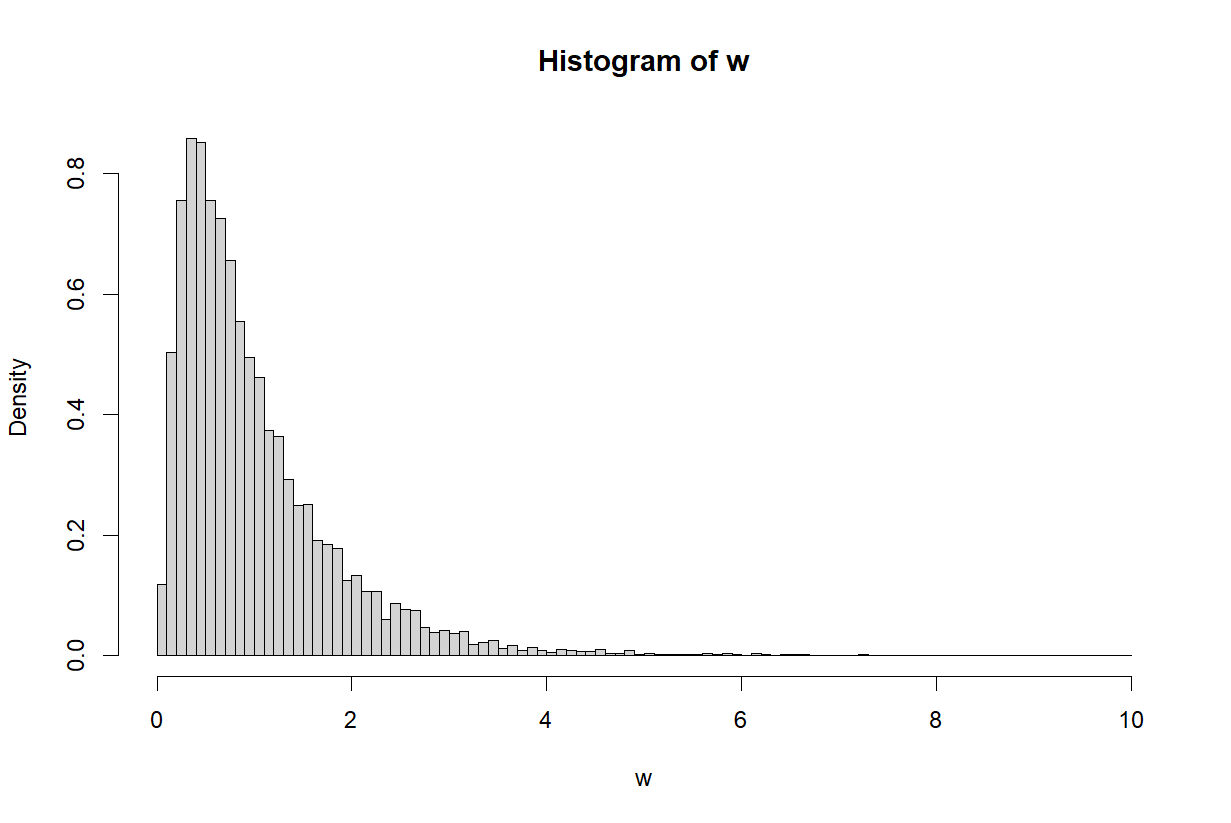
which is the distribution of $W_{300}$. I don't really know if this is a well known distribution, and I don't really know if its density function has a closed form. I don't know how to proceed. Thank you in advance for your help!

New approximation of $P(W_{\infty} > 1)$

Using the software R and the library "CompQuadForm":

https://cran.r-project.org/web/packages/CompQuadForm/CompQuadForm.pdf

I manage to approximate the value of $P(W_{\infty} > 1)$ with the code:

library(CompQuadForm)
n = 10000
q = 1
lambda = vector()
for(i in 1:n) {
  lambda[i] = 2^(-i)
}
acc1 = 10^(-15)
approx = davies(q, lambda, h = rep(1, length(lambda)), delta = rep(0,length(lambda)), sigma = 0, lim = 500000, acc = acc1)$Qq
sprintf("%.30f",approx)

which gives: $$ P(W_{\infty} > 1) \approx 0.371741079532780016592141691945 $$

which I think are the real first 30 digits. (I'm sure for the first 15 since I set an accuracy of $10^{-15}$). Of course I would prefer an "analytic" form of this number..

MathRevenge
  • 1,025
  • That's actually the mgf, not the cf. It's expressible in terms of the $q$-Pochhammer symbol, and at least one of these results should allow you to prove $\phi_{W_\infty}(it)$ is a cf. Obtaining a pdf and $P(W_\infty>1)$ are the hard parts. – J.G. Nov 25 '23 at 12:54
  • Oh.. my bad. Just forgotten the (fundamental) $i$ in the expression. Thank you! Yes.. I have seen by using the software Mathematica that for a fixed $n$ the cf of $W_n$ involves the $q$-Pochhammer symbol.. although simply taking the limit of this expression as $n$ approaches infinity seems to crash the software. I'm sure that this problem has been already studied as I pointed out in the question.. It's just a matter to understand how! Or where it has been proved. – MathRevenge Nov 25 '23 at 15:17
  • 1
    See https://math.stackexchange.com/questions/4033607/is-there-a-closed-form-for-the-distribution-of-t-sum-k-0-infty-2-k-x-k for a similar question. – A rural reader Nov 25 '23 at 15:21
  • @Aruralreader I'm checking it right now.. maybe it could help since the exponential distribution is a particular case of a gamma. Thank you. – MathRevenge Nov 25 '23 at 15:23
  • @Aruralreader it was a really nice idea for the exponential.. although for my case, using: $f(x) = \sum_{m = 1}^{M-1}C_m \frac{1}{\sqrt{x}} exp(-a_m x)$ and $f(y) = \frac{\sqrt{a_M}}{\sqrt{\pi}}\frac{1}{\sqrt{y}}exp(-a_M y)$ , and then calculating $Z = X + Y$, leads, during the process, to compute the following integral: $\int_{0}^{z} \frac{exp((a_M-a_m)x)}{\sqrt{x(z-x)}} dx$ , which is non trivial. – MathRevenge Nov 25 '23 at 15:54
  • 2
    @LucaOnnis, you’re correct. Good luck! – A rural reader Nov 25 '23 at 16:15
  • Perhaps of some use: https://www.ism.ac.jp/editsec/aism/pdf/037_3_0541.pdf. – A rural reader Nov 25 '23 at 20:13
  • @Aruralreader Thank you! I have seen this paper, which is very general and also refers to Mathai's work, which refers to Prabhu's work (like a chain). I'm trying to understand it and perhaps create a code to simulate it in my case. On the other hand I'm pretty sure there is something (like Prabhu's work) which is specific for my particular case. The search continues. – MathRevenge Nov 25 '23 at 20:48
  • Related (but not very helpful) : https://math.stackexchange.com/questions/4597485/distribution-of-sum-of-geometrically-scaled-uniform-variables – leonbloy Nov 26 '23 at 13:58
  • I was able to get a copy of the Prabhu book! Unfortunately, it doesn't answer the question of what is the distribution of the infinite summation, or how to calculate probabilities on that distribution. What it does provide is formulas for the mean and variance of the limiting distribution, but those are the obvious values you'd get from simply summing means or variances in the limit. It then poses a problem in terms of the finite and limiting distributions and finds an optimal value of $\alpha$ for that problem. So, it turns out Prabhu is not very useful for answering your question! – rajb245 Dec 06 '23 at 14:19
  • @rajb245 Oh.. that's bad news. Thank you for your important reply! I'm right now studying the "random power series", since my case is exacly one of them with $\alpha = \frac{1}{2}$.. I hope that it exists a closed form of the distribution of that infinite sum! – MathRevenge Dec 06 '23 at 15:43
  • @LucaOnnis good luck tracking this down. my guess is that there is no closed form in terms of the usual special functions that are known and tabulated. however, you have a numerical routine that can calculate the CDF of the limiting distribution to any precision you desire, something that allows you to do anything you can do with a closed form. a simple closed form might be faster to calculate, but if there is a closed form my guess is it involves confluent hypergeometric functions that are just as computationally complex to calculate. – rajb245 Dec 08 '23 at 19:53

0 Answers0
