5

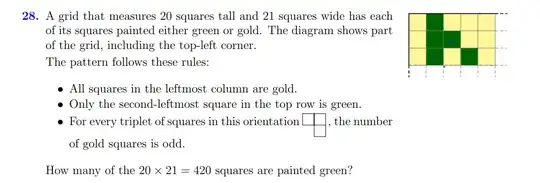
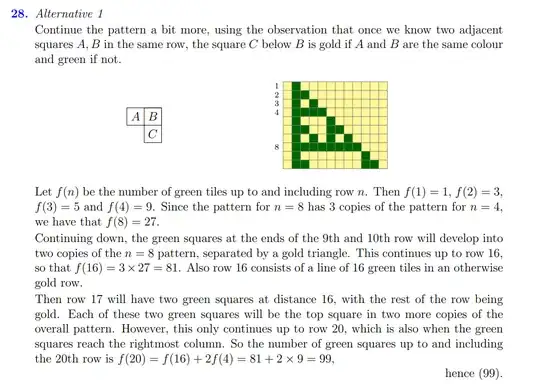
I am studying for the AMC and I am stuck on a question and do not understand the solution to it. Both the question and solution are attached. What I am unsure about the solution is: when it says that the 9th and 10th row will develop into two copies of the n=8 pattern, and I don't understand the rest of the solution on how it finds the "copies" in certain rows without a full diagram of the pattern and I don't understand how they got $f(20)=f(16)+2f(4)=81+2x9=99$.
A bit of clarification on this problem will be greatly appreciated.


Question: Question


Solution: Solution

Jean-Claude Arbaut
  • 23,601
  • 7
  • 53
  • 88
  • 1
    One request to my mathstackexchange folks...pls help this kid with his question and not close this question on account of the rules of this site as he is new here and unaware of the rules – Blue Cat Blues Nov 07 '23 at 11:45
  • Might be useful: if green means "odd" and gold "even", then this is exactly the parity of $n\choose p$, see https://math.stackexchange.com/questions/11002/cn-p-even-or-odd As to the pattern, see how every "complete" triangle starting from the top square is repeated twice below (there is a larger picture in one of the answers to this question). By complete I mean ending at the bottom with a completely odd row. – Jean-Claude Arbaut Nov 07 '23 at 11:49

1 Answers1

1

Let's suppose you have a row $n$ with the first square yellow, then $m$ green squares, followed by $20-m$ yellow squares. What would the pattern be on the next row? We know the first two squares are one yellow and one green. Since in the row $n$ you have green squares till column $m+1$, the square on row $n+1$ will be yellow, from column $3$ till column $m+1$. The next square on row $n$ will be green, since you have the transition from green to yellow in the above column, followed by all yellow squares, till the end of the row. So you have yellow, green, many yellows, one green, many yellows. That's two copies of the first row. These will evolve independently, until there is a green square from the first structure replacing touching the first green in the second structure. In the solution image, it means that on row 9 you have the first 8 elements in row 1, followed by a copy of row 1. So each structure will evolve the same as the one from row 1 down, until the square in column 9 is green. This will happen on row 16. Note that at that point you have 8 green squares from the structure on the left, followed by 8 green squares from the structure on the right, so 16 green squares. Then in next row, you will have two copies of row 1, one starting at column 1, one at column 17.
Andrei
  • 39,869