Another intuitive example: If it is raining ($R$), then this it is cloudy ($C$). In classical propositional logic this simply rules out the possibility that, currently, it is raining and not cloudy.
$~~~~~~ R \implies C ~\equiv ~ \neg (R \land \neg C)$
The truth table for $R \implies C$:
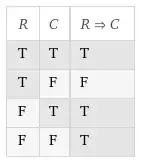
Suppose $R \implies C$ is true (lines 1, 3 or 4). Then, from the truth table, we have:
When $R$ is true (line 1), $C$ is true, i.e. $R$ is sufficient for $C$.
When $C$ is false (line 4), $R$ is false, i.e. $C$ is necessary for $R$.
Note that cloudiness ($C$) is not sufficient for rain ($R$). As is clear from the above truth table, when $C$ is true, the truth value of $R$ is indeterminate as you would expect.
Text version truth table:
R C R=>C
T T T
T F F
F T T
F F T


