1

I have for a long time having hard to understand how to create correct deductive proofs. I have been working on trying to solve examples but I don't really know how to proceed.

If we for instance have the argument: (A∧C)′∧C → (B∨C)∧A′ and have a list of equivalences and inference rules, how do I use the list in order to make hypotheses of the argument?

The inference rules are impl, dn, symm, de morgan, mp, mt, conj, add.

Erica
  • 141
  • What does $S'$ stand for? You should add to the question what the inference rules are. Are you following any text book? – Git Gud Aug 26 '13 at 17:57
  • @GitGud negation, or not S? – peterwhy Aug 26 '13 at 18:03
  • @GitGud it is negation, if (a^c) = true (a^c)' will be false and vice versa. – Erica Aug 26 '13 at 18:12
  • Can you outline the inference rules in symbols for us? I can hardly guess what "impl" means in terms of an inference rule. Also, can you assume the antecedent A of some conditional, derive a conclusion B, and then infer that (A→C) in your system? – Doug Spoonwood Aug 27 '13 at 01:23
  • @Erica If you are not committed to a particular set of rules of inference, and just want to learn the basic methods of logical or mathetmatical proof, may I humbly suggest my tutorial with accompanying software available free at my website http://www.dcproof.com – Dan Christensen Aug 27 '13 at 03:54
  • @Erica: Dan's website is not useful for actual mathematical work, and moreover has some bogus articles (e.g. about implication). – user21820 Jun 07 '22 at 17:44

3 Answers3

1

Normally you try to see if the statement you would like to prove is equivalent to a tautology. Like the following:

$$\begin{align} &(A\wedge C)'\wedge C \rightarrow (B\vee C)\wedge A'\\ \Leftrightarrow & [(A\wedge C)'\wedge C]' \vee [(B\vee C)\wedge A']\\ \Leftrightarrow & (A\wedge C)\vee C' \vee [(B\vee C)\wedge A']\\ \Leftrightarrow & (A\wedge C)\vee C' \vee (B\wedge A') \vee (C\wedge A')\\ \Leftrightarrow & [C \wedge(A \vee A')] \vee C' \vee (B\wedge A')\\ \Leftrightarrow & C \vee C' \vee (B\wedge A')\\ \Leftrightarrow & True\\ \end{align}$$

If you would like to write in a better way, write this backward, from $C \vee C' \vee (B\wedge A')$ up to $\Leftrightarrow (A\wedge C)'\wedge C \rightarrow (B\vee C)\wedge A'$.

peterwhy
  • 22,930
  • Ok, and then? Inference rules has to be used in order to make the hypothese. – Erica Aug 26 '13 at 18:26
  • If you think forward and write backward, you will see you have applied some distributive rules, de Morgan's rule, associative rule, definition of implication, etc. – peterwhy Aug 26 '13 at 18:30
1

Welcome to math.se! Two initial points. (1) It is worth taking a few moments, if you are going to ask questions here, to how to make logic symbols look nice by using LaTeX code. (2) You need to give more info if you want helpful answers: In particular, which logic system (from which textbook) are you having to work in? Even the labels you supply are not unambiguous.

As I understand your notation, you are given the premiss $\neg(A \land C) \land C$ and need to derive the conclusion $(B \lor C) \land \neg A$. [You talk about an argument here, not a proposition, so I assume this is the argument you mean.]

Think strategically. You are aiming to prove a conjunction. So you need to prove both conjuncts (what else could work?). I.e. you need to prove (i) $(B \lor C)$ and to prove (ii) $\neg A$. And looked at like that, it's now pretty obvious how to proceed.

(i) Can you see that this is pretty trivial? A disjunction follows from a disjunct ... and you are given one of the disjuncts in the premiss.

(ii) Can you see that $\neg A$ must follow from the premiss? So how to show this?? Hint: apply de Morgan's Law to half the premiss and then you are set up for a disjunctive syllogism.

Peter Smith
  • 56,527
  • She might not have a deduction theorem around. She might have to prove the conditional without assuming the antecedent of it as a premise. – Doug Spoonwood Aug 27 '13 at 01:22
  • The OP described the task as warranting an argument (so I read the arrow metalinguistically). If she does want to prove the conditional then I suspect the "impl" rule she mentions is Conditional Proof, which will give her the extra step. – Peter Smith Aug 27 '13 at 07:27
-1

Here is the OP's question:

If we for instance have the argument: (A∧C)′∧C → (B∨C)∧A′ and have a list of equivalences and inference rules, how do I use the list in order to make hypotheses of the argument?

Given a goal to derive in propositional logic, perhaps some premises that one may assume, and permitted inference rules the question appears to be: How should one construct a derivation leading to the goal?

One approach is to let a proof checker guide one through the proof by specifying the permitted rules, optionally checking each step, and verifying that the proof is correct when the goal has been reached.

Here is a proof of the example offered by the OP using such a proof checker:
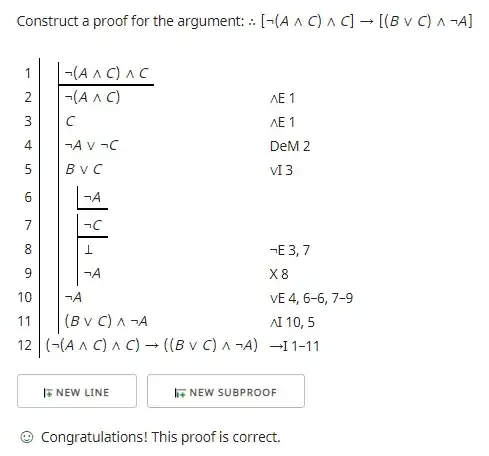
enter image description here

With a proof checker to guide one, this hopefully makes the task of learning how to write such proofs manageable. To see if one understands how this is done, one can try entering the above proof into the proof checker, line-by-line, to see if one gets the same result.


Kevin Klement's JavaScript/PHP Fitch-style natural deduction proof editor and checker http://proofs.openlogicproject.org/

P. D. Magnus, Tim Button with additions by J. Robert Loftis remixed and revised by Aaron Thomas-Bolduc, Richard Zach, forallx Calgary Remix: An Introduction to Formal Logic, Fall 2019. http://forallx.openlogicproject.org/forallxyyc.pdf

Frank Hubeny
  • 1,603