6

I have this equation:

$$\log_{10} [(+1)^2]=2$$

Applying the power law it becomes:

$$2\log_{10} (+1)=2$$

Solving for $x$:

$$\begin{align*} \log_{10} (+1)&=\frac{2}{2}\\ \log_{10} (+1)&=1\\ x+1 &= 10^1 \\ x&=9 \end{align*}$$

So I have one solution when using power law.

However, without using the power law:

$$\begin{align*}\log_{10} [(+1)^2]&=2\\ (+1)^2&=10^2\\ (+1)^2&=100\end{align*}$$

If $x=-11$, $$\begin{align*}(-11+1)^2&=100\\ (-10)^2&=100\end{align*}$$

If $x=9$, $$\begin{align*}(9+1)^2&=100\\ (10)^2&=100\end{align*}$$

Thus I can get $2$ solutions for $x$ without using the power law since I am able to square the negative value too.

What am I doing wrong?

PrincessEev
  • 50,606
user1078
  • 341

3 Answers3

5

I believe the core issue arises when using the power law. Consider the statement $$ \log_{10} \Big[ (x+1)^2 \Big] = 2 \log_{10}(x+1) \tag{1} $$ There is an implicit assumption here: that these are, in fact, equal. More precisely, that both sides of this equation represent defined quantities!

If you recall, any logarithmic function, $\log_a(x)$ ($a>0$), only defined for $x>0$, at least in traditional arithmetic.

Aside: You can deal with certain ideas that allow for values for other $x$'s, but these considerations generally don't arise until one takes an upper-level math class, so let's keep the discussion more grounded, and assume we want only real values of the function and hence $x>0$.

The left-hand side of $(1)$ is defined almost everywhere: $(x+1)^2 \ge 0$ just on merit of squaring a number, and in particular $(x+1)^2 > 0$ whenever $x \ne -1$. You can see this in the function's graph.
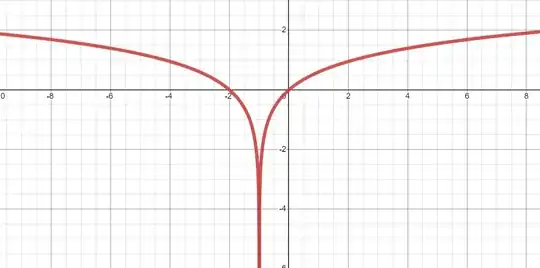
enter image description here

The same is not true of the right-hand side of $(1)$: it is only defined when $x+1 > 0$, i.e. when $x > -1$. So you have "lost" half of its graph:
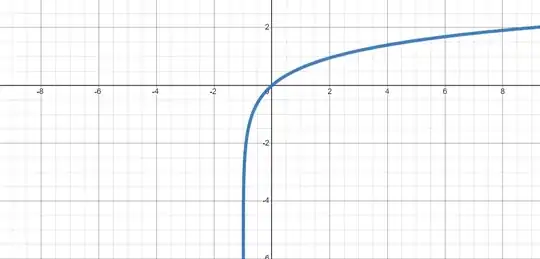
enter image description here

More broadly, then, the power law can be stated as the following generalization: $$ \log_a \Big[ f(x)^{b} \Big] = b \log_a \big[ f(x) \big] \text{ whenever } f(x) > 0 $$

Note: Technically, to ensure the left-hand side is valid, we should also state that $f(x)^b > 0$, but the function $g(x) = x^b$ is positive for any real value $b$, so this is a nonissue. Hence, $f(x)^b > 0$ if and only if $f(x) >0$.

The law you are familiar with is for the function $f(x)=x$, and hence likewise carries the stipulation: $$ \log_a \left( x^{b} \right) = b \log_a ( x ) \text{ whenever } x > 0 $$ So when solving this equation $(1)$ by the power law method, what you have discovered is:

If this equation has a solution $x$, and $x>0$, then $x=9$

Of course, this doesn't exhaust the entire solution space: other solutions for $x \le 0$ may exist, as you have seen via other methods.

PrincessEev
  • 50,606
2

Indeed!   Although $9$ is the only real solution for $x$ that make $\log_{10}(x+1)=1$; Both $9$ and $-11$ are real solutions for $x$ that make $\log_{10}(x+1)^2=2$.

Why?   Because $\log_{10} (-10)^2 \neq 2\log_{10}(-10)$ .

The Logarithmic Rule of Exponents, $\log_b(p^r)=r\log_b(p)$, only holds for all real non-negative numbers $p$, real non-negative and non-unity $b$, and real numbers $r$.

$$\forall b\in(0;1)\cup(1;\infty)\;\forall p\in(0;\infty)\;\forall r\in(-\infty;\infty)~.\log_b(p^r)=r\log_b(p)$$

So, when you apply the Rule of Exponents to solve $\log_{10}(x+1)^2=2$ , you are incorrectly dismissing that which make $x+1$ negative.

Watch out for this when using the Seven Logarithmic Rules.

Graham Kemp
  • 133,231
  • got it. what is a typical reference location to see precise definitions of various laws like the one you described? – user1078 Jun 02 '23 at 00:59
0

In the context of equations, an identity (e.g., $\sec^2(x)\equiv \tan^2(x)+1$) is one that is true wherever the equation is defined (on both sides).

The so-called Power Law $$\log_ax^p\equiv p\log_ax$$ is a logarithmic identity. In other words, it is applicable only for $x\in(0,\infty)$ and $a\in(0,1)\cup(1,\infty).$

An alternative formulation that requires nonzero $y$ rather than positive $x$ is $$\log_a|y|^p\equiv p\log_a|y|.$$

ryang
  • 44,428