How to solve the following integral by differential equations techniques? $$ \int_0^\infty \dfrac{\sin xt}{x(x^2+1)} dx $$
Asked
Active
Viewed 794 times
7

-
3Are you familiar with theorems of complex analysis (applications of residue theorems) for real integration? Also, does $t$ have any restrictions? – Jared Aug 03 '13 at 18:55
-
I think that the convolution transform is useful. – Angel Aug 03 '13 at 19:46
-
2Possible duplicate http://math.stackexchange.com/questions/34174/functions-defined-by-integrals-problem-10-23-from-apostols-mathematical-analys and http://math.stackexchange.com/questions/63275/completing-the-differential-equation-from-exercise-10-23-in-tom-apostols-mathe – N3buchadnezzar Aug 03 '13 at 19:54
4 Answers
7
Recalling the Laplace transform
$$ F(s)=\int_{0}^{\infty} f(t) e^{-st} dt. $$
We can use it to solve the problem. Taking Laplace transform with respect to $t$ gives
$$ f(t)=\int_0^\infty \dfrac{\sin xt}{x(x^2+1)} dx \implies F(s)=\int_{0}^{\infty}\frac{dx}{(1+x^2)(s^2+x^2)} . $$
The last integral can be evaluated using partial fraction techniques (see below) to give
$$ \implies F(s) = \frac{1}{2}\,{\frac {\pi }{s \left( s+1 \right) }}. $$
Now, we can find the inverse Laplace transform using convolution technique as
$$ f(t)=\frac{\pi}{2}\int_{0}^{t} e^{-\tau}d\tau = \frac{\pi}{2}(1-e^{-t}). $$
Alternatively, one can use partial fraction technique
$$ \frac{\pi}{2}\frac {1}{s(s+1)}=\frac{\pi}{2}\left(\frac{1}{s}-\frac{1}{s+1}\right). $$
to find the inverse Laplace transform
Notes:
1) The Laplace transform of $\sin(az)$ with respect to $z$ is $$ {\frac {a}{{s}^{2}+{a}^{2}}}. $$
2) $$\frac{1}{(1+x^2)(s^2+x^2)}={\frac {1}{ \left( {s}^{2}+{x}^{2} \right) \left(1- {s}^{2} \right)}}-{\frac {1}{ \left( {x}^{2}+1 \right)\left(1- {s}^{2} \right) }}.$$
3) Inverse Laplace transform of $\frac{1}{s}$ and $\frac{1}{1+s}$ are given by $$ 1,\quad e^{-t} $$ respectively.


Mhenni Benghorbal
- 48,099
-
Where is the mistake in my (mistaken) solution? For $t=1$, $$ \int 0^\infty{\sin x\over x(x^2+1)}dx={1\over2}\Im\int{-\infty}^\infty {e^{ix}\over x(x^2+1)}dx\ ={1\over2}\Im2\pi i\text{Res}({e^{ix}\over x(x^2+1)},i) $$ Since $i$ is a simple pole, $$ =\Im\pi i\cdot {e^{ix}\over x(x^2+1)}|_{x=i}=\ \Im \pi i{e^{-1}\over i\cdot2i}=\Im\pi i{e^{-1}\over-2}={-\pi \over2e} $$
I know how to get the propriate solution which is ${\pi(e-1)}\over 2e$ but I don't understand where is the mistake in this answer?
– J. Doe Jul 03 '19 at 12:49
6
This integral is custom-made for analysis via integration in the complex plane. I'm not sure if you have any familiarity with the following concepts (e.g., residues), but I am going to evaluate it here in this fashion for completeness.
Consider the following integral in the complex plane:
$$\oint_C dz \frac{e^{i z t}}{z (z^2+1)}$$
where $C$ is the following contour:
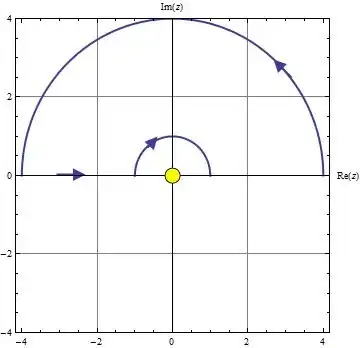
Thus, we avoid the pole at $z=0$ by deforming into the upper half plane. The contour integral is thus equal to
$$\int_{-R}^{-\epsilon} dx \frac{e^{i x t}}{x (x^2+1)} + i \epsilon \int_{\pi}^0 d\phi \, e^{i \phi} \frac{e^{i \epsilon e^{i \phi} t}}{\epsilon e^{i \phi} (\epsilon^2 e^{i 2 \phi}+1)}+ \\ \int_{\epsilon}^{R} dx \frac{e^{i x t}}{x (x^2+1)} +i R \int_0^{\pi} d\theta \, e^{i \theta} \frac{e^{i R e^{i \theta} t}}{R e^{i \theta} (R^2 e^{i 2 \theta}+1)} $$
We take the limit as $\epsilon \to 0$ and $R \to \infty$. Note that the second integral becomes $-i \pi$. The fourth integral vanishes when $t \gt 0$; its magnitude is bounded by
$$\frac{2}{R^2} \int_0^{\pi/2} d\theta \, e^{-R t \sin{\theta}} \le \frac{2}{R^2} \int_0^{\pi/2} d\theta \, e^{-2 R t \theta/\pi} \le \frac{\pi}{R^3 t}$$
On the other hand, the contour integral is equal to, by the residue theorem, $i 2 \pi$ times the residue at the pole $z=i$ (i.e., the only pole within the contour $C$). Thus
$$PV \int_{-\infty}^{\infty} dx \frac{e^{i x t}}{x (x^2+1)} - i \pi = i 2 \pi \frac{e^{-t}}{2 i^2} $$
or
$$PV \int_{-\infty}^{\infty} dx \frac{e^{i x t}}{x (x^2+1)} = i \pi \left ( 1 - e^{-t}\right )$$
Now, take the imaginary part of both sides; the principal value disappears and we get, for $t \gt 0$:
$$\int_{0}^{\infty} dx \frac{\sin{ x t}}{x (x^2+1)} = \frac{\pi}{2} \left ( 1 - e^{-t}\right )$$

Ron Gordon
- 141,538
-
-
@Angel: You're welcome, and I am aware of what you asked for vs what I provided. But again, some integrals are just tailor-made for contour integration, and I just wanted to express that. – Ron Gordon Aug 03 '13 at 21:23
2
In order to get rid of the term x in the denominator, we use Feynman’s trick using the parametrised integral $$ I(t)=\int_0^{\infty} \frac{\sin (tx)}{x\left(1+x^2\right)} d x $$ Differentiating $I(t)$ w.r.t. $t$ yields $$ I^{\prime}(t)=\int_0^{\infty} \frac{\cos (tx)}{x^2+1} d x $$ Using contour integration along anti-clockwise direction of the path $$\gamma=\gamma_{1} \cup \gamma_{2} \textrm{ where } \gamma_{1}(t)=t+i 0(-R \leq t \leq R) \textrm{ and } \gamma_{2}(t)=R e^{i t} (0<t<\pi) $$ $$ \begin{aligned} \int_0^{\infty} \frac{\cos (tx)}{x^2+1} d x &= \Re \int_0^{\infty} \frac{e^{x t i}}{x^2+1} d x\\&=\frac{1}{2} \int_{-\infty}^{\infty} \frac{e^{x t i}}{x^2+1} d x \\&=\\ & =\frac{1}{2} \cdot 2 \pi i\left(\lim _{z \rightarrow i}(z-i) \frac{e^{z t i}}{z^2+1}\right) \\ & =\pi i \cdot \frac{e^{i \cdot t i}}{2 i}\\&=\frac{\pi e^{-t}}{2} \end{aligned} $$ Integrating back, we have $$ \begin{aligned} I(t) & =I(t)-I(0)\\&=\int_0^t \frac{\pi e^{-a}}{2} d a \\ & =\frac{\pi}{2}\left(1-e^{-t}\right) \end{aligned} $$

Lai
- 31,615
0
Hint: Let $$ y(t)=\int_0^{\infty} \frac{\sin (tx)}{x\left(1+x^2\right)} d x. $$ Then, $$\ddot{y}-y=-\frac{\pi}2.$$ The solution is $$y(t)=\frac{\pi}2+c_1e^t+c_2e^{-t}$$ with initial conditions $y(0)=0$ and $\dot y(0)=\frac{\pi}2$.

Bob Dobbs
- 15,712