0

Could anybody please translate this exercise into English? A friend of mine sent me the translation via Facebook but I still don't understand why I have to first do the logaritmization of both sides of the equation and then the differentiation...

Another thing - the last sentence.... They say that it's an implicit function? It does not look like an implicit function to me.... I'm just confused because of the Spanish language.... Maybe they push me to logaritmize the whole equation so that it becomes an implicit function...
enter image description here

user1111261
  • 1,179
  • Do you know a way to do the differentiation without first taking logarithms? – Gerry Myerson Jul 12 '13 at 13:13
  • You don't have to to do it that way, you could write $f(x)^{g(x)}=\large{e^{g(x)\log f(x)}}$ and differentiate that with a mix of the product rule and the chain rule. But the logarithm method is a cute way to avoid the chain rule part. – Thomas Andrews Jul 12 '13 at 13:16
  • You can actually do it directly by combining the power rule and the exponent rule. $d(x^z) = zx^{z - 1},dx + \ln(x) x^z,dz$. This is the "generalized power rule". It's not taught much anymore, but I included it in my "Calculus from the Ground Up" book. – johnnyb Jan 11 '22 at 16:32

1 Answers1

5

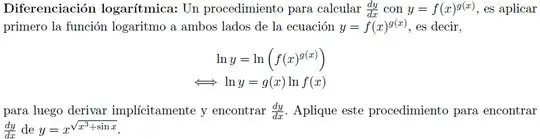
Logarithmic differentiation: A procedure to compute $\frac{dy}{dx}$ with $y=f(x)^{g(x)}$, is to apply first the logarithmic function to both sides of the equation $y=f(x)^{g(x)}$, that is, $$\ln(y)=\ln(f(x)^{g(x)})\ \Longleftrightarrow\ \ln(y)=g(x)\ln(f(x))$$ and then derive implicitly to find $\frac{dy}{dx}$. Apply this procedure to find $\frac{dy}{dx}$ with $y=x^{\sqrt{x^3+\sin(x)}}$.

This is the translation. The reason to do so is simply that it is easy to derivate the product of two functions while the original function is more complicated to derive directly.

Simone
  • 2,044