In the following diagram: 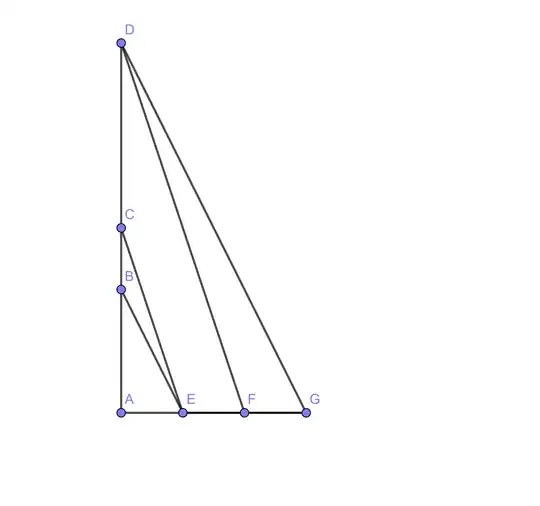
- $\overline{AE}$ is of length $1$.
- $\overline{AF}$ is of length $b$.
- $\overline{AG}$ and $\overline{AC}$ are of length $a$.
- $\angle BEA=\angle DGA$.
- $\angle CEA = \angle DFA$.
It is sufficient to demonstrate that $\overline{AB}$ is congruent to $\overline{AF}$.
Extend segment $\overline{AG}$ to point $H$ such that segment $\overline{AH}$ is congruent to segment $\overline{AD}$. Additionally, segments $\overline{CH}$ and $\overline{BH}$ are constructed.
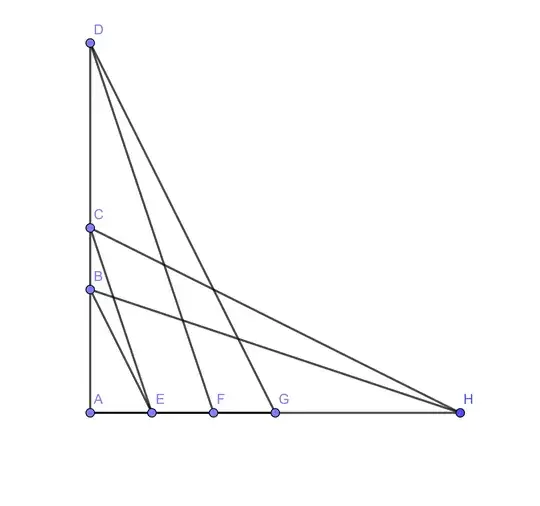
Now, observe that $\triangle ADG$ is congruent to $\triangle AHC$ by SAS. Due to this $\angle ACH= \angle AGD$.
By construction, $\angle AGD=\angle AEB$. Therefore, $\angle ACH=\angle AEB$.
As a result, $\angle BEH$ is the supplementary angle of $\angle ACH$, and so the quadrilateral $EBCH$ has opposite angles that are supplementary, meaning it is a cyclic quadrilateral, then $\angle CHB= \angle BEC$.
We have $\angle BEC =\angle AEC - \angle AEB$. So $\angle CHB = \angle AEC - \angle AEB$.
By the exterior angle theorem, $\angle ABH =\angle CHB + \angle BCH = (\angle AEC - \angle AEB) + \angle ACH = \angle AEC - \angle AEB + \angle AEB = \angle AEC$.
Finally, by AAS criterion, $\triangle AFD$ is congruent $\triangle ABH$. Therefore, segment $\overline{AB}$ is congruent to segment $\overline{AF}$.


