46

Let $\mathscr{F}$ be a collection of connected subsets of a metric space $M$ such that $\bigcap\mathscr{F}\ne\emptyset$. Prove that $\bigcup\mathscr{F}$ is connected.

If $\bigcup\mathscr{F}$ is not connected, then it can be partitioned into two disjoint, non-empty subsets $A,B$. Let $x$ be a point in $\bigcap\mathscr{F}$. Then either $x\in A$ or $x\in B$. I don't know where to go from here.

PJ Miller
  • 8,471

11 Answers11

64

HINT: You’re actually about halfway there, though you omitted an important qualification of $A$ and $B$: if $\bigcup\mathscr{F}$ is not connected, then it can be partitioned into two disjoint, non-empty, relatively open subsets $A$ and $B$. Now fix $x\in\bigcap\mathscr{F}$, and without loss of generality assume that $x\in A$. $B\ne\varnothing$, so pick any $y\in B$. Then there is some $F\in\mathscr{F}$ such that $y\in F$, and of course $x\in F$. Thus, $x\in A\cap F$, and $y\in B\cap F$, so $A\cap F\ne\varnothing\ne B\cap F$. Why is this a contradiction?

Brian M. Scott
  • 631,399
  • After doing this problem for myself a slightly different way: would the contradiction here be that we have shown that $A$ and $B$ are also disconnected, when they are given to be connected? – Taylor Rendon Oct 15 '20 at 15:08
  • 2
    @TaylorRendon: No, the problem is that $A$ and $B$ split the connected set $F$. – Brian M. Scott Oct 15 '20 at 15:12
  • Gotcha! So that means $F \subset A \cup B$? – Taylor Rendon Oct 15 '20 at 15:20
  • @TaylorRendon: Yes, because $F\subseteq\bigcup\mathscr{F}=A\cup B$. – Brian M. Scott Oct 15 '20 at 15:29
  • Do you also mean that $y\in\bigcap\mathscr{F}$ – Ari Royce Hidayat Jun 25 '23 at 08:35
  • 1
    @AriRoyceHidayat: Definitely not: $y$ can be any point of $\bigcup\mathscr{F}$. – Brian M. Scott Jun 25 '23 at 18:53
  • But how could be that $x \in F$? – Ari Royce Hidayat Jun 25 '23 at 19:04
  • 1
    @AriRoyceHidayat: $x\in\bigcap\mathscr{F}$, so $x\in F$ for every $F\in\mathscr{F}$. – Brian M. Scott Jun 25 '23 at 19:34
  • Ah... I can see it now. Thanks. – Ari Royce Hidayat Jun 25 '23 at 19:45
  • 1
    @AriRoyceHidayat: You’re welcome. – Brian M. Scott Jun 25 '23 at 21:24
  • I'm sorry to bother you again, I have tried to look for the answer elsewhere but found none. If I have two sets $A$ and $B$ that $A \cap B \ne \emptyset$ then $A \cup B$ is connected. Say $A \cap C = \emptyset$ but $B \cap C \ne \emptyset$, so $(A \cup B) \cap C \ne \emptyset$ -- doesn't it mean $(A \cup B) \cup C$ connected while $A \cap B \cap C = \emptyset$ suggesting $A \cup B \cup C$ is disconnected? While $(A \cup B) \cup C = A \cup B \cup C$? Where am I wrong with my logic? Thanks. – Ari Royce Hidayat Aug 07 '23 at 07:03
  • 1
    @AriRoyceHidayat: If $A,B$, and $C$ are connected, $A\cap B\ne\varnothing$, and $B\cap C\ne\varnothing$, then $A\cup B\cup C$ is connected; it doesn’t matter whether $A\cap C$ is empty or not. From the result in the question we know that if $A\cap B\ne\varnothing$, then $A\cup B$ is connected. Let $D=A\cup B$; then $D\cap C\supseteq B\cap C\ne\varnothing$, and $D$ and $C$ are connected, so the same result tells us that $D\cup C$ is connected, i.e., that $A\cup B\cup C$ is connected. – Brian M. Scott Aug 07 '23 at 07:23
  • Thanks but sorry, I still don't get it... isn't it the theorem demands that for $\bigcup \mathscr{F}$ be connected then $\bigcap \mathscr{F} \ne \emptyset$? – Ari Royce Hidayat Aug 07 '23 at 16:31
  • Aahh... I may get it... The theorem says that if $\bigcap \mathscr{F} \ne \emptyset$ then $\bigcup \mathscr{F}$ is connected. But $\bigcap \mathscr{F} = \emptyset$ doesn't necessarily mean that $\bigcup \mathscr{F}$ is disconnected as the sample with $A$, $B$, and $C$ in the first question shows? – Ari Royce Hidayat Aug 07 '23 at 16:42
  • 1
    @AriRoyceHidayat: Correct. An example in $\Bbb R$: $A=[0,1]$, $B=[1,2]$, and $C=[2,3]$. $A\cap B\cap C=\varnothing$, but $A\cup B\cup C=[0,3]$. – Brian M. Scott Aug 07 '23 at 17:21
  • Really thanks again. – Ari Royce Hidayat Aug 08 '23 at 17:02
  • @AriRoyceHidayat: You’re very welcome. – Brian M. Scott Aug 08 '23 at 19:17
  • A nice proof. After reading through all the answers, I noticed that all of them (at least all those which are easily verifiable) consider a point in the intersection, it was peculiar to me that such a theme was so widespread, so I tried to write one that doesn't do this, but I wonder if it is correct, or of there is some "deeper reason" this step is needed – Carlyle Dec 28 '23 at 06:55
  • @Carlyle: I’d have organized your proof a little differently, beginning by showing that if $F\in\mathscr{F}$, then either $F\subseteq A$ of $F\subseteq B$, letting $\mathscr{F}_A={F\in\mathscr{F}:F\subseteq A}$ and $\mathscr{F}_B={F\in\mathscr{F}:F\subseteq B}$, and showing that $\mathscr{F}_A\ne\varnothing\ne\mathscr{F}_B$, but what you have is fine, and I’ve upvoted it. (It’s actually essentially the same as the one using functions mentioned by James at the beginning of his answer, with $A=f^{-1}[{0}]$ and $B=f^{-1}[{1}]$ for some continuous $f:\bigcup\mathscr{F}\to{0,1}$.) ... – Brian M. Scott Dec 28 '23 at 07:25
  • ... Probably the most obvious way to use the hypothesis that $\bigcap\mathscr{F}\ne\varnothing$ is to start by picking a point in the intersection, and once one has done that, the argument almost writes itself. As you saw, it’s actually necessary, but it is very natural. – Brian M. Scott Dec 28 '23 at 07:27
  • @BrianM.Scott I see, yes that is a more natural order. Thank you for the reply! – Carlyle Dec 28 '23 at 07:31
  • @Carlyle: You’re welcome! (And please note that I left out a word in my last comment: I meant to say that it’s not necessary to pick a point in the intersection, just very natural.) – Brian M. Scott Dec 29 '23 at 07:39
24

Use that $X$ is connected if and only if the only continuous functions $f:X\to\{0,1\}$ are constant, where $\{0,1\}$ is endowed with the discrete topology.

Now, you know each $F$ in $\mathscr F$ is connected. Consider $f:\bigcup \mathscr F\to\{0,1\}$, $f$ continuous.

Take $\alpha \in\bigcap\mathscr F$. Look at $f(\alpha)$, and at $f\mid_{F}:\bigcup \mathscr F\to\{0,1\}$ for any $F\in\mathscr F$.


Since you mention metric spaces, I am not sure if you know about the first thing I mention, so let's prove it:

THM Let $(X,\mathscr T)$ be a metric (or more generally, a topological) space. Then $X$ is connected if and only if whenever $f:X\to\{0,1\}$ is continuous, it is constant. The space $\{0,1\}$ is endowed with the discrete metric (topology), that is, the open sets are $\varnothing,\{0\},\{1\},\{0,1\}$.

P First, suppose $X$ is disconnected, say by $A,B$, so $A\cup B=X$ and $A\cap B=\varnothing$, $A,B$ open. Define $f:X\to\{0,1\}$ by $$f(x)=\begin{cases}1& \; ; x\in A\\0&\; ; x\in B\end{cases}$$

Then $f$ is continuous because $f^{-1}(G)$ is open for any open $G$ in $\{0,1\}$ (this is simply a case by case verification), yet it is not constant. Now suppose $f:X\to\{0,1\}$ is continuous but not constant. Set $A=\{x:f(x)=1\}=f^{-1}(\{1\})$ and $B=\{x:f(x)=0\}=f^{-1}(\{0\})$. By hypothesis, $A,B\neq \varnothing$. Morover, both are open, since they are the preimage of open sets under a continuous map, and $A\cup B=X$ and $A\cap B=\varnothing$. Thus $X$ is disconnected. $\blacktriangle$

Pedro
  • 125,149
  • 19
  • 236
  • 403
9

I like "clopen" sets... it is a set that is at the same time closed and open. A topological space $X$ is not connected if, and only if, for any point $a \in X$, you have a "non-trivial" clopen set $C$ containing $a$. That is, a clopen set such that $\emptyset \neq C \subsetneq X$.

Take $a \in \bigcap \mathscr{F}$. Then, take a clopen set $C \subset \bigcup \mathscr{F}$ containing $a$. In the relative topology, for any $X \in \mathscr{F}$, $C \cap X$ is a clopen set. Since $X$ is connected, $C \cap X = X$. That is, $X \subset C$ for every $X \in \mathscr{F}$. Therefore, $\bigcup \mathscr{F} \subset C$.

Therefore, $\bigcup \mathscr{F}$ has no "non-trivial" clopen set, and so, it is connected.


The proof admits some variants. For example, if you take any non-empty clopen set $C'$, it will intersect some $X \in \mathscr{F}$. From connectedness, we have that $X \subset C'$. In particular, $a \in C'$.

6

The quickest way is using functions from $\bigcup\mathcal{F}$ to $\{0,1\}$, However you can do it directly.

Let $A, B$ be a partition of $\bigcup\mathcal{F}$ into open, disjoint subsets. WLOG assume that $A$ is non-empty. Then there is some $x\in A$ and hence some $F\in \mathcal{F}$ so that $x\in F$. As $F$ is connected it follows that $F\subseteq A$, hence $\bigcap \mathcal{F} \subseteq F \subseteq A$. As this intersection is non-empty every $G\in \mathcal{F}$ has a point in $A$ and by the connectness of each $G$ then $G\subseteq A$. Hence every member of $\mathcal{F}$ is a subset of $A$ and so $B$ is empty.

James
  • 5,550
  • 1
  • 17
  • 25
3

Here is a proof which never needs to refer to any point in the space itself.

Assume for the sake of contradiction that $A\cup B=\bigcup \mathcal{F}$ where $A,B$ are open (in $\bigcup\mathcal{F}$) and non-trivial, and disjoint.

If we then suppose that each $F\in \mathcal{F}$ is contained in $A$, we get $B=\emptyset$, a contradiction. So there is at least one $F_A$ which is not contained in $A$. Suppose $F_A$ is not entirely contained in $B$, then it is disconnected with seperation $$(F_A\cap A)\cup (F_A\cap B) $$ where each component of the partition is open relative to $F_A$. This is a contradiction.

So $F_A$ is entirely contained in $B$. Similarly, we can find $F_B$ entirely contained in $A$, and then $$F_A\cap F_B=\emptyset.$$ A contradiction.

Hans
  • 10,484
Carlyle
  • 3,865
2

Denote the whole topology space as $(\bigcup \mathcal{F},\mathcal{T})$.

Suppose $\bigcup \mathcal{F}$ is not connected, then there exists disjoint two non-empty open sets $A,B$ that decompose $\bigcup \mathcal{F}$, that is , $A,B \neq \emptyset$, $A \bigcap B = \emptyset$, $A \bigcup B = \bigcup \mathcal{F}$ and $A,B\in\mathcal{T} $.

Since $\bigcap \mathcal{F} \neq \emptyset$, so $\exists x \in \bigcap \mathcal{F}$, W.L.O.G we assume $x \in A$.

Meanwhile, since $B \neq \emptyset$, we know $B \bigcap \mathcal{F}_j \neq \emptyset$ for some $\mathcal{F}_j$, and $\exists y \in B \bigcap \mathcal{F}_j$.

Then we claim that $\mathcal{F}_j$ can be decomposed into two non-empty disjoint open sets $A \bigcap \mathcal{F}_j$ and $B \bigcap \mathcal{F}_j$. This is because, $x \in A \bigcap \mathcal{F}_j \Rightarrow (A \bigcap \mathcal{F}_j) \neq \emptyset$; $y \in B \bigcap \mathcal{F}_j \Rightarrow (B \bigcap \mathcal{F}_j) \neq \emptyset$;
$A \bigcap B = \emptyset \Rightarrow (A \bigcap \mathcal{F}_j) \bigcap (B \bigcap \mathcal{F}_j) = \emptyset$;
$A \bigcup B = \bigcup \mathcal{F} \Rightarrow (A \bigcap \mathcal{F}_j) \bigcup (B \bigcap \mathcal{F}_j) = (A \bigcup B) \bigcap \mathcal{F}_j = \mathcal{F}_j$;
$A,B \in \mathcal{T} \Rightarrow (A \bigcap \mathcal{F}_j), (B \bigcap \mathcal{F}_j) \in \mathcal{T}_{F_j}$, where $(\mathcal{F}_j,\mathcal{T}_{F_j})$ is the induced subspace.

The above claim contradicts with the assumption that each $\mathcal{F}$ is connected, hence we know $\bigcup \mathcal{F}$ is connected.

0

We begin with a Lemma:

If $X$ is a topological space with separation $A \cup B$ and $Y \subset X$ is connected, then $Y \subset A$ or $Y \subset B$. The proof goes by noticing that $(Y \cap A) \cup (Y \cap B)$ is a disconnection of $Y$. Which cannot happen as $Y$ is connected.

Now for main proof: Let us suppose $\bigcup \mathcal{F} = A \cup B$ where $A,B$ are disjoint open nonempty subsets of our space $M$. Then there exists some $x \in \bigcap \mathcal{F}$. WLOG say $x \in A$. But $B$ is nonempty thus there exists some $b \in B$ forcing $b \in \mathcal{F}_\beta$ for some $\beta$ in our indexing set. But as $x \in \bigcap \mathcal{F}$ we have $x \in \mathcal{F}_\beta$ but by our lemma $\mathcal{F}_\beta \subset A$ or $\mathcal{F}_\beta \subset B$ thus the union is connected.

0

Proof: Suppose the contrary. Let $A$ and $B$ be nonempty open subsets partition of $\cup\scr F$. There are subsets $F_1, F_2\in \mathscr F\ni (F_1\cap A \neq\emptyset \wedge F_2\cap B\neq\emptyset)$. $A\cup B \supseteq F_1\cup F_2$, it cannot be true $F_1\subseteq A\wedge F_2 \subseteq B$ since $F_1\cap F_2\neq \emptyset$. Without loss of generality, we suppose $F_1\cap B\neq\emptyset$. Then $F_1\cap A$ and $F_1\cap B$ are nonempty open partition of $F_1$ contradicting the connectedness of $F_1$.$\quad \square$

Hans
  • 10,484
0

Key Lemma: Let $F$ be a connected set and $U,V$ be disjoint open sets such that $F\subset U\cup V$. Then either $F\subset U$ or $F\subset V.$

Now, let $\cal F$ be a collection of connected sets such that $x\in\cap_{F\in\cal F} F\neq\emptyset$.

Assume that $X=\cup_{F\in\cal F}F$ is disconnected so that there are disjoint open sets $U,V$ such that $X\subset U\cup V$, $X\cap U\neq\emptyset$ and $X\cap V\neq\emptyset$. WLOG $x\in U$. But then due to key lemma each $F\in\cal F$ is a subset of $U$ contradicting the fact that $X$ intersects $V$.

Bob Dobbs
  • 15,712
-1

Let $X$ be a space and $\{A_\alpha:\alpha \in I\}$ a family of connected subsets of $X$ for which $\bigcap\limits_{\alpha \in I} A_\alpha \ne \emptyset$.

Let first modify the notation a little bit. We modify $\bigcup \mathscr{F}$ in the question into $Y = \bigcup\limits_{\alpha \in I} A_\alpha$.

We will use this Theorem 1 to prove that $Y$ is connected: (For the curious minds, the proof of Theorem 1 itself is outlined below.)

$Y$ is disconnected if and only if there exist open sets $U$ and $V$ in $X$ such that:

$U \cap Y \ne \emptyset$; $V \cap Y \ne \emptyset$; $U \cap V \cap Y = \emptyset$; $Y \subset U \cup V$.

Note that $U$ and $V$ are not necessarily disjoint.

Suppose that $U$ and $V$ are open sets in $X$ for which $U \cap Y \ne \emptyset$; $U \cap V \cap Y = \emptyset$; $Y \subset U \cup V$. We will show that $V \cap Y = \emptyset$ thus proving that $Y$ is connected.

As $U \cap Y \ne \emptyset$, so $U$ contains some points in $A_{\alpha'}$ for some $\alpha' \in I$. We know that $Y \subset U \cup V$ which means $A_{\alpha'}$ could be in both $U$ and $V$ as well. However, because $(U \cap A_{\alpha'}) \cap (V \cap A_{\alpha'}) = U \cap V \cap A_{\alpha'} \subseteq U \cap V\cap Y = \emptyset$, we know that if $A_{\alpha'}$ are in both $U$ and $V$, then it would be disconnected. As $A_{\alpha'}$ is connected by definition, $A_{\alpha'}$ must be either in $U$ or $V$, so $A_{\alpha'} \subset U$.

Refer to this picture for a clearer visualization of when both $A_{\alpha'}$ are present in both $U$ and $V$. This situation leads to the disconnection into $A_{{\alpha'}_U}$ and $A_{{\alpha'}_V}$:
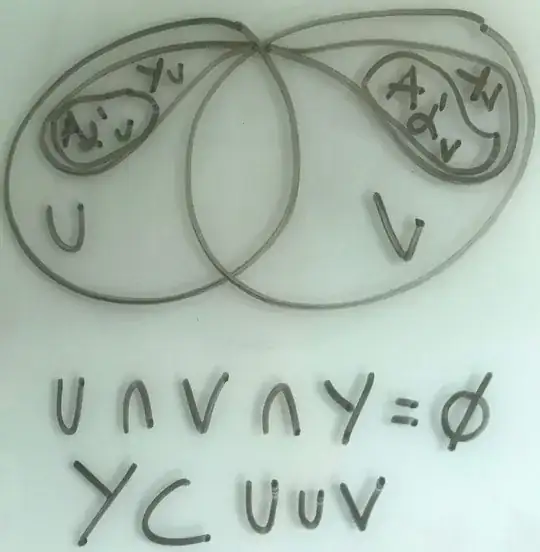
enter image description here

If $b \in \bigcap\limits_{\alpha \in I} A_\alpha$, then $b$ must be in $A_{\alpha'}$, so $b \in U$. Thus U contains a point b in each $A_\alpha$, $\alpha \in I$. By the same reasoning above and as $A_\alpha$ is connected, then $A_\alpha \in U$ for each $\alpha \in I$.

Thus:

$Y = \bigcup\limits_{\alpha \in I} A_\alpha \subset U$.

Which leaves nothing remaining for $V$, so:

$V \cap Y = \emptyset$.


Proof of Theorem 1:

Suppose that Y is disconnected. Then there are non-empty open sets $A$ and $B$ in the subspace topology for $Y$ such that $Y = A \cup B$ and $A \cap B = \emptyset$. By the definition of relatively open sets, there must be open sets $U$ and $V$ in $X$ such that:

$A = U \cap Y$, $B = V \cap Y$.

So:

$U \cap V \cap Y = (U \cap Y) \cap (V \cap Y) = A \cap B = \emptyset$; $Y = A \cup B = (U \cap Y) \cup (V \cap Y) \subset U \cup V$.

For the reverse implication:

$A \cap B = (U \cap Y) \cap (V \cap Y) = U \cap V \cap Y = \emptyset$; $A \cup B = (U \cap Y) \cup (V \cap Y) = (U \cup V) \cap Y$, and since $Y \subset U \cup V$, $A \cup B = Y$.

  • 1
    Comment to Brian M. Scott's answer: so $A′ = A \cap F \ne \emptyset$, $B′ = B \cap F \ne \emptyset$, $A′ \cap B′ = \emptyset$ and $A′ \cup B′ = F$. It is a contradiction because F is connected. – Ari Royce Hidayat Aug 07 '23 at 17:07
-1

There is a generalised version. If $\{F_\alpha:\alpha\in\Lambda\}$ be arbitrary subsets of a metric space with non-empty pairwise intersection. Then also $F=\cup_\alpha F_\alpha$ is connected.

Consider, $f:F\to \{0,1\}$, a continuous map. Take, $x$ from $f^{-1}(1)$ and $y$ from $f^{-1}(0)$. Then, $x\in F_\alpha$ and $y\in F_\beta$ for some $\alpha,\beta\in\Lambda$. Observe, $f(F_\alpha)=\{1\}$ and $f(F_\beta)=\{0\}$. But, for some $z\in F_\alpha\cap F_\beta$, $f(z)$ has no well defined value. $F_\beta$ say it should be $0$ whereas $F_\alpha$ say’s it’s $1$. A contradiction.

So, any continuous map must be constant. Hence, $X$ is connected.

Biplab
  • 622
  • This is clearly not true, consider ${{0,1},{1,2}}$ as a family of subsets in $\mathbb{R}$. They have non-empty pairwise intersection, yet their union is very much disconnected. It is also not a Generalisation, since you specified a context of metric spaces, whereas the original theorem was stated in the more general context of Topological spaces – Carlyle Dec 27 '23 at 20:47